

This article was automatically translated from the original Turkish version.
+1 More
Location | Djenné West Africa Mali | ||||||||
|---|---|---|---|---|---|---|---|---|---|
Style | Neo-Sudanese Style | ||||||||
Original Construction | 13th century (Mansa Musa period) | ||||||||
Reconstruction | 1906–1907 (French colonial period) | ||||||||
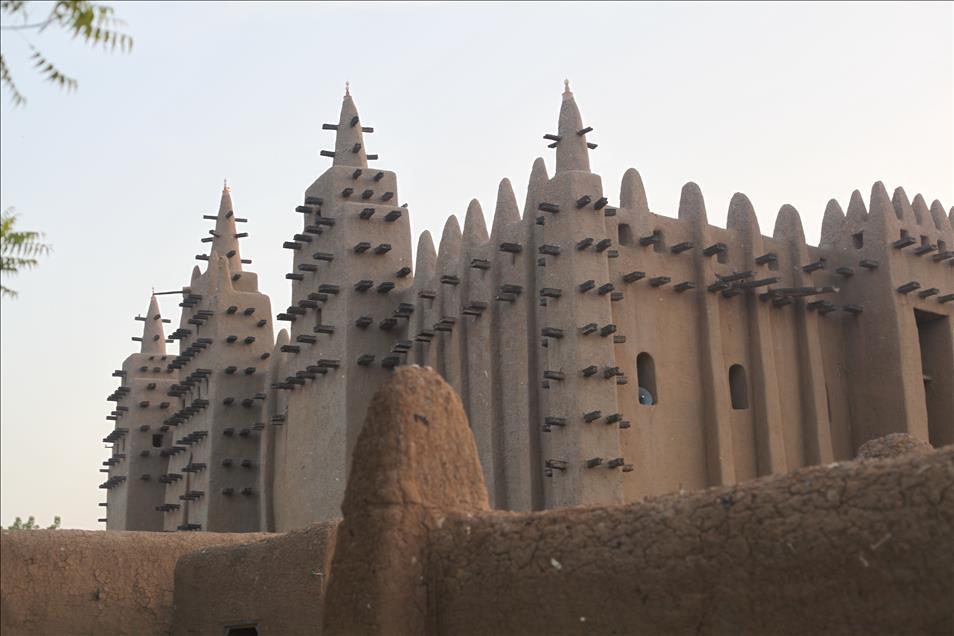
Mali is a country located in West Africa, south of the Sahara Desert. The city of Djenné and its surrounding area were inscribed on the UNESCO World Heritage List in 1988 due to their historical and cultural significance. The Djenné (Cenne) Great Mosque in Djenné is one of the most important examples of Sudano-Sahelian architecture and is among the largest structures built entirely from mudbrick. This mosque, constructed entirely from mudbrick, stands out for both its structural scale and historical identity.

Djenné Great Mosque (Anadolu Agency)
Mansa Musa, one of the prominent rulers of the Mali Empire, supported architectural activities during his return from pilgrimage, leading to the construction of numerous mosques. It is known that the first structure of the Djenné Great Mosque was built during this period under the patronage of Mansa Musa.
However, in the 19th century, Seku Ahmadu, who controlled the region, ordered the demolition of the original mosque and commissioned a new structure in its place. The mosque was rebuilt in 1907. The extent to which this restoration preserved the building’s original character remains a subject of debate today.
The Djenné Great Mosque is one of the largest religious structures built entirely from mudbrick. The primary construction materials are sun-dried mud bricks (banco), palm wood beams (toron), and natural earthen mortar. The toron beams, which project outward from the walls, serve both as structural reinforcement and as scaffolding for annual maintenance. The mosque is built on a platform 3 meters high and measures approximately 75 by 75 meters.
Three large minarets are positioned along the qibla wall, their forms reflecting the regional architectural style. The interior prayer hall (harim) is covered with mud-plastered palm wood beams that allow only limited daylight to enter. Additionally, the section designated for women is located on the western side of the mosque. Fired clay pots placed in the ceiling facilitate natural ventilation within the interior space.
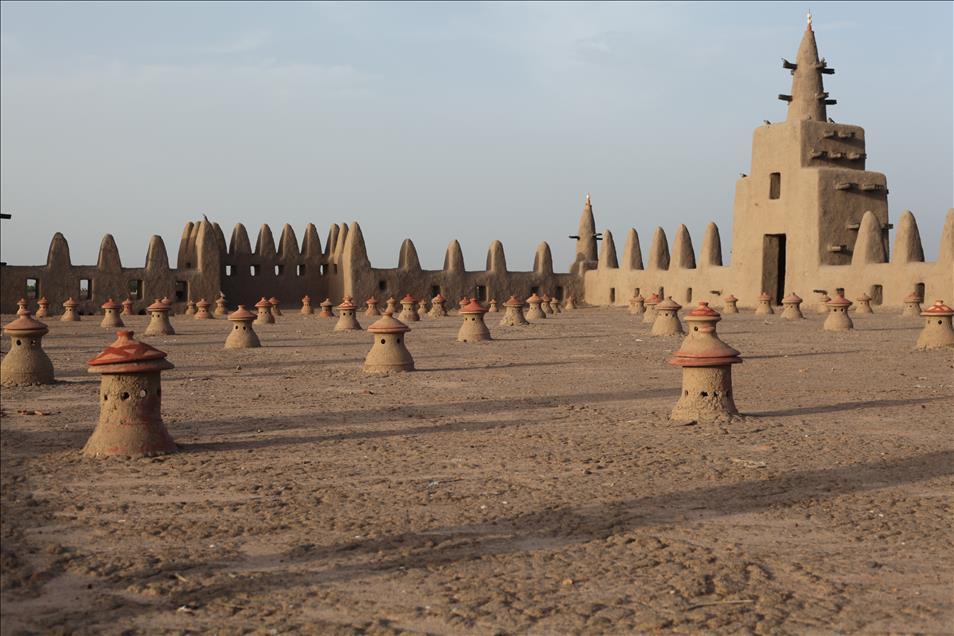
Djenné Great Mosque (Anadolu Agency)
The Djenné Great Mosque is not only an architectural landmark but also a social institution. The annual festival known as “Crepissage de la Grand Mosquée” (Replastering of the Great Mosque) brings the community together through collective maintenance of the structure. During this event, men prepare the mud, women supply water, and master craftsmen apply the plaster. The entire urban population participates regardless of age, gender, or social status. This tradition sustains the physical durability of the building while preserving the cultural unity of the community.
Cenne Great Mosque TRT Documentary
Anadolu Ajansı. “Afrika’nın kerpiç sarayı: Djenne Ulu Cami.” Accessed July 3, 2025. https://www.aa.com.tr/tr/pg/foto-galeri/afrika-nin-kerpic-sarayi-djenne-ulu-camii/0/49514#!.
Earth Architecture. "Great Mosque of Djenné." Earth Architecture. Accessed July 3, 2025. https://eartharchitecture.org/?p=1071.
Google Arts & Culture. "The Great Mosque of Djenné – Children's Museum." Google Arts & Culture. Accessed July 3, 2025. https://artsandculture.google.com/story/the-great-mosque-of-djenn%C3%A9-childrens-museum/GQUxz0PyzONLLg?hl=en.
Islam Thought Atlas. "Djenne Ulu Camii." *Islam Thought Atlas*. Accessed July 3, 2025. http://islamdusunceatlasi.org/djenne-ulu-camii/5398.
YouTube. "Doğu'nun Kayıp Silüetleri | Cenne Ulu Camii, TRT Belgesel." Accessed July 3, 2025. https://www.youtube.com/watch?v=bqcq7MRkSG8.
“Mosque of Djenné.” *Whose Culture? The Curation and Management of World Heritage*, Harvard University. Accessed July 3, 2025. https://whoseculture.hsites.harvard.edu/mosque-djenne

Location | Djenné West Africa Mali | ||||||||
|---|---|---|---|---|---|---|---|---|---|
Style | Neo-Sudanese Style | ||||||||
Original Construction | 13th century (Mansa Musa period) | ||||||||
Reconstruction | 1906–1907 (French colonial period) | ||||||||
No Discussion Added Yet
Start discussion for "Djenné Great Mosque" article
Historical Development
Architectural Features
Social and Cultural Significance