


+1 More

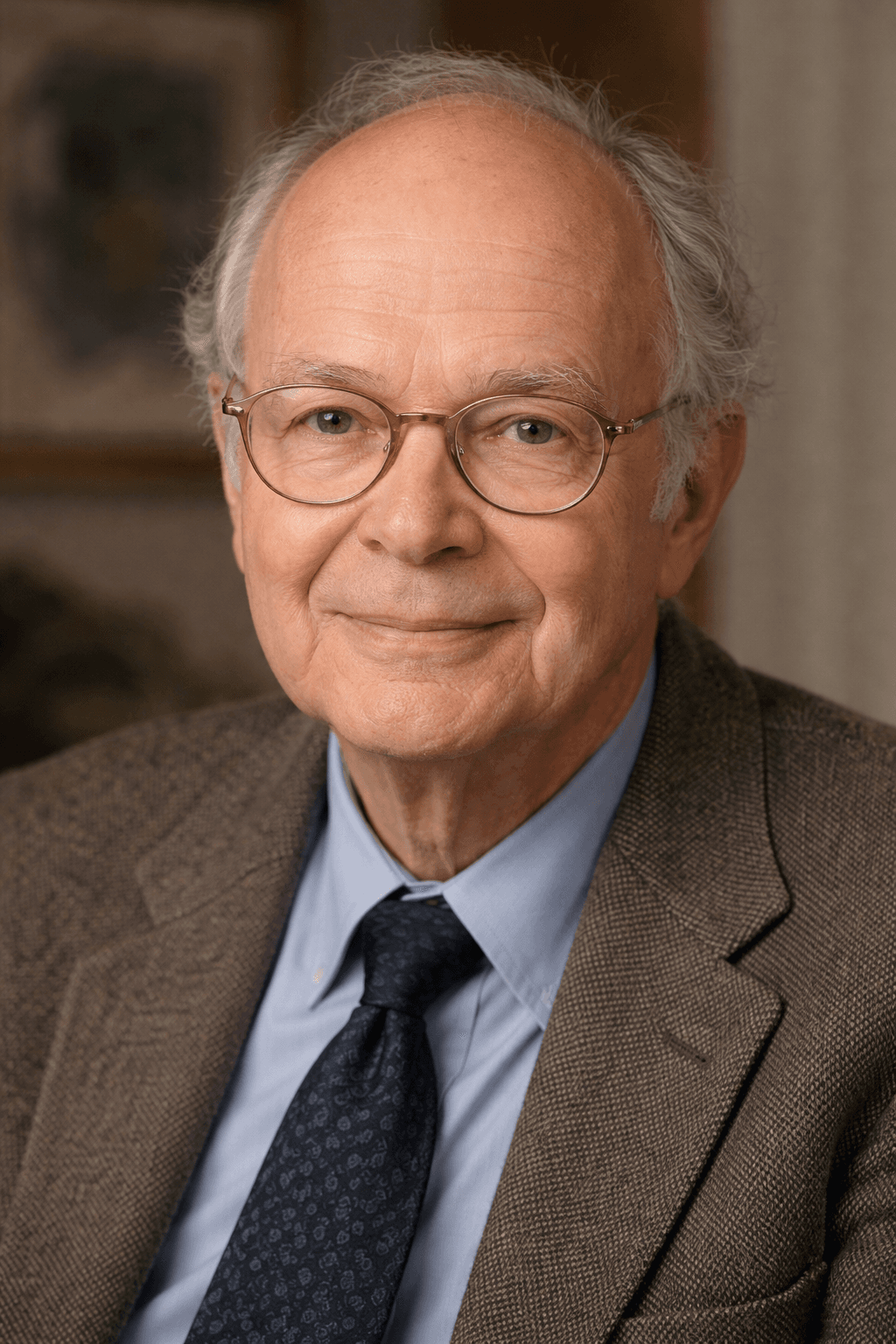
Donald Knuth (generated by artificial intelligence)
Doğum tarihi | 1938-01-10 | ||||||||
|---|---|---|---|---|---|---|---|---|---|
Eş | Nancy Jill Carter (b. 1961) | ||||||||
Çocuk | Jennifer Sierra Knuth (d. 1966) John Martin Knuth (d. 1965) | ||||||||
Bachelor’s / Master’s | Case Institute of Technology, Mathematics (1960) | ||||||||
Important Awards and Honors | IEEE John von Neumann Medal (1995) Franklin Medal (1988) Hopper Award Kyoto Prize National Medal of Science Turing Award | ||||||||
Doctorate (Ph.D.) | California Institute of Technology (Caltech), Mathematics (1963) | ||||||||
Place of Birth | Milwaukee, Wisconsin, USA | ||||||||
Donald Ervin Knuth is an American computer scientist whose work in algorithm analysis, programming methodology, and digital typography has shaped the institutionalization of computer science. In particular, his series The Art of Computer Programming, the concept of literate programming, and the TeX system have defined the theoretical and practical framework of the discipline.
Donald Ervin Knuth was born on January 10, 1938, in Milwaukee, Wisconsin, to Ervin Henry Knuth and Louise Marie Bohning. His father’s profession as a teacher at a Lutheran school and as a church organist laid the foundation for Knuth’s early interests in education, music, and mathematics. Knuth received his primary education at the schools where his father taught and developed a strong interest in English grammar and sentence structure analysis. This linguistic analytical ability laid the groundwork for his later success in programming before he ever encountered computers.
During his secondary school years, Knuth entered a word-creation contest called “Ziegler’s Giant Bar” organized by a candy manufacturer. Using a dictionary as a reference, he spent two weeks generating 4,500 words and won first place by surpassing the jury’s list. This disciplined approach to work remained a defining trait throughout his academic career. In high school, his focus shifted toward music; he played saxophone and tuba in the school band and composed his own pieces. In 1956, Knuth graduated with the highest grade point average in the school’s history. His mathematical interest became evident when he manually calculated and graphed multidimensional surfaces without computer assistance.
Initially planning to study music, Knuth enrolled at the Case Institute of Technology in September 1956 after accepting a physics scholarship. However, he soon realized that the practical aspects of physics laboratories did not suit him. After solving a challenging problem presented by a mathematics professor, he gained academic confidence and switched to mathematics in his second year.
Knuth first encountered computers during his freshman year through an IBM 650 system【1】. After studying the example programs in the user manual, he realized he could write more efficient code. In 1958, he wrote a program to analyze the performance of the school’s basketball team; this work was featured in national media outlets. In 1960, due to his outstanding achievements, the administration of Case Institute of Technology awarded him both his bachelor’s and master’s degrees simultaneously. During his student years, he published two significant papers on virtual number systems and the construction of Latin squares using computer assistance.
In the fall of 1960, Knuth began his doctoral studies at the California Institute of Technology, where he also worked as a software development consultant for Burroughs Corporation. He married Nancy Jill Carter on June 24, 1961. He completed his Ph.D. in mathematics on June 6, 1963, with a thesis titled “Finite Semifields and Projective Planes,” and immediately began serving as an assistant professor at the same institution. In 1962, he accepted an offer from Addison-Wesley to write a book on compilers, which marked the beginning of his most important project: the series The Art of Computer Programming.
Originally planned as a single volume, The Art of Computer Programming (TAOCP) expanded into a seven-volume project due to Knuth’s desire to explore the subject in depth【2】. The first three volumes—“Fundamental Algorithms” (1968), “Seminumerical Algorithms” (1969), and “Sorting and Searching” (1973)—became central to computer science curricula. Through this work, Knuth aimed to organize existing computer methods and provide them with solid mathematical and historical foundations.
Knuth defines programming as both a science and an art. He describes “science” as knowledge that can be clearly understood well enough to be taught to a computer, and “art” as creative processes that cannot yet be automated. Knuth argues that programmers should write “beautiful programs” with aesthetic value, evaluating a program’s quality not only by its correctness but also by its readability and efficiency. He also emphasized that “premature optimization is the root of all evil,” warning that focusing on efficiency at the wrong stage increases code complexity.
In the early 1980s, Knuth developed the approach of “literate programming,” based on the idea that a programmer’s primary task is not merely to give instructions to a computer but to explain the process to other humans. To implement this philosophy, he created the WEB system, which consists of two components:
Knuth’s theoretical contributions to computer science include the Knuth-Bendix algorithm for computation with algebraic structures, the Knuth-Morris-Pratt (KMP) algorithm for fast text searching, and the LR(k) parsing method developed for left-to-right analysis of languages【3】. He also computed Euler’s constant to 1,271 decimal places and constructed sets of mutually orthogonal Latin squares in combinatorial mathematics.
Knuth introduced the term “surreal numbers” into mathematical literature by presenting John Horton Conway’s discovery in a 1974 mathematical novella of the same name. Surreal numbers form the largest ordered field structure, encompassing rational, real, hyperreal, infinite, and infinitesimal numbers. Numbers are defined iteratively as pairs of previously constructed sets. This work is an original example of pure mathematics presented within a literary genre.
In the mid-1970s, dissatisfied with the typesetting quality of his publications, Knuth devoted ten years to digital typography. The result was the development of the TeX typesetting language for high-quality mathematical text and the METAFONT system for font design. TeX became a global standard in scientific publishing, enabling error-free data transfer across platforms. METAFONT provided a flexible structure that defines letter characters using mathematical equations and geometric parameters.
Knuth elevated his inherited passion for the organ to a professional level. He joined the American Guild of Organists in 1965 and served as an assistant organist at Faith Lutheran Church in Pasadena during his tenure at Caltech. He commissioned a custom pipe organ from Abbott and Sieker, named “Opus 67,” which features 16 stops and a total of 812 pipes. Designed according to the North German Baroque tradition, the instrument consists of three main divisions:
Throughout his professional career, Knuth has maintained his connection to music. He has been a member of the American Guild of Organists since 1965. In retirement, he completed his extensive composition “Fantasia Apocalyptica” and has held public concerts. He also participates in chamber music performances at home using his Bösendorfer piano and pipe organ.
Throughout his career, Knuth has received the following prestigious awards:
He is also a member of the National Academy of Sciences, the Royal Society, and the American Academy of Arts and Sciences. In 2001, the minor planet “21656 Knuth” was named in his honor.
Knuth has been affiliated with Stanford University since 1968 and retired in 1993 with the title of Professor Emeritus. In retirement, he continues to live on the Stanford campus, actively uses its libraries, and delivers public lectures titled “Computer Musings.” Knuth still writes several computer programs each week but refuses to use email due to the deep concentration required for his work. To maintain his physical fitness, he bicycles to campus and swims regularly.
Charlton, Steven. "An Very Brief Overview of Surreal Numbers for Gandalf MM 2014." Accessed February 7, 2026. https://maths.dur.ac.uk/gandalf/1415/charlton_surrealnumbers_notes.pdf
Computer History Museum. “Donald Knuth.” Accessed February 7, 2026. https://computerhistory.org/profile/donald-knuth/
Cs Stanford. "The Organ of Don and Jill Knuth." Accessed February 7, 2026. https://cs.stanford.edu/~knuth/organ.html
Knuth, Donald E. "Computer Programming as an Art." Accessed February 7, 2026. https://www.cs.tufts.edu/~nr/cs257/archive/don-knuth/as-an-art.pdf
Knuth, Donald E. "Literate Programming." Accessed February 7, 2026. https://www.cs.tufts.edu/~nr/cs257/archive/literate-programming/01-knuth-lp.pdf
MacTutor History of Mathematics Archive. "Donald Ervin Knuth." O’Connor, John J., and Edmund F. Robertson. Accessed February 7, 2026. https://mathshistory.st-andrews.ac.uk/Biographies/Knuth/
[1]
John J. O’Connor ve Edmund F. Robertson "Donald Ervin Knuth" MacTutor History of Mathematics Archive (University of St Andrews), erişim 7 Şubat 2026, https://mathshistory.st-andrews.ac.uk/Biographies/Knuth/
[2]
John J. O’Connor ve Edmund F. Robertson "Donald Ervin Knuth" MacTutor History of Mathematics Archive (University of St Andrews), erişim 7 Şubat 2026, https://mathshistory.st-andrews.ac.uk/Biographies/Knuth/
[3]
John J. O’Connor ve Edmund F. Robertson "Donald Ervin Knuth" MacTutor History of Mathematics Archive (University of St Andrews), erişim 7 Şubat 2026, https://mathshistory.st-andrews.ac.uk/Biographies/Knuth/
[4]
Donald E. Knuth, “The Organ of Don and Jill Knuth,” Stanford University, erişim 7 Şubat 2026, https://cs.stanford.edu/~knuth/organ.html
[5]
John J. O’Connor ve Edmund F. Robertson, Donald Ervin Knuth, MacTutor History of Mathematics Archive (University of St Andrews), erişim 7 Şubat 2026, https://mathshistory.st-andrews.ac.uk/Biographies/Knuth/

Donald Knuth (generated by artificial intelligence)
Doğum tarihi | 1938-01-10 | ||||||||
|---|---|---|---|---|---|---|---|---|---|
Eş | Nancy Jill Carter (b. 1961) | ||||||||
Çocuk | Jennifer Sierra Knuth (d. 1966) John Martin Knuth (d. 1965) | ||||||||
Bachelor’s / Master’s | Case Institute of Technology, Mathematics (1960) | ||||||||
Important Awards and Honors | IEEE John von Neumann Medal (1995) Franklin Medal (1988) Hopper Award Kyoto Prize National Medal of Science Turing Award | ||||||||
Doctorate (Ph.D.) | California Institute of Technology (Caltech), Mathematics (1963) | ||||||||
Place of Birth | Milwaukee, Wisconsin, USA | ||||||||
Early Life
University Years and Doctoral Studies
"The Art of Computer Programming" and Programming Methodology
Programming Philosophy: Science and Art
Literate Programming and the WEB System
Theoretical Contributions and Digital Typography
Surreal Numbers
TeX and METAFONT Systems
Musical Performance and Pipe Organ Design
Academic Honors and Retirement
Awards and Memberships
Professor Emeritus Status and Current Activities