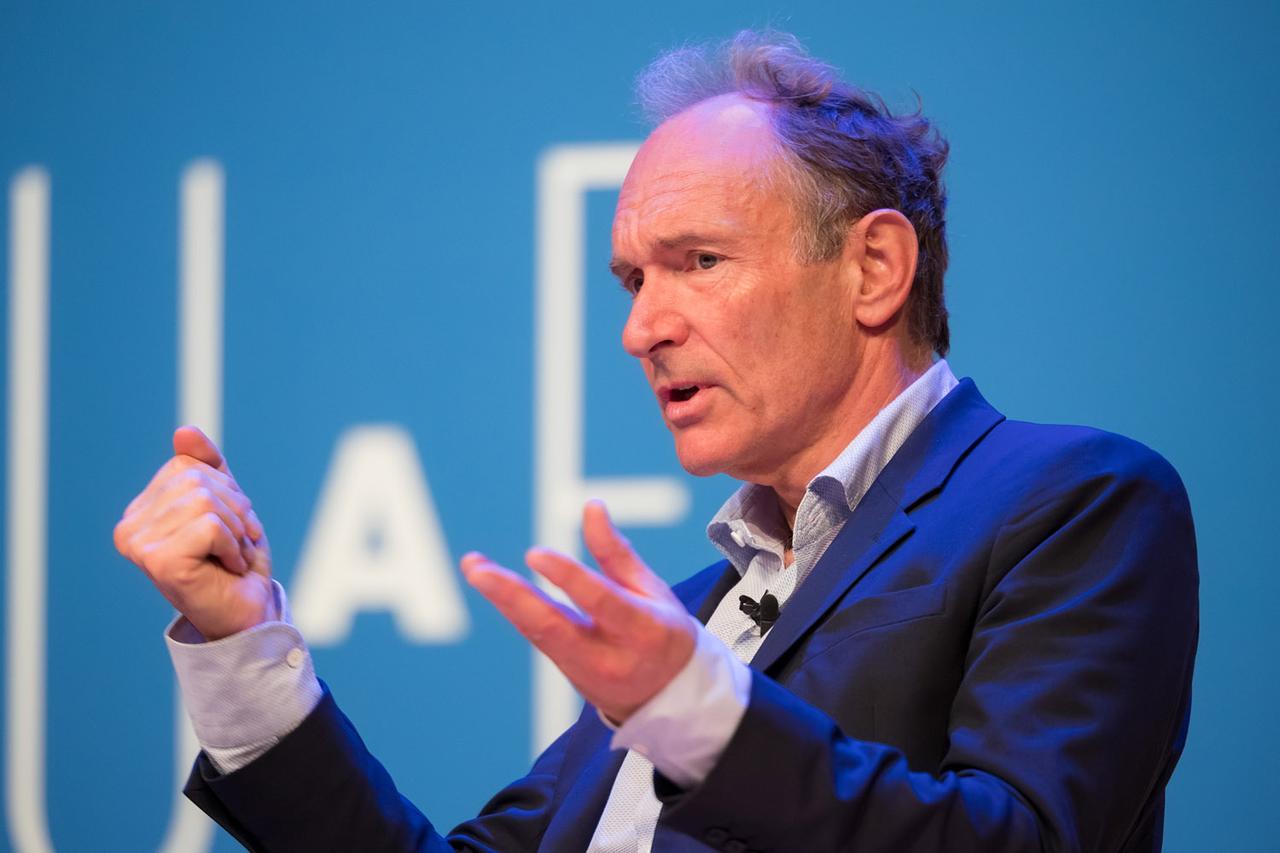



Full Name | Timothy John Berners-Lee | ||||||||
|---|---|---|---|---|---|---|---|---|---|
Doğum tarihi | 1955-06-08 | ||||||||
Education | University of Oxford 1976) Queen's College (Physics | ||||||||
Professional Title | Computer Scientist, Academic, Software Engineer | ||||||||
Most Important Invention | World Wide Web | ||||||||
Core Technologies | URL/URI HTTP HTML | ||||||||
Notable Book | Weaving the Web | ||||||||
Philosophy | "This is for everyone" | ||||||||
Active Project | Solid (Decentralized Data Control) | ||||||||
Timothy John Berners-Lee (8 June 1955, London) is a British computer scientist and academic. While working at CERN (European Organization for Nuclear Research), he laid the foundations of the World Wide Web through a document titled "Information Management: A Proposal," which he developed to facilitate information sharing between different computers. By never patenting or registering his invention, he ensured that the internet became a universally accessible, open platform for everyone.
Tim was born to Mary Lee Woods and Conway Berners-Lee, both mathematicians who worked on the Ferranti Mark 1, the world’s first commercial computer. This strong mathematical background in his family inspired his early interest in electronics and model railway systems.
He studied physics at Queen’s College, Oxford University, and graduated in 1976 with a first-class degree. During his time at Oxford, one of the earliest tangible demonstrations of his engineering skill was building his own computer by soldering together an old television set he had purchased.
After graduation, he worked in the telecommunications industry and in 1980 took up a position as an independent consultant at CERN. There, he developed a personal software program called Enquire, which linked information through hyperlinks. This program became the conceptual blueprint for the future web. When he returned to CERN in 1984, he proposed a global hypertext system to enable scientists around the world to share data.
By the end of 1990, he wrote the world’s first web browser and web server (httpd) on a NeXT computer. In 1994, he founded the World Wide Web Consortium (W3C) under MIT to manage web standards. In 2004, he was knighted by Queen Elizabeth II and received the title "Sir." In 2016, he was awarded the ACM A.M. Turing Award, the highest honor in computer science.

Tim Berners-Lee (This image was generated by artificial intelligence)
Berners-Lee constructed the three foundational pillars of the web:
His most important work is the book Weaving the Web (1999), which recounts the history of the web’s creation. In recent years, he has focused on the Solid project, which aims to return control of data to individuals, and on the World Wide Web Foundation, which advocates for the web to remain a fundamental human right.
His childhood passion for trainspotting helped him understand how complex systems interconnect. He enjoys science fiction and has consistently demonstrated a humble, public-spirited personality.
He married Nancy Carlson in 1990 (later divorced) and married Rosemary Leith in 2014. He is the father of two children.
Today, Tim Berners-Lee dedicates his time to restoring the original free and decentralized nature of the internet.
He frequently voices his concerns about the concentration of the web in the hands of large technology corporations and about data privacy issues. He currently holds professorships at Oxford University and MIT, and serves as president of the W3C (World Wide Web Consortium), which sets web standards.
By refusing to monetize his invention, Tim Berners-Lee created the largest collective library in human history. His legacy is the digital ecosystem that enables billions of people today to access information, education, and each other.
During the opening ceremony of the 2012 London Olympics, he sat at a computer in the center of the world stage and tweeted, "This is for everyone," reminding the entire world of the sharing spirit at the heart of his invention.
ACM A.M. Turing Award. "Sir Tim Berners-Lee: 2016 Turing Award Laureate." Association for Computing Machinery. Accessed December 18, 2025. https://amturing.acm.org/award_winners/berners-lee_2320364.cfm.
CERN (European Organization for Nuclear Research). “A Short History of the Web.” Accessed December 18, 2025. https://home.cern/science/computing/birth-web/short-history-web.
MIT CSAIL (Computer Science and Artificial Intelligence Laboratory). “Tim Berners-Lee Official Biography.” Massachusetts Institute of Technology. Accessed December 18, 2025. https://www.csail.mit.edu/person/tim-berners-lee.
W3C (World Wide Web Consortium). “Biography: Sir Tim Berners-Lee.” Accessed December 18, 2025. https://www.w3.org/People/Berners-Lee/.
Full Name | Timothy John Berners-Lee | ||||||||
|---|---|---|---|---|---|---|---|---|---|
Doğum tarihi | 1955-06-08 | ||||||||
Education | University of Oxford 1976) Queen's College (Physics | ||||||||
Professional Title | Computer Scientist, Academic, Software Engineer | ||||||||
Most Important Invention | World Wide Web | ||||||||
Core Technologies | URL/URI HTTP HTML | ||||||||
Notable Book | Weaving the Web | ||||||||
Philosophy | "This is for everyone" | ||||||||
Active Project | Solid (Decentralized Data Control) | ||||||||
Early Life and Education
Career and Achievements
Key Works and Contributions
Contributions
Works and Projects
Personal Life
Recent Years and Active Career
Legacy and Impact
Source of Inspiration