


+2 More

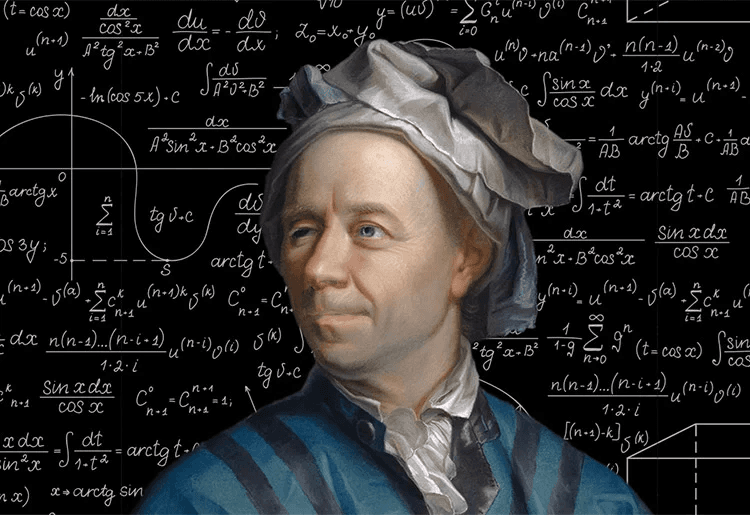
Genius Beyond Time: Leonhard Euler
Ölüm tarihi | 1783-09-18 | ||||||||
|---|---|---|---|---|---|---|---|---|---|
Eş | Salome Abigail Gsell (1776-1783) Katharina Euler (1734-1773) | ||||||||
Doğum tarihi | 1707-04-15 | ||||||||
Yaş | 76 | ||||||||
Leonhard Euler was born on 15 April 1707 in Basel, Switzerland. He began his education at an early age and showed interest in fields such as mathematics and philosophy from a young age. His father initially planned for him to become a clergyman; however, Euler’s passion for mathematics soon became dominant. At the age of thirteen, he was admitted to the University of Basel, where he met mathematician Johann Bernoulli and began his studies under his guidance. This period played a decisive role in shaping Euler’s scientific orientation.
In 1727, Euler moved to St. Petersburg to take up a position at the Russian Academy of Sciences. In 1741, he joined the Berlin Academy of Sciences. He returned to St. Petersburg in 1766 and continued his work there. During these periods, he focused on various topics in mathematics, physics, and engineering. He also played a key role in popularizing several notations used in scientific writing.
One of Euler’s most notable contributions is his work in complex analysis. Equations such as Euler’s formula and Euler’s identity have become foundational pillars of mathematics. Moreover, Euler laid the groundwork for a new mathematical field, graph theory, thereby contributing to the development of modern computer science. His work has had a broad impact across a wide range of disciplines, from mathematical analysis to topology, and from physical theories to engineering, expanding the boundaries of mathematical thought.
Euler made numerous contributions to mathematics, physics, engineering, astronomy, and other scientific fields. His work in mathematical analysis and function theory, particularly on differential equations, found extensive applications in engineering and physics. He also pioneered the development of modern mathematical fields such as topology and graph theory. Euler formulated important theories in number theory and fluid mechanics, and developed countless fundamental principles across various branches of the natural sciences.
Euler worked on functions, series, and integral calculus.


Euler conducted research in number theory, particularly focusing on prime numbers and modular arithmetic.

Euler conducted foundational work that established the key concepts of graph theory. The Seven Bridges of Königsberg problem is one of the most famous examples in this field.
Euler performed mathematical analyses in the fields of music theory and acoustics. He developed mathematical models for the frequencies of sound waves.
Euler contributed to physical theories such as mechanics and fluid dynamics. The equations he developed formed the fundamental mathematical models of these fields. Euler also made significant contributions to physical theories, particularly through the equations he formulated for mechanics and fluid dynamics, which became the cornerstones of these disciplines.

Euler Equations (Fluid Dynamics): Euler developed fundamental equations to model the motion of fluids. These equations describe the dynamic relationship between pressure, velocity, density, and external forces:

Euler worked on the mathematical modeling of planetary motion. Using differential equations, he provided more precise descriptions of the movements of celestial bodies.

Euler conducted theoretical work in structural engineering. The models he developed were used in the analysis of beam deformation and strength.

Euler developed visual analytical methods in mathematical logic. Euler diagrams are tools used to represent relationships and intersections between sets. These diagrams were developed to visualize logical relationships and illustrate how sets interact and overlap.
Euler published numerous works on mathematics, mechanics, and astronomy. His major publications include:
These theoretical works later found applications in engineering and physics.
In 1734, Euler married Katharina Gsell and had five children. He lost sight in his right eye in the 1740s and became completely blind in 1776. Despite this, he continued his work, dictating his mathematical calculations to assistants.
Euler’s daily life was largely centered on his academic work. He was actively involved in scientific circles in St. Petersburg and Berlin, spending long hours solving mathematical problems. Even after losing his sight, he maintained his productivity through mental calculations and verbal dictation of his work.
Euler suffered from serious health problems beginning in 1771 and died in St. Petersburg in 1779. Even in his final years, he continued developing mathematical theories. His works remain foundational reference sources in physics, engineering, and mathematics.
"Leonhard Euler." MacTutor History of Mathematics Archive. University of St Andrews. Accessed May 6, 2025.
Calinger, Ronald S. Leonhard Euler: Mathematical Genius in the Enlightenment. Illustrated ed. Princeton, NJ: Princeton University Press, 2015
Leonhard Euler: Works," Leonhard Euler: The Mathematical Genius of the Enlightenment, accessed May 6, 2025

Genius Beyond Time: Leonhard Euler
Ölüm tarihi | 1783-09-18 | ||||||||
|---|---|---|---|---|---|---|---|---|---|
Eş | Salome Abigail Gsell (1776-1783) Katharina Euler (1734-1773) | ||||||||
Doğum tarihi | 1707-04-15 | ||||||||
Yaş | 76 | ||||||||
1) Childhood and Youth
2) Career Path
3) Major Achievements
4) Contributions
Mathematical Analysis
Number Theory
Graph Theory
Music and Acoustics
Physics
Astronomy
Engineering and Structural Dynamics
Logic
5) Works and Projects
6) Personal Life
7) Daily Life
8) Final Years