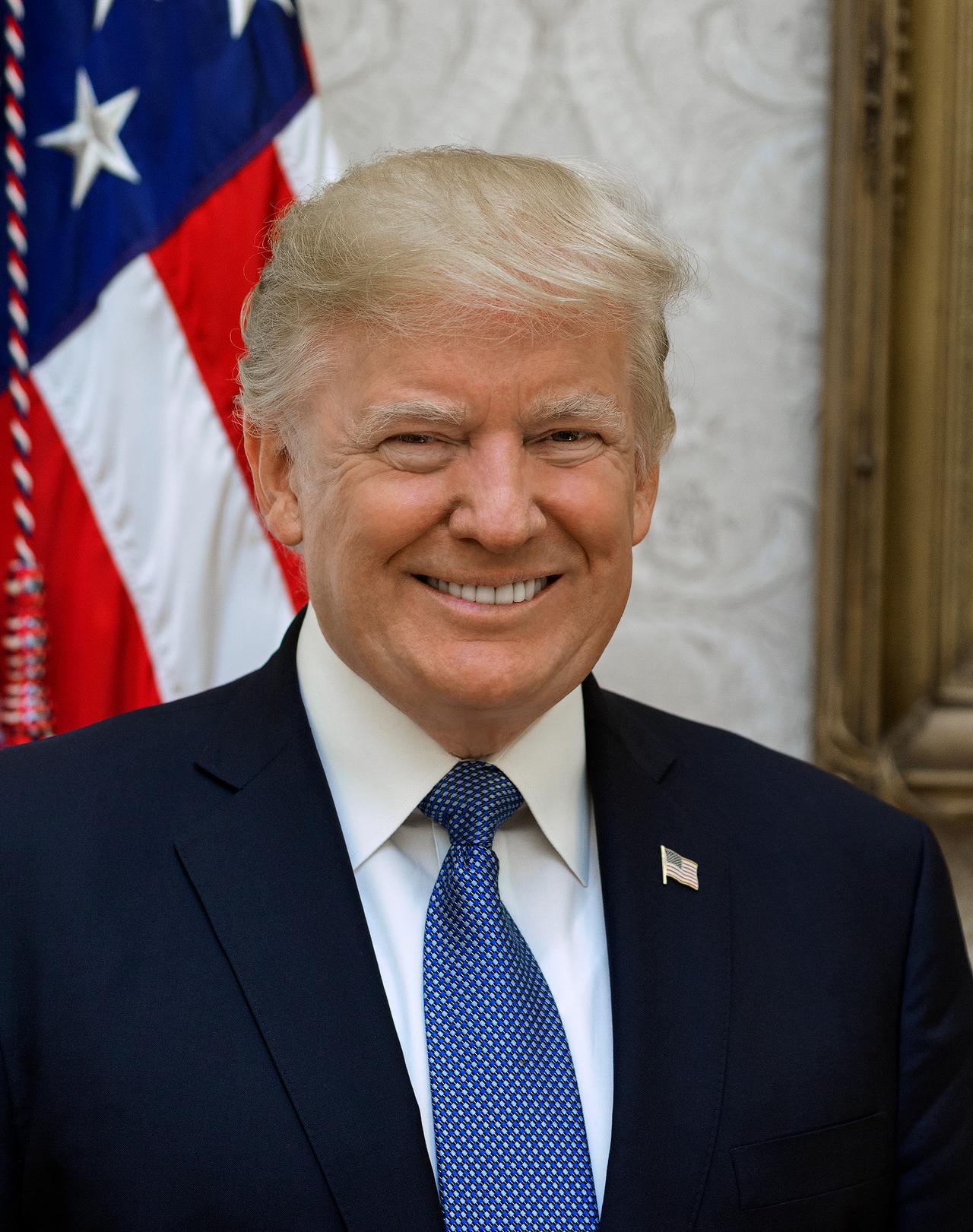


Full Name | Donald John Trump | ||||||||
|---|---|---|---|---|---|---|---|---|---|
Date of Birth | 14 June 1946 | ||||||||
Place of Birth | Queens, New York, USA | ||||||||
Nationality | American | ||||||||
Profession | Businessman, real estate developer, television personality and politician | ||||||||
Political Party | Republican Party | ||||||||
Office | 45th and 47th president of the United States of America | ||||||||
First Term of Presidency | 20 January 2017 to 20 January 2021 | ||||||||
Second Term of Presidency | Began on 20 January 2025 | ||||||||
Education | University of Pennsylvania, Wharton School of Finance and Commerce, Bachelor of Science in Economics, 1968 | ||||||||
Main Commercial Organization | Trump Organization | ||||||||
Television Work | Host and producer of The Apprentice program, 2004–2015 | ||||||||
Spouse(s) | Ivana Zelnickova Trump (1977–1992) Marla Maples (1993–1999) Melania Knauss Trump (2005–present) | ||||||||
Children | Donald Jr., Ivanka, Eric, Tiffany and Barron | ||||||||
Historical Position | Second U.S. president after Grover Cleveland to be elected to two non-consecutive terms | ||||||||
Donald John Trump (June 14, 1946, New York) is an American businessman, media personality, and politician. He is the 45th and 47th president of the United States. A member of the Republican Party, Trump completed his first presidential term from January 20, 2017 to January 20, 2021 and began his second term on January 20, 2025 after winning the 2024 election. He thus became the second person after Grover Cleveland to serve two non-consecutive terms as president. Before entering politics, he managed the Trump Organization, a company he inherited from his family, which operated in real estate, hospitality, casinos, golf courses, brand licensing, publishing, beauty pageants, and television.
Donald Trump was born in the Queens borough of New York as the fourth of five children of Mary Anne MacLeod Trump and Frederick Christ Trump. His mother was born in Scotland and immigrated to the United States in 1930. His father was a native New Yorker from a family of German immigrants. Trump spent his childhood in the Jamaica Estates neighborhood of Queens. His siblings are Maryanne, Fred Jr., Elizabeth, and Robert.【1】
His father, Fred Trump, developed residential projects in Queens, Brooklyn, and Staten Island through a company he co-founded with his mother, Elizabeth Trump & Son. The Trump sons—Fred Jr., Donald, and Robert—worked in the company’s offices and construction sites during their youth.【2】 Fred Jr. later left the family business to become a pilot; he died at age 43 in 1981 due to alcoholism. Donald Trump attributed his own abstinence from alcohol and tobacco to his older brother’s struggle with addiction and early death. Robert Trump worked as an executive in the family business and died in 2020.【3】 Maryanne Trump Barry pursued a career in law and federal judiciary service; she died in 2023.【4】
At age thirteen, Trump was sent by his family to the New York Military Academy, where he received military training and participated in sports such as basketball, American football, soccer, and baseball.【5】 After the academy, he enrolled at Fordham University and later transferred to the University of Pennsylvania. He graduated in 1968 with a bachelor’s degree in economics from the Wharton School of Finance and Commerce.【6】
During the Vietnam War, Trump received educational deferments from military service. Later, he obtained a medical deferment based on a doctor’s diagnosis of a bone spur in his heel. When the U.S. draft lottery began in 1969, Trump’s birth date was drawn 356th out of 366 numbers, and he was not called to serve.【7】
While still a university student, Trump began investing in real estate in Philadelphia. After graduating in 1968, he returned to New York and joined his father’s company full-time.【8】 The company’s activities initially focused on housing projects targeting middle-income families in Queens, Brooklyn, and Staten Island.【9】
In 1971, Trump assumed control of the company and in 1973 renamed it the Trump Organization.【10】 That same year, the U.S. Department of Justice accused the Trump family company of discriminating against Black rental applicants. The company reached a settlement without admitting any legal wrongdoing and agreed to rent more units to Black applicants.【11】
During the 1970s, Trump expanded the company’s operations beyond New York by acquiring properties in states such as Virginia, Ohio, Nevada, and California. He also shifted the company’s focus from New York’s outer boroughs to Manhattan; by the mid-1970s, the Trump Organization entered high-rise building projects in Manhattan.【12】 His first major Manhattan venture was the redevelopment of the bankrupt Penn Central’s Commodore Hotel into the Grand Hyatt Hotel. The project was supported by a forty-year real estate tax exemption granted by the New York City government.【13】
One of Trump’s first major Manhattan initiatives was the redevelopment of the Commodore Hotel, owned by the financially troubled Penn Central Railroad. The project, launched in 1976, relied on a partnership with the Hyatt hotel chain and a forty-year real estate tax exemption granted by New York City.【14】 The total value of the tax exemption, initially worth about $4 million annually, grew to approximately $400 million over forty years due to the property’s increased value and changes in tax legislation.【15】 The hotel reopened after renovation as the Grand Hyatt.【16】
In the 1980s, Trump developed the 36-story cooperative apartment complex Trump Plaza and Trump Tower on Fifth Avenue. Trump Tower housed luxury retail stores, Trump’s multi-story residence, and the headquarters of the Trump Organization within a single building.【17】
Other New York real estate activities by Trump included 40 Wall Street in Manhattan’s Financial District, the 90-story Trump World Tower near the United Nations building, and the conversion of the former Delmonico Hotel into Trump Park Avenue. Trump purchased the Delmonico Hotel in 2002 and redeveloped it as a 35-story residential project.【18】
Trump’s real estate activities gradually expanded beyond New York and into international markets. The Trump Organization’s portfolio included hotels, golf courses, resorts, residential and commercial properties, and licensing agreements in the United States and other countries.【19】 While the company directly owned some properties and businesses, the Trump name was also licensed for use on golf courses, hotels, resorts, and various products.【20】
In the 1980s, Trump entered the casino industry in Atlantic City, New Jersey. He developed the Trump Plaza Hotel and Casino and Trump Castle, and in 1990 constructed the Trump Taj Mahal at a cost of approximately $1 billion.【21】 He borrowed heavily to finance these hotel and casino projects.【22】
As the companies struggled to meet debt payments, Fred Trump purchased casino chips worth more than $3 million from Trump Castle in 1990. This transaction, intended to help the casino meet its interest obligations, was later deemed an illegal loan, and New Jersey authorities imposed a $65,000 fine.【23】
The Trump Taj Mahal filed for bankruptcy protection in 1991, and the Trump Plaza Hotel followed in 1992.【24】 In the following years, Trump used bankruptcy protection to restructure the debts of companies within the Trump Organization. While continuing to service debt, the total debt amount and interest rates increased.【25】
Trump later founded the publicly traded company Trump Hotels and Casino Resorts. His initial ownership of 56 percent of the company’s shares gave him majority control. The public company took over certain real estate assets and operations affiliated with the Trump Organization.【26】 The company filed for bankruptcy protection in 2004 due to its inability to repay debts and generate profits. Trump’s ownership stake dropped to 27 percent, and he lost active management control.【27】
Efforts to revive the company were unsuccessful, and it filed for bankruptcy protection again between 2009 and 2014. By the time Trump launched his 2015 presidential campaign, all of his casino operations had ceased.【28】
During these processes, shareholders lost their investments, and numerous suppliers and creditors suffered financial losses. Trump’s personal financial losses, however, were limited by the corporate structure of the publicly traded company and the legal and financial maneuvers he employed.【29】
Following financial difficulties in his real estate and casino businesses, the Trump Organization expanded its licensing activities based on the Trump name across the United States and internationally. The Trump brand was used on golf courses, hotels, resorts, and branded products such as steaks, vodka, and bottled water.【30】 The Trump Organization’s portfolio included both directly owned companies and properties as well as products and licensing agreements.【31】
Trump, with the help of co-authors, published several books on business management and personal success, including the first edition of Trump: The Art of the Deal in 1987.【32】
From 1996 to 2015, Trump owned the Miss USA, Miss Teen USA, and Miss Universe beauty pageants. NBC and Univision stopped broadcasting the pageants after Trump’s controversial remarks about Latin American immigrants during his 2015 presidential campaign. Trump announced the following year that lawsuits with these companies had been settled through negotiation and sold his stake in the pageants.【33】 After purchasing NBC’s stake in the Miss Universe Organization, he transferred full ownership to IMG.【34】
Trump’s main television activity was the NBC reality competition show The Apprentice, which aired from 2004 to 2015. Trump served as both host and producer.【35】 Contestants aiming to build careers in business faced various tasks, and Trump eliminated one contestant per episode. His repeated phrase “You’re fired” became a signature element of the show. A celebrity version, Celebrity Apprentice, was later produced.【36】 Both shows reached wide audiences and contributed significantly to Trump’s national recognition as a businessman. NBCUniversal ended its relationship with the show after Trump announced his 2015 presidential campaign.【37】
The Trump Organization was not a single publicly traded parent company with subsidiaries but a private structure composed of approximately 500 separate businesses. All or the majority of these businesses were owned by Donald Trump. Because the companies comprising this structure were not publicly traded, they were not required to disclose their financial status or total value to the public.【38】
Trump did not release his personal income tax returns for years prior to the 2016 presidential election. As a result, a complete assessment of the Trump Organization’s financial status was not possible.【39】 After being elected president, he delegated formal leadership and daily operational oversight of the company to his sons Donald Trump Jr. and Eric Trump.【40】 However, he did not transfer ownership into blind trusts and did not establish a legal separation between himself and the company’s activities. The failure to separate his presidential duties from his commercial ownership sparked debates over potential conflicts of interest.【41】
At the time of his first election in November 2016, the Trump Organization had a broad portfolio of companies, products, real estate, and licensing agreements. This portfolio included at least twelve golf courses in the United States and five abroad, eight hotels in the U.S. and six overseas, and numerous properties around the world. As of August 2016, Trump’s real estate-related debts stood at least at $650 million.【42】
By 2016, Trump or his companies had been parties to approximately 3,500 legal proceedings in federal and state courts. In about 1,900 of these cases, Trump or his companies were plaintiffs, and in about 1,450, they were defendants. The remaining proceedings included bankruptcy filings and other types of legal actions.【43】
Trump University, established in 2005, was a company that offered real estate courses for a fee and promised to teach Trump’s business methods. The company, which later ceased operations, became the subject of three lawsuits alleging consumer deception. In the aftermath of the 2016 presidential election, Trump settled these lawsuits for a total of $25 million without admitting any wrongdoing.【44】
Trump’s party affiliation and political stance changed over time. After adopting a Republican identity in 1987, he was also associated with the Democratic Party, the Reform Party, and as an independent voter. Between 1987 and 2012, he changed his official party registration five times and re-registered with the Republican Party in April 2012.【45】
Trump showed interest in a presidential candidacy from the late 1980s. In 1987, he indicated his interest in running for president through newspaper advertisements criticizing the Reagan administration’s foreign policy. In 1999, he joined the Reform Party and formed a research committee to seek its presidential nomination; he withdrew from the race in February 2000.【46】
In 2011, Trump announced his interest in the Republican Party’s 2012 presidential nomination but did not enter the race.【47】 He cited his ongoing business activities and his role on The Apprentice as reasons for not running.【48】
During the Obama administration, Trump became one of the leading figures in the movement claiming that Barack Obama was not born in the United States. Despite the existence of documents proving Obama’s birth in Hawaii in 1961, Trump continued to assert this claim until September 2016.【49】
Trump announced his candidacy for the 2016 presidential election under the Republican Party banner at a rally held at Trump Tower in Manhattan on June 16, 2015.【50】 He had never held elected public office or appointed government or military leadership positions.【51】 In his campaign, he emphasized his background in business and his status as an outsider to political institutions, criticizing the existing political establishment, international trade arrangements, and entrenched politicians.【52】
Throughout his campaign, Trump used the slogan “Make America Great Again.” His key campaign issues included tightening immigration laws, building a wall along the U.S.-Mexico border, deporting undocumented immigrants, renegotiating international trade agreements, lowering taxes, reducing financial and environmental regulations, and repealing the Affordable Care Act.【53】 In foreign policy and national security, he advocated for reassessing U.S. commitments within NATO, increasing military spending, and adopting a tougher stance against terrorist organizations.【54】
Seventeen major candidates competed in the Republican Party primaries. Trump gained prominence with strong showings in states such as New Hampshire, Nevada, Florida, New York, and Indiana. After winning the Indiana primary on May 3, 2016, Ted Cruz and John Kasich withdrew from the race. Trump received approximately 13.3 million votes in the Republican primaries and was formally nominated as the Republican presidential candidate at the Republican National Convention on July 19, 2016.【55】 He selected Indiana Governor Mike Pence as his vice presidential running mate.【56】
Trump’s rallies attracted large crowds and intense media attention. He leveraged his television experience in campaign communications, using social media, particularly Twitter, to communicate directly with voters.【57】
In October 2016, a video was released showing Trump making sexually explicit remarks about women during a 2005 recording for the Access Hollywood program. After the video’s release, Trump apologized and characterized his comments as “locker room talk.” Despite calls from some Republican leaders for him to withdraw, he continued his campaign.【58】 During and after the election, at least 25 women accused Trump of sexual harassment, non-consensual contact, and sexual assault. Trump denied all these allegations.【59】
In the presidential election on November 8, 2016, Democratic candidate Hillary Clinton received 65,844,969 votes, while Republican candidate Donald Trump received 62,979,984 popular votes. Clinton won 48.3 percent of the popular vote, and Trump won 46.2 percent.【60】 However, Trump gained the advantage in the Electoral College, which determines the winner based on state results. Trump and Clinton were projected to receive 306 and 232 electoral votes respectively, but seven electors voted for other candidates; the final results showed Trump with 304 electoral votes and Clinton with 227.【61】
Trump won the presidency despite receiving approximately 2.8 million fewer popular votes than his opponent, due to his advantage in the Electoral College. He thus became the fifth person in U.S. history to win the presidency while losing the popular vote.【62】
Trump’s electoral success was decisively influenced by narrow victories in Pennsylvania, Michigan, and Wisconsin—states that had previously mostly supported Democratic candidates. Florida was also among the states Trump won.【63】
Trump was inaugurated on January 20, 2017, becoming the 45th president of the United States.【64】 He had never held any public office or military leadership position before becoming president, making him the first such person in U.S. presidential history.【65】
Trump’s initial cabinet and senior advisor appointments brought together traditional Republican politicians, individuals with limited government experience, and those known for personal loyalty to Trump. The cabinet included billionaires, multimillionaires, and executives from the financial sector.【66】 Mike Pence assumed office as vice president on January 20, 2017.【67】
At the start of the administration, there were 24 positions, including the vice president, designated as cabinet-level or cabinet-equivalent. This number decreased to 23 after Nikki Haley, the U.S. Ambassador to the United Nations, was removed from cabinet status.【68】
Treasury Secretary Steven Mnuchin, Commerce Secretary Wilbur Ross, and Education Secretary Betsy DeVos served throughout Trump’s first term.【69】 After Secretary of State Rex Tillerson resigned in March 2018, Mike Pompeo was appointed to the position. Following Attorney General Jeff Sessions’ resignation in November 2018 at Trump’s request, Matthew Whitaker temporarily assumed the role before William Barr became attorney general.【70】 Multiple leadership changes occurred in various senior positions, including the Department of Defense, Department of Homeland Security, and the White House Chief of Staff office.【71】
National Security Advisor Michael Flynn was removed from office in the third week of Trump’s term after it was revealed he had provided false information regarding his contacts with Russian diplomats. Trump’s second White House Chief of Staff, John Kelly, resigned following disagreements with the president. Rex Tillerson was dismissed; Defense Secretary Jim Mattis resigned due to disagreements with Trump’s decision to withdraw U.S. troops from Syria.【72】 The rate of turnover in senior positions during Trump’s administration was high compared to modern presidential terms; the senior staff turnover rate during the first year was recorded at 34 percent.【73】
Trump’s daughter Ivanka Trump and son-in-law Jared Kushner served as White House advisors during his first term. These appointments sparked debate over the application of the 1967 federal nepotism law. The Justice Department’s legal division determined that the regulation applied to agency heads and cabinet secretaries but not to White House advisors. Subsequently, Ivanka Trump and Jared Kushner assumed their advisory roles; Ivanka Trump also used the title “First Daughter.”【74】
The Federal Bureau of Investigation, under Director James Comey, was investigating Russia’s interference in the 2016 presidential election, Michael Flynn’s role, and the publication of hacked emails from the Democratic National Committee. Trump dismissed Comey in May 2017.【75】 Comey later stated that Trump had asked him during a private meeting to drop the investigation into Michael Flynn, show personal loyalty, and publicly declare that Trump himself was not under investigation.【76】
Attorney General Jeff Sessions recused himself from the Russia investigation after it was revealed he had met with Russia’s ambassador to Washington during the 2016 campaign. In response, Deputy Attorney General Rod Rosenstein appointed former FBI Director Robert Mueller as special counsel to lead the investigation.【77】 Sessions’ recusal and Mueller’s appointment caused tension between Trump and Sessions. Sessions resigned at Trump’s request in November 2018; he was replaced by William Barr.【78】
The Mueller investigation found that Russian-linked Internet Research Agency operatives had interfered in the election to harm Hillary Clinton’s campaign and assist Trump, and that Russian intelligence agents were responsible for hacking the Democratic National Committee’s emails.【79】 The report documented numerous contacts between the Russian government and the Trump campaign, but no clear evidence was found that the campaign engaged in a criminal conspiracy with Russia.【80】 No definitive conclusion was reached on whether Trump’s dismissal of Comey and other related actions constituted obstruction of justice. The report neither concluded that Trump committed a crime nor exonerated him.【81】
Mueller brought criminal charges against six individuals connected to Trump’s campaign and administration related to Russia’s interference in the 2016 election. He also prepared an indictment against twelve Russians for conspiring to interfere in the election by targeting computer systems and email accounts. After meeting with Vladimir Putin in 2018, Trump stated he accepted the Russian president’s assertion that Russia did not interfere in the election.【82】
After the completion of the Mueller report, Trump requested an examination of how the investigation was initiated and conducted, and granted Attorney General William Barr authority to remove classification levels from related documents. Barr assigned federal prosecutor John Durham to conduct the review. Durham, who continued his investigation after Trump left office, completed his work in 2023. His final report criticized FBI practices but found no evidence that any law had been violated in initiating the investigation.【83】
One of Trump’s first domestic policy goals was to repeal and replace the Affordable Care Act, enacted during the Obama administration and commonly known as Obamacare.【84】 Within hours of taking office, he signed a non-binding presidential memorandum declaring the repeal and replacement of the law a top administration priority.【85】
Republican members of Congress drafted two bills in spring 2017 aimed at repealing the Affordable Care Act. The first bill failed to gain sufficient support in the House of Representatives. The revised second bill passed the House but was not approved by the Senate in July 2017. Thus, the law was not fully repealed.【86】
In December 2017, the tax reform law eliminated the “individual mandate penalty,” which required individuals to obtain health insurance or pay a higher tax. However, some states continued their own individual insurance mandates.【87】 Since the Affordable Care Act was not fully repealed, its remaining provisions remained in effect. Trump had promised that protections preventing insurance companies from discriminating against individuals with pre-existing conditions would be maintained under any replacement legislation.【88】
Trump signed legislation extending the Children’s Health Insurance Program for six years, covering health services for approximately nine million children. The administration also declared the opioid crisis a national public health emergency as part of efforts to combat drug addiction and opioid use.【89】
The Trump administration and the Republican-controlled Congress adopted reducing federal taxes as a primary economic goal. Trump signed the Tax Cuts and Jobs Act in December 2017. The law altered federal tax codes to lower tax rates for corporations and individuals and eliminated the individual insurance mandate penalty under the Affordable Care Act.【90】 The reduction in tax burden varied by income group; higher-income and wealthier individuals received broader tax cuts, while most taxpayers received more limited reductions.【91】
Trump argued that the federal bureaucracy and regulatory system constrained economic activity. In the early months of his presidency, he suspended or repealed approximately one hundred federal regulations.【92】 He also instructed federal agencies to eliminate two existing regulations for every new regulation they enacted.【93】
In energy policy, priority was given to expanding domestic oil and natural gas production. The Trump administration approved the Keystone XL and Dakota Access pipeline projects.【94】 The Obama administration’s Clean Power Plan was repealed and replaced with the Affordable Clean Energy Rule. The administration also rescinded various energy and environmental regulations adopted during the Obama era.【95】
Trump appointed Scott Pruitt as head of the Environmental Protection Agency. Pruitt was known for his skepticism toward scientific assessments of climate change.【96】 After Pruitt’s resignation in July 2018, his deputy Andrew Wheeler assumed the role of EPA administrator on an acting basis.【97】
Shortly after taking office, Trump issued an executive order blocking entry visas for citizens of Iran, Iraq, Libya, Somalia, Sudan, Syria, and Yemen and suspending the admission of all refugees to the United States for four months. The order triggered widespread protests and legal challenges. Following lawsuits, the Trump administration revised the executive order.【98】
Building a wall along the U.S.-Mexico border was central to Trump’s immigration policy. During his campaign, Trump promised that Mexico would pay for the wall’s cost; however, the Mexican government refused to do so.【99】 When Congress failed to provide the $5 billion or more Trump requested for the wall, parts of the federal government shut down in December 2018. This 35-day shutdown became the longest in U.S. history up to that point. The resulting agreement allocated $1.375 billion for border barriers.【100】
Between 2017 and 2021, new barriers were constructed along more than 450 miles of the approximately 2,000-mile U.S.-Mexico border. About 50 miles of this length were in areas that previously had no barriers. In other sections, most existing fences were replaced with barriers made of steel bollards approximately 30 feet high.【101】
The Trump administration implemented a family separation policy in 2018 aimed at deterring migrants and asylum seekers arriving at the southern border. Under the “zero tolerance” policy, parents apprehended at the border were separated from their children.【102】 Initially, no adequate system was established to track separated families and reunite children with their parents. Within six weeks, at least 2,300 children were separated from their parents.【103】 Facing backlash from the public, politicians, and foreign leaders, Trump signed an executive order in June 2018 reversing the policy. However, hundreds of children remained un-reunited with their parents by the time of the 2020 presidential election.【104】
The Trump administration also began phasing out the Deferred Action for Childhood Arrivals (DACA) program, citing a Justice Department assessment that the program lacked legal authority. The administration also proposed limiting family-based immigration and transitioning to a merit-based immigration system prioritizing immigrants’ professional qualifications.【105】 The administration also proposed limiting family-based immigration and transitioning to a merit-based immigration system prioritizing immigrants’ professional qualifications.【106】
In December 2018, Trump signed the First Step Act, which introduced reforms to the federal criminal justice system.【107】 He also appointed a total of 234 federal judges during his first term, including three to the U.S. Supreme Court.【108】 In January 2017, Trump nominated Neil Gorsuch to fill the Supreme Court seat vacated by the death of Antonin Scalia. Gorsuch’s nomination was confirmed by the Senate by a vote of 54 to 45.【109】
Following Justice Anthony Kennedy’s retirement, Trump nominated Brett Kavanaugh to the Supreme Court in July 2018. During Kavanaugh’s confirmation process, allegations surfaced that he had attempted to sexually assault a fellow student in high school. Kavanaugh denied the allegations; his nomination was confirmed by the Senate by a vote of 50 to 48.【110】
Following the death of Ruth Bader Ginsburg, Trump nominated Amy Coney Barrett to the Supreme Court in September 2020. The Republican-controlled Senate confirmed Barrett’s nomination one week and one day before the 2020 presidential election.【111】 The appointments of Gorsuch, Kavanaugh, and Barrett increased the number of conservative-leaning justices on the Supreme Court and shifted the court’s ideological balance to the right.【112】
In August 2017, hundreds of white nationalists gathered in Charlottesville, Virginia, for a rally called “Unite the Right.” During the event, a white supremacist drove his car into a crowd of counter-protesters, killing one person.【113】 In his initial statement, Trump condemned violence “on many sides,” and his failure to explicitly denounce racist ideology, white supremacy, and far-right domestic terrorism drew criticism.【114】
Trump criticized the Black Lives Matter movement throughout his presidency. The movement protested police violence against Black people and instances of racism, discrimination, and injustice.【115】 Following the May 2020 killing of George Floyd by Minneapolis police officer Derek Chauvin, nationwide protests against police violence and racism erupted. Trump characterized the protest movement as incompatible with his “law and order” rhetoric.【116】
During the 2020 campaign, Trump supported law enforcement and blamed certain activists from the Black Lives Matter movement for social unrest. He also criticized “antifa,” loosely organized left-wing and anti-fascist activists, and argued that they posed a threat to domestic security.【117】
The first confirmed case of COVID-19 in the United States was recorded on January 20, 2020; the first death linked to the disease was reported in February. Trump made statements during the early stages of the pandemic that distanced himself from scientific assessments.【118】
As the pandemic’s nationwide impact intensified, Trump declared a national emergency in March 2020. He also established the White House Coronavirus Task Force and signed the Coronavirus Aid, Relief, and Economic Security (CARES) Act. The CARES Act provided approximately $2.2 trillion in economic stimulus.【119】
Economic support measures during the pandemic included direct payments to individuals, assistance for the unemployed, and the Paycheck Protection Program to support small businesses. The administration also announced approximately $2 billion in investment in community health centers.【120】
The Trump administration launched Operation Warp Speed to accelerate the development of vaccines and treatments. The program contributed to the approval of two vaccines developed by the private sector; COVID-19 vaccines became available by the end of 2020.【121】
Trump’s approach to the pandemic sometimes diverged from recommendations by federal health officials. While White House Coronavirus Task Force member Anthony Fauci advocated for continued social distancing, stay-at-home orders, and mask-wearing, Trump mostly refused to wear a mask and publicly criticized some scientists and health experts.【122】 He also supported the reopening of activities in states, emphasizing the economic and social harms of prolonged closures.【123】
On October 2, 2020, Trump announced that he and his wife Melania had tested positive for COVID-19. He was hospitalized for treatment and discharged on October 5.【124】
During his campaign and inaugural address, Trump declared his foreign policy would follow an “America First” approach. Under this approach, he prioritized bilateral arrangements over multilateral agreements and alliances. He viewed the European Union as an economic competitor and repeatedly threatened to withdraw the United States from NATO, arguing that defending Europe imposed high costs on the United States.【125】
In June 2017, Trump announced the United States would withdraw from the Paris Agreement, established to combat climate change. During the COVID-19 pandemic, he initiated the process of withdrawing from the World Health Organization, accusing it of shielding China from blame for the outbreak. The Biden administration rejoined the Paris Agreement at the start of its term and completed the process of returning to the World Health Organization in January 2021.【126】
In April 2017, Trump authorized a cruise missile strike on a Syrian military airbase. In December 2018, despite opposition from military advisors, he announced the withdrawal of approximately 2,000 U.S. troops stationed in Syria. This decision led to the resignation of Defense Secretary Jim Mattis.【127】
During Trump’s presidency, the number of U.S. troops in Afghanistan was significantly reduced. In February 2020, U.S. officials and the Taliban signed an agreement calling for the withdrawal of U.S. forces from the country. The complete withdrawal of U.S. troops was completed in 2021 under President Joe Biden; the Taliban regained control of Afghanistan that same year.【128】
The Trump administration announced in May 2018 that the United States would withdraw from the Joint Comprehensive Plan of Action (JCPOA). Also known as the Iran nuclear deal, the 2015 agreement involved the United States, Iran, five other countries, and the European Union. It permitted Iran to use nuclear technology for non-military purposes under international monitoring in exchange for easing economic sanctions on the country.【129】 Trump and many within the Republican Party argued that the deal gave excessive concessions to Iran and that if Iran violated the agreement to develop nuclear weapons, it would threaten Israel’s security.【130】
After the U.S. withdrawal from the deal, economic pressure on Iran was renewed. In November 2018, all U.S. sanctions previously lifted or suspended under the nuclear deal were reinstated.【131】 Thus, Trump’s Iran policy shifted from the multilateral framework of limiting Iran’s nuclear program under the deal to applying pressure through sanctions.
Trump also took different steps in U.S. policy toward the Israeli-Palestinian conflict than previous administrations. In December 2017, he announced that the United States would recognize Jerusalem as Israel’s capital. The U.S. Embassy in Israel opened in Jerusalem in May 2018.【132】 The decision was supported by the Israeli government but criticized by many foreign leaders. This decision on Jerusalem’s status provoked objections from the Palestinian side. The Trump administration also worked on a peace plan aimed at ending the Israeli-Palestinian conflict.【133】
As a result of negotiations led by Trump’s son-in-law and White House advisor Jared Kushner, the United Arab Emirates and Bahrain agreed in 2020 to normalize diplomatic relations with Israel. The agreement with the UAE was announced in August 2020 and with Bahrain in September 2020. These agreements are collectively known as the Abraham Accords.【134】 The agreements provided for the establishment of formal diplomatic relations between Israel and the two Gulf countries.
Another focus of the Trump administration’s Middle East policy was the campaign against ISIS, which operated in Iraq and Syria. During Trump’s first term, the territorial control of ISIS, which called itself a caliphate, diminished.【135】 A military raid during this period resulted in the death of the group’s leader, Abu Bakr al-Baghdadi.【136】
Within days of taking office, Trump withdrew the United States from the Trans-Pacific Partnership, which aimed to reduce trade barriers among countries around the Pacific.【137】 He reached an agreement in 2018 to replace the 1994 North American Free Trade Agreement (NAFTA) with the United States-Mexico-Canada Agreement (USMCA).【138】 The new agreement largely preserved the general framework of the previous trade system but updated provisions related to digital technology and e-commerce; it also introduced new regulations to encourage automotive manufacturing in the United States.【139】
The Trump administration accused China of engaging in unfair trade practices and violating intellectual property rights. Beginning in January 2018, new tariffs were imposed on various Chinese imports, especially steel and aluminum.【140】 These tariffs aimed to boost sales of American-made products but increased the cost of imported goods for American consumers. The Chinese government responded by imposing tariffs on U.S. imports, negatively affecting American exporters’ sales in the Chinese market.【141】
The reciprocal tariff measures between the two countries expanded throughout 2019, evolving into a trade dispute. The Trump administration and the Chinese government later reached an agreement to reduce tensions.【142】 Trump’s trade policy was supported for aiming to protect American manufacturers from foreign competition but criticized for restricting global trade and increasing costs for American consumers.【143】
In his first year as president, Trump adopted a firm stance against North Korea’s tests of long-range missiles capable of reaching targets in the United States. Amid rising tensions, he warned that North Korea’s nuclear aggression would be met with “fire and fury.”【144】
In 2018, Trump changed his approach to North Korea by seeking direct diplomatic engagement with its leader, Kim Jong-un. This initiative aimed to resolve the long-standing dispute between the United States and North Korea through direct talks between the leaders.【145】 Trump and Kim met in Singapore in June 2018. This meeting was the first between the two countries’ sitting leaders. The two leaders met two more times afterward.【146】
During a 2019 meeting, Trump walked with Kim Jong-un across the Demilitarized Zone between North and South Korea, becoming the first sitting U.S. president to enter North Korean territory.【147】 The meetings between the leaders did not lead North Korea to abandon its nuclear program. Kim Jong-un refused to end the program, believing his country’s security depended on possessing nuclear weapons.【148】
During the 2016 presidential campaign, Trump described Russian President Vladimir Putin as a strong leader.【149】 Before the election, American intelligence officials disclosed that Russian operatives had accessed the computer systems of the Democratic National Committee and Hillary Clinton’s campaign. The hacked emails were assessed to have been released to put Clinton in a political bind and help Trump win. Allegations of Russian interference later expanded to include disinformation campaigns on social media and other political interference methods.【150】
Russia’s interference in the 2016 presidential election, Trump’s statements about Putin, and the numerous connections identified between the Russian government and the Trump campaign led to scrutiny of the relationship between the two leaders throughout Trump’s presidency.【151】 Trump’s refusal to disclose details of his personal meetings with Putin further fueled debates about the relationship.【152】
During a 2018 meeting with Putin, Trump stated he accepted the Russian president’s assertion that Russia did not interfere in the U.S. election.【153】
Trump’s first impeachment centered on allegations that he linked U.S. military aid to Ukraine to requests for investigations into U.S. domestic politics. It was alleged that Trump asked Ukrainian President Volodymyr Zelensky to initiate an investigation into Joe Biden, Trump’s likely 2020 presidential rival, and to examine certain allegations related to Biden.【154】
In the House of Representatives investigation, it was alleged that military aid to Ukraine, intended for its defense against Russia, was withheld in exchange for an investigation into Joe Biden. The written summary of the call between Trump and Zelensky and testimonies from individuals including Colonel Alexander Vindman were among the documents evaluated in the impeachment inquiry.【155】
House committees also alleged that Trump instructed his administration officials not to comply with congressional subpoenas. As a result, the second charge in the impeachment was obstruction of Congress. Trump denied the allegations and characterized the impeachment inquiry as a politically motivated effort.【156】
On December 18, 2019, the House of Representatives approved two articles of impeachment against Trump. The charge of abuse of power passed by a vote of 230 to 197, and the charge of obstruction of Congress passed by a vote of 229 to 198.【157】 With this decision, Trump became the third U.S. president, after Andrew Johnson and Bill Clinton, to be impeached by the House of Representatives.【158】
The Senate trial began in January 2020. On February 5, 2020, the Senate acquitted Trump on the charge of abuse of power by a vote of 52 to 48 and on the charge of obstruction of Congress by a vote of 53 to 47. Trump thus remained in office.【159】 Utah Senator Mitt Romney was the only Republican senator to vote to convict Trump on one of the impeachment articles.【160】
Trump filed campaign documents with the Federal Election Commission on January 20, 2017, the day he was inaugurated, to seek re-election.【161】 He adopted the slogan “Keep America Great” for his re-election campaign.【162】 He held his first re-election rally on February 1, 2017, just two weeks after taking office.【163】
Trump faced no decisive rival within the Republican Party and won all primary elections and party caucuses.【164】 He reached the required threshold of 1,276 delegates to secure the Republican Party nomination on March 17, 2020.【165】 He was formally renominated as the Republican presidential candidate at the Republican National Convention on August 24, 2020; Vice President Mike Pence was also nominated for a second term as vice president.【166】
Trump’s re-election campaign focused on the economy, employment, immigration, and foreign policy; during the general election, he defended his domestic and foreign policy actions from his first term and emphasized his “law and order” rhetoric.【167】 However, the most significant development affecting the 2020 presidential election was the COVID-19 pandemic.【168】 Due to the pandemic, major political events were canceled, Trump and Democratic candidate Joe Biden suspended in-person campaigning, and many states postponed their primary elections.【169】 To reduce crowding at polling places and voting centers, some states extended early voting periods, and others expanded mail-in voting programs.【170】 Trump claimed, without providing sufficient evidence, that mail-in voting would lead to election fraud.【171】 In June 2020, he resumed in-person campaign events with a rally in Tulsa, Oklahoma.【172】
The Democratic Party nominated former Vice President Joe Biden as its presidential candidate, and Biden selected California Senator Kamala Harris as his vice presidential running mate.【173】 The presidential election was held on November 3, 2020.【174】 Biden received 81,282,632 votes and Trump received 74,223,234 popular votes.【175】 In the Electoral College, Biden and Harris won 306 votes, and Trump and Pence won 232 votes.【176】
On election night, November 3, 2020, before vote counting was complete, Trump claimed he had won the election, asserted that the result was being taken from him, and alleged fraud in the election process.【177】 Even after Joe Biden’s victory became clear, Trump refused to accept the election result and continued to claim the election had been “stolen” from him.【178】
Trump’s campaign filed various lawsuits seeking to halt vote counting, invalidate certain ballots, and investigate allegations of election fraud.【179】 Of approximately 60 lawsuits filed, only one resulted in a court ruling in Trump’s favor; none of the other lawsuits changed the election results.【180】 Despite numerous advisors informing Trump that the claims about the election result were false, he continued to assert that the election was rigged.【181】
After court efforts failed to change state election results, Trump sought other ways to invalidate the election outcome.【182】 He pressured some state officials to send alternative lists of electors to the Electoral College that differed from the official election results.【183】 He urged his allies in Congress to object to the certification of the Electoral College votes.【184】
Trump attempted to convince Vice President Mike Pence, who presided over the counting of Electoral College votes in Congress on January 6, 2021, that he had the authority to invalidate the certification process.【185】 Trump also claimed that Pence could halt the certification of the Electoral College votes.【186】 After the events of January 6, Congress reconvened that same night and certified the Electoral College results, confirming Joe Biden’s election victory.【187】
On January 6, 2021, thousands of Trump supporters gathered in Washington for a rally called “Stop the Steal.”【188】 Among the participants were members of the Proud Boys and individuals linked to other paramilitary and white supremacist groups.【189】 In his speech at the rally, Trump repeated his baseless claim that he had won the 2020 election and warned his supporters that they would lose their country if they did not fight.【190】 He announced that he would march with the crowd to the Capitol to stop the certification of the election results; however, he was taken to the White House by Secret Service agents.【191】
A group of Trump supporters forcibly entered the Capitol building in the afternoon.【192】 Members of Congress and staff took shelter in secure areas within the building.【193】 More than a hundred police officers were injured during the events.【194】 One protester was shot and killed by a police officer.【195】 Despite appeals from members of Congress and some staff to end the violence, Trump did not condemn the riot or urge his supporters to leave the building for several hours.【196】
After Capitol police regained control of the building in the evening, members emerged from secure areas and resumed their work.【197】 Congress certified the Electoral College votes and confirmed Joe Biden’s election victory.【198】
Trump did not attend the inauguration of his successor, Joe Biden, on January 20, 2021.【199】 Thus, he became the fifth outgoing president, excluding those who died in office, not to attend his successor’s inauguration, and the first since Richard Nixon, who resigned in 1974.【200】 The other three presidents who did not attend their successors’ inaugurations were John Adams, John Quincy Adams, and Andrew Johnson.【201】 After the end of his first term, Trump moved to his Mar-a-Lago property in Palm Beach, Florida.【202】
One week after the January 6 Capitol riot, on January 13, 2021, the House of Representatives impeached Trump for a second time on the charge of “incitement of insurrection.”【203】 The impeachment article accused Trump of inciting his supporters to unlawfully and violently enter the Capitol to prevent the certification of the Electoral College votes.【204】 The resolution passed with the votes of 222 Democrats and 10 Republicans.【205】 Trump thus became the first U.S. president to be impeached twice by the House of Representatives.【206】
The Republican Senate leadership delayed the formal transmission of the impeachment article to the Senate until after Joe Biden’s inauguration on January 20, 2021.【207】 The Senate trial, held after Trump’s term had ended, began on February 9, 2021.【208】 Some Republican senators argued that the trial should not proceed because Trump was no longer in office.【209】 The Senate rejected the motion to dismiss the charge on this basis by a vote of 55 to 45 and continued the trial.【210】
On February 13, 2021, the Senate voted to acquit Trump for the second time.【211】 In the vote, 57 senators voted for conviction and 43 voted for acquittal.【212】 The two-thirds majority required by the Constitution—67 votes—was not reached.【213】 The acquittal meant no decision was made to bar Trump from holding future federal office.【214】
After leaving the White House in January 2021, Trump continued his political activities within the Republican Party.【215】 He raised funds from supporters and participated in election campaigns for Republican candidates running for various offices ahead of the 2022 midterm elections.【216】 While criticizing President Joe Biden and the Democratic Party, he also made critical remarks against Republicans whom he believed were not sufficiently loyal to him or the “Make America Great Again” agenda.【217】
Trump maintained his influence within the party by supporting Republican candidates.【218】 It was recorded that in 2022, Trump supported a total of 276 candidates, 241 of whom were primary candidates.【219】
After leaving office, Trump lost access to some social media accounts he had previously used, such as Twitter.【220】 During this period, he published political statements through press releases and experimented with using newly created social media platforms.【221】
Trump had planned to run for president again after the end of his first term.【222】 On November 15, 2022, he formally announced his candidacy for the 2024 presidential election under the Republican Party banner.【223】
E. Jean Carroll alleged that Trump sexually assaulted her in the mid-1990s.【224】 Carroll also sued in November 2022, arguing that Trump’s denials of the allegations constituted defamation.【225】 Trump denied the allegations, stating he did not know Carroll.【226】
A jury in the U.S. District Court for the Southern District of New York found Trump liable for civil sexual abuse and defamation against Carroll on May 9, 2023.【227】 The jury awarded Carroll a total of $5 million in damages.【228】 Trump’s attorneys filed an appeal with the Second Circuit Court of Appeals on May 11, 2023, stating the decision would be appealed.【229】
A federal grand jury in Florida brought charges against Trump in June and July 2023 related to his retention of classified documents at Mar-a-Lago after leaving office.【230】 The first indictment, released on June 9, 2023, contained 37 charges; an additional indictment on July 27 added three more charges, bringing the total to 40.【231】 Thirty-two of the charges related to the willful retention of national defense information; other charges included conspiracy to obstruct justice, concealment of documents, making false statements, and attempting to alter or destroy evidence.【232】 Trump pleaded not guilty to the charges.【233】
On July 15, 2024, U.S. District Judge Aileen Cannon dismissed the case, ruling that the appointment of special counsel Jack Smith violated the Constitution’s Appointments and Compensation Clause.【234】 Smith appealed the ruling.【235】 After Trump won the 2024 presidential election, Smith withdrew his appeal.【236】
A federal grand jury in Washington, D.C., indicted Trump in August 2023 on four charges related to the certification process of the 2020 presidential election.【237】 The charges included conspiracy to defraud the United States, conspiracy to obstruct the certification of the Electoral College votes on January 6, 2021, obstruction of the certification process, and conspiracy to interfere with citizens’ rights to vote and have their votes counted.【238】 Trump pleaded not guilty to the charges.【239】
Special counsel Jack Smith requested on November 25, 2024, that the case be dismissed without prejudice to its future re-filing, following Trump’s victory in the 2024 presidential election.【240】 The request cited a constitutional interpretation that a sitting president cannot be criminally prosecuted.【241】 The federal case was dismissed in November 2024.【242】
A Georgia grand jury prepared an indictment against Trump and eighteen others, totaling 41 charges related to efforts to interfere with the state’s 2020 presidential election results.【243】 The indictment was made public on August 14, 2023, and included 13 charges against Trump.【244】 Trump pleaded not guilty to the charges on August 31, 2023.【245】
Judge Scott McAfee dismissed three charges against Trump in March 2024 for lack of sufficient clarity and two additional charges in September 2024 under the Constitution’s Supremacy Clause.【246】 The Georgia Court of Appeals removed Fulton County District Attorney Fani Willis from the case in December 2024.【247】 Prosecutor Peter Skandalakis assumed responsibility for the case in November 2025.【248】 McAfee dismissed the remaining charges on November 26, 2025, following the prosecution’s assessment that it was not realistic to try a sitting president in Georgia.【249】
The New York criminal case arose around the payment made by Trump’s attorney Michael Cohen to adult film actress Stormy Daniels in October 2016.【250】 Daniels alleged she had a sexual relationship with Trump in 2006.【251】 Prosecutors argued that Trump used fraudulent business records to influence the outcome of the 2016 presidential election and deceive voters.【252】
A Manhattan jury found Trump guilty on all 34 counts of first-degree falsifying business records on May 30, 2024.【253】 With this verdict, Trump became the first former U.S. president to be convicted of a felony after leaving office.【254】
After Trump’s re-election in November 2024, Judge Juan Merchan issued an unconditional release on January 10, 2025. Although the conviction remains on his record, no prison sentence, fine, supervised release, or community service was imposed on Trump.【255】 Trump appealed the conviction on October 27, 2025.【256】
In a civil lawsuit filed by New York Attorney General Letitia James in 2022, Trump, his two sons, the company, and company executives were accused of inflating the value of properties and other assets in financial statements.【257】 The lawsuit alleged that these valuations enabled the company to obtain more favorable credit and insurance terms.【258】
Ballotpedia. "Donald Trump Presidential Cabinet, 2017–2021." Accessed June 30, 2026. https://ballotpedia.org/Donald_Trump_presidential_Cabinet,_2017-2021.
Ballotpedia. "Donald Trump Presidential Campaign, 2016." Accessed June 30, 2026. https://ballotpedia.org/Donald_Trump_presidential_campaign,_2016.
Ballotpedia. "Donald Trump Presidential Campaign, 2020." Accessed June 30, 2026. https://ballotpedia.org/Donald_Trump_presidential_campaign,_2020.
Ballotpedia. "Donald Trump." Accessed June 30, 2026. https://ballotpedia.org/Donald_Trump.
Ballotpedia. "Policy Issues under the Trump Administration, 2017–2021." Accessed June 30, 2026. https://ballotpedia.org/Policy_issues_under_the_Trump_administration,_2017-2021.
Ballotpedia. "Presidential Election, 2016." Accessed June 30, 2026. https://ballotpedia.org/Presidential_election,_2016.
Ballotpedia. "Presidential Election, 2020." Accessed June 30, 2026. https://ballotpedia.org/Presidential_election,_2020.
Deutsche Welle. "Önce Amerika Diyen Donald Trump Kimdir?" Deutsche Welle Türkçe. Accessed June 3, 2026. https://www.dw.com/tr/%C3%B6nce-amerika-diyen-donald-trump-kimdir/a-70709348.
Forbes. "Donald Trump." Accessed June 30, 2026. https://www.forbes.com/profile/donald-trump/.
Miller Center. "Donald Trump." Accessed June 30, 2026. https://millercenter.org/president/trump.
Miller Center. "Donald Trump: Campaigns and Elections." Accessed June 30, 2026. https://millercenter.org/president/trump/campaigns-and-elections.
Miller Center. "Donald Trump: Domestic Affairs." Accessed June 30, 2026. https://millercenter.org/president/trump/domestic-affairs.
Miller Center. "Donald Trump: Family Life." Accessed June 30, 2026. https://millercenter.org/president/trump/family-life
Miller Center. "Donald Trump: Foreign Affairs." Accessed June 30, 2026. https://millercenter.org/president/trump/foreign-affairs
Miller Center. "Donald Trump: Impact and Legacy." Accessed June 30, 2026. https://millercenter.org/president/trump/impact-and-legacy
Miller Center. "Donald Trump: Life Before the Presidency." Accessed June 30, 2026. https://millercenter.org/president/trump/life-presidency
Miller Center. "Donald Trump: Life Between the Presidencies." Accessed June 30, 2026. https://millercenter.org/president/trump/life-between-the-presidencies.
Miller Center. "Donald Trump: Life in Brief." Accessed June 30, 2026. https://millercenter.org/president/trump/life-in-brief.
NBC News. "What you need to know about Trump Accounts." Accessed June 30, 2026. https://www.nbcnews.com/business/personal-finance/trump-accounts-what-to-know-rcna260605
The Trump Organization. "Donald J. Trump Biography." Accessed June 30, 2026. https://www.trump.com/leadership/donald-j-trump-biography
The Wall Street Journal. "Donald Trump." Accessed June 30, 2026. https://www.wsj.com/topics/person/donald-trump
The White House. "President Donald J. Trump’s First Year in Office." Accessed June 30, 2026. https://www.youtube.com/watch?v=6JNbcVjoqcc
The White House. "The Administration." Accessed June 30, 2026. https://www.whitehouse.gov/administration/
The White House. "The White House." Accessed June 30, 2026. https://www.whitehouse.gov/
Trump Presidential Library. "President Donald J. Trump." Accessed June 30, 2026. https://www.trumplibrary.gov/trumps/president-donald-j-trump
Trump White House Archives. "Donald J. Trump." Accessed June 30, 2026. https://trumpwhitehouse.archives.gov/people/donald-j-trump/
Trump White House Archives. "Melania Trump." Accessed June 30, 2026. https://trumpwhitehouse.archives.gov/people/melania-trump/
White House Historical Association. "Donald J. Trump." Accessed June 30, 2026. https://www.whitehousehistory.org/bios/donald-j-trump
[1]
Miller Center. “Donald Trump: Family Life.” Miller Center. Erişim 30 Haziran 2026. https://millercenter.org/president/trump/family-life
[2]
Miller Center. “Donald Trump: Life Before the Presidency.” Miller Center. Erişim 30 Haziran 2026. https://millercenter.org/president/trump/life-presidency
[3]
Miller Center. “Donald Trump: Family Life.” Miller Center. Erişim 30 Haziran 2026. https://millercenter.org/president/trump/family-life
[4]
Miller Center. “Donald Trump: Family Life.” Miller Center. Erişim 30 Haziran 2026. https://millercenter.org/president/trump/family-life
[5]
Miller Center. “Donald Trump: Life Before the Presidency.” Miller Center. Erişim 30 Haziran 2026. https://millercenter.org/president/trump/life-presidency
[6]
Miller Center. “Donald Trump: Life Before the Presidency.” Miller Center. Erişim 30 Haziran 2026. https://millercenter.org/president/trump/life-presidency
[7]
Miller Center. “Donald Trump: Life Before the Presidency.” Miller Center. Erişim 30 Haziran 2026. https://millercenter.org/president/trump/life-presidency
[8]
Miller Center. “Donald Trump: Life Before the Presidency.” Miller Center. Erişim 30 Haziran 2026. https://millercenter.org/president/trump/life-presidency
[9]
Miller Center. “Donald Trump: Life Before the Presidency.” Miller Center. Erişim 30 Haziran 2026. https://millercenter.org/president/trump/life-presidency
[10]
Miller Center. “Donald Trump: Life Before the Presidency.” Miller Center. Erişim 30 Haziran 2026. https://millercenter.org/president/trump/life-presidency
[11]
Miller Center. “Donald Trump: Life Before the Presidency.” Miller Center. Erişim 30 Haziran 2026. https://millercenter.org/president/trump/life-presidency
[12]
Miller Center. “Donald Trump: Life Before the Presidency.” Miller Center. Erişim 30 Haziran 2026. https://millercenter.org/president/trump/life-presidency
[13]
Miller Center. “Donald Trump: Life Before the Presidency.” Miller Center. Erişim 30 Haziran 2026. https://millercenter.org/president/trump/life-presidency
[14]
Miller Center. “Donald Trump: Life Before the Presidency.” Miller Center. Erişim 30 Haziran 2026. https://millercenter.org/president/trump/life-presidency
[15]
Miller Center. “Donald Trump: Life Before the Presidency.” Miller Center. Erişim 30 Haziran 2026. https://millercenter.org/president/trump/life-presidency
[16]
Miller Center. “Donald Trump: Life Before the Presidency.” Miller Center. Erişim 30 Haziran 2026. https://millercenter.org/president/trump/life-presidency
[17]
Miller Center. “Donald Trump: Life Before the Presidency.” Miller Center. Erişim 30 Haziran 2026. https://millercenter.org/president/trump/life-presidency
[18]
The Trump Organization. “Donald J. Trump Biography.” The Trump Organization. Erişim 30 Haziran 2026. https://www.trump.com/leadership/donald-j-trump-biography
[19]
Miller Center. “Donald Trump: Life Before the Presidency.” Miller Center. Erişim 30 Haziran 2026. https://millercenter.org/president/trump/life-presidency
[20]
Miller Center. “Donald Trump: Life Before the Presidency.” Miller Center. Erişim 30 Haziran 2026. https://millercenter.org/president/trump/life-presidency
[21]
Miller Center. “Donald Trump: Life Before the Presidency.” Miller Center. Erişim 30 Haziran 2026. https://millercenter.org/president/trump/life-presidency
[22]
Miller Center. “Donald Trump: Life Before the Presidency.” Miller Center. Erişim 30 Haziran 2026. https://millercenter.org/president/trump/life-presidency
[23]
Miller Center. “Donald Trump: Life Before the Presidency.” Miller Center. Erişim 30 Haziran 2026. https://millercenter.org/president/trump/life-presidency
[24]
Miller Center. “Donald Trump: Life Before the Presidency.” Miller Center. Erişim 30 Haziran 2026. https://millercenter.org/president/trump/life-presidency
[25]
Miller Center. “Donald Trump: Life Before the Presidency.” Miller Center. Erişim 30 Haziran 2026. https://millercenter.org/president/trump/life-presidency
[26]
Miller Center. “Donald Trump: Life Before the Presidency.” Miller Center. Erişim 30 Haziran 2026. https://millercenter.org/president/trump/life-presidency
[27]
Miller Center. “Donald Trump: Life Before the Presidency.” Miller Center. Erişim 30 Haziran 2026. https://millercenter.org/president/trump/life-presidency
[28]
Miller Center. “Donald Trump: Life Before the Presidency.” Miller Center. Erişim 30 Haziran 2026. https://millercenter.org/president/trump/life-presidency
[29]
Miller Center. “Donald Trump: Life Before the Presidency.” Miller Center. Erişim 30 Haziran 2026. https://millercenter.org/president/trump/life-presidency
[30]
Miller Center. “Donald Trump: Life Before the Presidency.” Miller Center. Erişim 30 Haziran 2026. https://millercenter.org/president/trump/life-presidency
[31]
Miller Center. “Donald Trump: Life Before the Presidency.” Miller Center. Erişim 30 Haziran 2026. https://millercenter.org/president/trump/life-presidency
[32]
Miller Center. “Donald Trump: Life Before the Presidency.” Miller Center. Erişim 30 Haziran 2026. https://millercenter.org/president/trump/life-presidency
[33]
Miller Center. “Donald Trump: Life Before the Presidency.” Miller Center. Erişim 30 Haziran 2026. https://millercenter.org/president/trump/life-presidency
[34]
Miller Center. “Donald Trump: Life Before the Presidency.” Miller Center. Erişim 30 Haziran 2026. https://millercenter.org/president/trump/life-presidency
[35]
Ballotpedia. “Donald Trump.” Ballotpedia. Erişim 30 Haziran 2026. https://ballotpedia.org/Donald_Trump
[36]
Miller Center. “Donald Trump: Life Before the Presidency.” Miller Center. Erişim 30 Haziran 2026. https://millercenter.org/president/trump/life-presidency
[37]
Miller Center. “Donald Trump: Life Before the Presidency.” Miller Center. Erişim 30 Haziran 2026. https://millercenter.org/president/trump/life-presidency
[38]
Miller Center. “Donald Trump: Life Before the Presidency.” Miller Center. Erişim 30 Haziran 2026. https://millercenter.org/president/trump/life-presidency
[39]
Miller Center. “Donald Trump: Life Before the Presidency.” Miller Center. Erişim 30 Haziran 2026. https://millercenter.org/president/trump/life-presidency
[40]
Miller Center. “Donald Trump: Life Before the Presidency.” Miller Center. Erişim 30 Haziran 2026. https://millercenter.org/president/trump/life-presidency
[41]
Miller Center. “Donald Trump: Impact and Legacy.” Miller Center. Erişim 30 Haziran 2026. https://millercenter.org/president/trump/impact-and-legacy
[42]
Miller Center. “Donald Trump: Life Before the Presidency.” Miller Center. Erişim 30 Haziran 2026. https://millercenter.org/president/trump/life-presidency
[43]
Miller Center. “Donald Trump: Life Before the Presidency.” Miller Center. Erişim 30 Haziran 2026. https://millercenter.org/president/trump/life-presidency
[44]
Miller Center. “Donald Trump: Life Before the Presidency.” Miller Center. Erişim 30 Haziran 2026. https://millercenter.org/president/trump/life-presidency
[45]
Miller Center. “Donald Trump: Campaigns and Elections.” Miller Center. Erişim 30 Haziran 2026. https://millercenter.org/president/trump/campaigns-and-elections
[46]
Miller Center. “Donald Trump: Campaigns and Elections.” Miller Center. Erişim 30 Haziran 2026. https://millercenter.org/president/trump/campaigns-and-elections
[47]
Ballotpedia. “Donald Trump Presidential Campaign, 2016.” Ballotpedia. Erişim 30 Haziran 2026. https://ballotpedia.org/Donald_Trump_presidential_campaign,_2016
[48]
Miller Center. “Donald Trump: Campaigns and Elections.” Miller Center. Erişim 30 Haziran 2026. https://millercenter.org/president/trump/campaigns-and-elections
[49]
Miller Center. “Donald Trump: Campaigns and Elections.” Miller Center. Erişim 30 Haziran 2026. https://millercenter.org/president/trump/campaigns-and-elections
[50]
Miller Center. “Donald Trump: Campaigns and Elections.” Miller Center. Erişim 30 Haziran 2026. https://millercenter.org/president/trump/campaigns-and-elections
[51]
Miller Center. “Donald Trump: Campaigns and Elections.” Miller Center. Erişim 30 Haziran 2026. https://millercenter.org/president/trump/campaigns-and-elections
[52]
Ballotpedia. “Donald Trump Presidential Campaign, 2016.” Ballotpedia. Erişim 30 Haziran 2026. https://ballotpedia.org/Donald_Trump_presidential_campaign,_2016
[53]
Ballotpedia. “Donald Trump Presidential Campaign, 2016.” Ballotpedia. Erişim 30 Haziran 2026. https://ballotpedia.org/Donald_Trump_presidential_campaign,_2016
[54]
Ballotpedia. “Donald Trump Presidential Campaign, 2016.” Ballotpedia. Erişim 30 Haziran 2026. https://ballotpedia.org/Donald_Trump_presidential_campaign,_2016
[55]
Ballotpedia. “Donald Trump Presidential Campaign, 2016.” Ballotpedia. Erişim 30 Haziran 2026. https://ballotpedia.org/Donald_Trump_presidential_campaign,_2016
[56]
Miller Center. “Donald Trump: Campaigns and Elections.” Miller Center. Erişim 30 Haziran 2026. https://millercenter.org/president/trump/campaigns-and-elections
[57]
Miller Center. “Donald Trump: Campaigns and Elections.” Miller Center. Erişim 30 Haziran 2026. https://millercenter.org/president/trump/campaigns-and-elections
[58]
Miller Center. “Donald Trump: Campaigns and Elections.” Miller Center. Erişim 30 Haziran 2026. https://millercenter.org/president/trump/campaigns-and-elections
[59]
Ballotpedia. “Donald Trump.” Ballotpedia. Erişim 30 Haziran 2026. https://ballotpedia.org/Donald_Trump
[60]
Ballotpedia. “Presidential Election, 2016.” Ballotpedia. Erişim 30 Haziran 2026. https://ballotpedia.org/Presidential_election,_2016
[61]
Ballotpedia. “Presidential Election, 2016.” Ballotpedia. Erişim 30 Haziran 2026. https://ballotpedia.org/Presidential_election,_2016
[62]
Miller Center. “Donald Trump: Life in Brief.” Miller Center. Erişim 30 Haziran 2026. https://millercenter.org/president/trump/life-in-brief
[63]
Miller Center. “Donald Trump: Campaigns and Elections.” Miller Center. Erişim 30 Haziran 2026. https://millercenter.org/president/trump/campaigns-and-elections
[64]
Ballotpedia. “Presidential Election, 2016.” Ballotpedia. Erişim 30 Haziran 2026. https://ballotpedia.org/Presidential_election,_2016
[65]
Miller Center. “Donald Trump: Life in Brief.” Miller Center. Erişim 30 Haziran 2026. https://millercenter.org/president/trump/life-in-brief
[66]
Miller Center. “Donald Trump: Domestic Affairs.” Miller Center. Erişim 30 Haziran 2026. https://millercenter.org/president/trump/domestic-affairs
[67]
Ballotpedia. “Donald Trump Presidential Cabinet, 2017–2021.” Ballotpedia. Erişim 30 Haziran 2026. https://ballotpedia.org/Donald_Trump_presidential_Cabinet,_2017-2021
[68]
Ballotpedia. “Donald Trump Presidential Cabinet, 2017–2021.” Ballotpedia. Erişim 30 Haziran 2026. https://ballotpedia.org/Donald_Trump_presidential_Cabinet,_2017-2021
[69]
Miller Center. “Donald Trump: Domestic Affairs.” Miller Center. Erişim 30 Haziran 2026. https://millercenter.org/president/trump/domestic-affairs
[70]
Ballotpedia. “Donald Trump Presidential Cabinet, 2017–2021.” Ballotpedia. Erişim 30 Haziran 2026. https://ballotpedia.org/Donald_Trump_presidential_Cabinet,_2017-2021
[71]
Ballotpedia. “Donald Trump Presidential Cabinet, 2017–2021.” Ballotpedia. Erişim 30 Haziran 2026. https://ballotpedia.org/Donald_Trump_presidential_Cabinet,_2017-2021
[72]
Miller Center. “Donald Trump: Domestic Affairs.” Miller Center. Erişim 30 Haziran 2026. https://millercenter.org/president/trump/domestic-affairs
[73]
Miller Center. “Donald Trump: Domestic Affairs.” Miller Center. Erişim 30 Haziran 2026. https://millercenter.org/president/trump/domestic-affairs
[74]
Miller Center. “Donald Trump: Family Life.” Miller Center. Erişim 30 Haziran 2026. https://millercenter.org/president/trump/family-life
[75]
Miller Center. “Donald Trump: Domestic Affairs.” Miller Center. Erişim 30 Haziran 2026. https://millercenter.org/president/trump/domestic-affairs
[76]
Miller Center. “Donald Trump: Domestic Affairs.” Miller Center. Erişim 30 Haziran 2026. https://millercenter.org/president/trump/domestic-affairs
[77]
Miller Center. “Donald Trump: Domestic Affairs.” Miller Center. Erişim 30 Haziran 2026. https://millercenter.org/president/trump/domestic-affairs
[78]
Miller Center. “Donald Trump: Domestic Affairs.” Miller Center. Erişim 30 Haziran 2026. https://millercenter.org/president/trump/domestic-affairs
[79]
Miller Center. “Donald Trump: Domestic Affairs.” Miller Center. Erişim 30 Haziran 2026. https://millercenter.org/president/trump/domestic-affairs
[80]
Miller Center. “Donald Trump: Domestic Affairs.” Miller Center. Erişim 30 Haziran 2026. https://millercenter.org/president/trump/domestic-affairs
[81]
Miller Center. “Donald Trump: Domestic Affairs.” Miller Center. Erişim 30 Haziran 2026. https://millercenter.org/president/trump/domestic-affairs
[82]
Miller Center. “Donald Trump: Foreign Affairs.” Miller Center. Erişim 30 Haziran 2026. https://millercenter.org/president/trump/foreign-affairs
[83]
Miller Center. “Donald Trump: Foreign Affairs.” Miller Center. Erişim 30 Haziran 2026. https://millercenter.org/president/trump/foreign-affairs
[84]
Miller Center. “Donald Trump: Domestic Affairs.” Miller Center. Erişim 30 Haziran 2026. https://millercenter.org/president/trump/domestic-affairs
[85]
Miller Center. “Donald Trump: Domestic Affairs.” Miller Center. Erişim 30 Haziran 2026. https://millercenter.org/president/trump/domestic-affairs
[86]
Miller Center. “Donald Trump: Domestic Affairs.” Miller Center. Erişim 30 Haziran 2026. https://millercenter.org/president/trump/domestic-affairs
[87]
Miller Center. “Donald Trump: Domestic Affairs.” Miller Center. Erişim 30 Haziran 2026. https://millercenter.org/president/trump/domestic-affairs
[88]
Miller Center. “Donald Trump: Domestic Affairs.” Miller Center. Erişim 30 Haziran 2026. https://millercenter.org/president/trump/domestic-affairs
[89]
Ballotpedia. “Donald Trump Presidential Campaign, 2020.” Ballotpedia. Erişim 30 Haziran 2026. https://ballotpedia.org/Donald_Trump_presidential_campaign,_2020
[90]
Miller Center. “Donald Trump: Domestic Affairs.” Miller Center. Erişim 30 Haziran 2026. https://millercenter.org/president/trump/domestic-affairs
[91]
Miller Center. “Donald Trump: Domestic Affairs.” Miller Center. Erişim 30 Haziran 2026. https://millercenter.org/president/trump/domestic-affairs
[92]
Miller Center. “Donald Trump: Domestic Affairs.” Miller Center. Erişim 30 Haziran 2026. https://millercenter.org/president/trump/domestic-affairs
[93]
Miller Center. “Donald Trump: Domestic Affairs.” Miller Center. Erişim 30 Haziran 2026. https://millercenter.org/president/trump/domestic-affairs
[94]
Ballotpedia. “Donald Trump Presidential Campaign, 2020.” Ballotpedia. Erişim 30 Haziran 2026. https://ballotpedia.org/Donald_Trump_presidential_campaign,_2020
[95]
Ballotpedia. “Donald Trump Presidential Campaign, 2020.” Ballotpedia. Erişim 30 Haziran 2026. https://ballotpedia.org/Donald_Trump_presidential_campaign,_2020
[96]
Miller Center. “Donald Trump: Domestic Affairs.” Miller Center. Erişim 30 Haziran 2026. https://millercenter.org/president/trump/domestic-affairs
[97]
Ballotpedia. “Donald Trump Presidential Cabinet, 2017–2021.” Ballotpedia. Erişim 30 Haziran 2026. https://ballotpedia.org/Donald_Trump_presidential_Cabinet,_2017-2021
[98]
Miller Center. “Donald Trump: Domestic Affairs.” Miller Center. Erişim 30 Haziran 2026. https://millercenter.org/president/trump/domestic-affairs
[99]
Miller Center. “Donald Trump: Domestic Affairs.” Miller Center. Erişim 30 Haziran 2026. https://millercenter.org/president/trump/domestic-affairs
[100]
Miller Center. “Donald Trump: Domestic Affairs.” Miller Center. Erişim 30 Haziran 2026. https://millercenter.org/president/trump/domestic-affairs
[101]
Miller Center. “Donald Trump: Domestic Affairs.” Miller Center. Erişim 30 Haziran 2026. https://millercenter.org/president/trump/domestic-affairs
[102]
Miller Center. “Donald Trump: Domestic Affairs.” Miller Center. Erişim 30 Haziran 2026. https://millercenter.org/president/trump/domestic-affairs
[103]
Miller Center. “Donald Trump: Domestic Affairs.” Miller Center. Erişim 30 Haziran 2026. https://millercenter.org/president/trump/domestic-affairs
[104]
Miller Center. “Donald Trump: Domestic Affairs.” Miller Center. Erişim 30 Haziran 2026. https://millercenter.org/president/trump/domestic-affairs
[105]
Ballotpedia. “Donald Trump Presidential Campaign, 2020.” Ballotpedia. Erişim 30 Haziran 2026. https://ballotpedia.org/Donald_Trump_presidential_campaign,_2020
[106]
Ballotpedia. “Donald Trump Presidential Campaign, 2020.” Ballotpedia. Erişim 30 Haziran 2026. https://ballotpedia.org/Donald_Trump_presidential_campaign,_2020
[107]
Ballotpedia. “Donald Trump.” Ballotpedia. Erişim 30 Haziran 2026. https://ballotpedia.org/Donald_Trump
[108]
Ballotpedia. “Donald Trump.” Ballotpedia. Erişim 30 Haziran 2026. https://ballotpedia.org/Donald_Trump
[109]
Miller Center. “Donald Trump: Domestic Affairs.” Miller Center. Erişim 30 Haziran 2026. https://millercenter.org/president/trump/domestic-affairs
[110]
Miller Center. “Donald Trump: Domestic Affairs.” Miller Center. Erişim 30 Haziran 2026. https://millercenter.org/president/trump/domestic-affairs
[111]
Miller Center. “Donald Trump: Domestic Affairs.” Miller Center. Erişim 30 Haziran 2026. https://millercenter.org/president/trump/domestic-affairs
[112]
Miller Center. “Donald Trump: Domestic Affairs.” Miller Center. Erişim 30 Haziran 2026. https://millercenter.org/president/trump/domestic-affairs
[113]
Miller Center. “Donald Trump: Domestic Affairs.” Miller Center. Erişim 30 Haziran 2026. https://millercenter.org/president/trump/domestic-affairs
[114]
Miller Center. “Donald Trump: Domestic Affairs.” Miller Center. Erişim 30 Haziran 2026. https://millercenter.org/president/trump/domestic-affairs
[115]
Miller Center. “Donald Trump: Domestic Affairs.” Miller Center. Erişim 30 Haziran 2026. https://millercenter.org/president/trump/domestic-affairs
[116]
Miller Center. “Donald Trump: Domestic Affairs.” Miller Center. Erişim 30 Haziran 2026. https://millercenter.org/president/trump/domestic-affairs
[117]
Miller Center. “Donald Trump: Campaigns and Elections.” Miller Center. Erişim 30 Haziran 2026. https://millercenter.org/president/trump/campaigns-and-elections
[118]
Miller Center. “Donald Trump: Domestic Affairs.” Miller Center. Erişim 30 Haziran 2026. https://millercenter.org/president/trump/domestic-affairs
[119]
Miller Center. “Donald Trump: Domestic Affairs.” Miller Center. Erişim 30 Haziran 2026. https://millercenter.org/president/trump/domestic-affairs
[120]
Ballotpedia. “Donald Trump Presidential Campaign, 2020.” Ballotpedia. Erişim 30 Haziran 2026. https://ballotpedia.org/Donald_Trump_presidential_campaign,_2020
[121]
White House Historical Association. “Donald J. Trump.” White House Historical Association. Erişim 30 Haziran 2026. https://www.whitehousehistory.org/bios/donald-j-trump
[122]
Miller Center. “Donald Trump: Domestic Affairs.” Miller Center. Erişim 30 Haziran 2026. https://millercenter.org/president/trump/domestic-affairs
[123]
Miller Center. “Donald Trump: Campaigns and Elections.” Miller Center. Erişim 30 Haziran 2026. https://millercenter.org/president/trump/campaigns-and-elections
[124]
Ballotpedia. “Donald Trump.” Ballotpedia. Erişim 30 Haziran 2026. https://ballotpedia.org/Donald_Trump
[125]
Miller Center. “Donald Trump: Foreign Affairs.” Miller Center. Erişim 30 Haziran 2026. https://millercenter.org/president/trump/foreign-affairs
[126]
Miller Center. “Donald Trump: Foreign Affairs.” Miller Center. Erişim 30 Haziran 2026. https://millercenter.org/president/trump/foreign-affairs
[127]
Miller Center. “Donald Trump: Foreign Affairs.” Miller Center. Erişim 30 Haziran 2026. https://millercenter.org/president/trump/foreign-affairs
[128]
Miller Center. “Donald Trump: Foreign Affairs.” Miller Center. Erişim 30 Haziran 2026. https://millercenter.org/president/trump/foreign-affairs
[129]
Miller Center. “Donald Trump: Foreign Affairs.” Miller Center. Erişim 30 Haziran 2026. https://millercenter.org/president/trump/foreign-affairs
[130]
Miller Center. “Donald Trump: Foreign Affairs.” Miller Center. Erişim 30 Haziran 2026. https://millercenter.org/president/trump/foreign-affairs
[131]
Miller Center. “Donald Trump: Foreign Affairs.” Miller Center. Erişim 30 Haziran 2026. https://millercenter.org/president/trump/foreign-affairs
[132]
Miller Center. “Donald Trump: Foreign Affairs.” Miller Center. Erişim 30 Haziran 2026. https://millercenter.org/president/trump/foreign-affairs
[133]
Miller Center. “Donald Trump: Foreign Affairs.” Miller Center. Erişim 30 Haziran 2026. https://millercenter.org/president/trump/foreign-affairs
[134]
Miller Center. “Donald Trump: Foreign Affairs.” Miller Center. Erişim 30 Haziran 2026. https://millercenter.org/president/trump/foreign-affairs
[135]
Ballotpedia. “Donald Trump Presidential Campaign, 2020.” Ballotpedia. Erişim 30 Haziran 2026. https://ballotpedia.org/Donald_Trump_presidential_campaign,_2020
[136]
Ballotpedia. “Donald Trump Presidential Campaign, 2020.” Ballotpedia. Erişim 30 Haziran 2026. https://ballotpedia.org/Donald_Trump_presidential_campaign,_2020
[137]
Miller Center. “Donald Trump: Foreign Affairs.” Miller Center. Erişim 30 Haziran 2026. https://millercenter.org/president/trump/foreign-affairs
[138]
Miller Center. “Donald Trump: Foreign Affairs.” Miller Center. Erişim 30 Haziran 2026. https://millercenter.org/president/trump/foreign-affairs
[139]
Miller Center. “Donald Trump: Foreign Affairs.” Miller Center. Erişim 30 Haziran 2026. https://millercenter.org/president/trump/foreign-affairs
[140]
Miller Center. “Donald Trump: Foreign Affairs.” Miller Center. Erişim 30 Haziran 2026. https://millercenter.org/president/trump/foreign-affairs
[141]
Miller Center. “Donald Trump: Foreign Affairs.” Miller Center. Erişim 30 Haziran 2026. https://millercenter.org/president/trump/foreign-affairs
[142]
Miller Center. “Donald Trump: Foreign Affairs.” Miller Center. Erişim 30 Haziran 2026. https://millercenter.org/president/trump/foreign-affairs
[143]
Miller Center. “Donald Trump: Foreign Affairs.” Miller Center. Erişim 30 Haziran 2026. https://millercenter.org/president/trump/foreign-affairs
[144]
Miller Center. “Donald Trump: Foreign Affairs.” Miller Center. Erişim 30 Haziran 2026. https://millercenter.org/president/trump/foreign-affairs
[145]
Miller Center. “Donald Trump: Foreign Affairs.” Miller Center. Erişim 30 Haziran 2026. https://millercenter.org/president/trump/foreign-affairs
[146]
Miller Center. “Donald Trump: Foreign Affairs.” Miller Center. Erişim 30 Haziran 2026. https://millercenter.org/president/trump/foreign-affairs
[147]
Miller Center. “Donald Trump: Foreign Affairs.” Miller Center. Erişim 30 Haziran 2026. https://millercenter.org/president/trump/foreign-affairs
[148]
Miller Center. “Donald Trump: Foreign Affairs.” Miller Center. Erişim 30 Haziran 2026. https://millercenter.org/president/trump/foreign-affairs
[149]
Miller Center. “Donald Trump: Foreign Affairs.” Miller Center. Erişim 30 Haziran 2026. https://millercenter.org/president/trump/foreign-affairs
[150]
Miller Center. “Donald Trump: Campaigns and Elections.” Miller Center. Erişim 30 Haziran 2026. https://millercenter.org/president/trump/campaigns-and-elections
[151]
Miller Center. “Donald Trump: Foreign Affairs.” Miller Center. Erişim 30 Haziran 2026. https://millercenter.org/president/trump/foreign-affairs
[152]
Miller Center. “Donald Trump: Foreign Affairs.” Miller Center. Erişim 30 Haziran 2026. https://millercenter.org/president/trump/foreign-affairs
[153]
Miller Center. “Donald Trump: Foreign Affairs.” Miller Center. Erişim 30 Haziran 2026. https://millercenter.org/president/trump/foreign-affairs
[154]
Miller Center. “Donald Trump: Domestic Affairs.” Miller Center. Erişim 30 Haziran 2026. https://millercenter.org/president/trump/domestic-affairs
[155]
Miller Center. “Donald Trump: Domestic Affairs.” Miller Center. Erişim 30 Haziran 2026. https://millercenter.org/president/trump/domestic-affairs
[156]
Miller Center. “Donald Trump: Domestic Affairs.” Miller Center. Erişim 30 Haziran 2026. https://millercenter.org/president/trump/domestic-affairs
[157]
Ballotpedia. “Donald Trump.” Ballotpedia. Erişim 30 Haziran 2026. https://ballotpedia.org/Donald_Trump
[158]
Miller Center. “Donald Trump: Domestic Affairs.” Miller Center. Erişim 30 Haziran 2026. https://millercenter.org/president/trump/domestic-affairs
[159]
Ballotpedia. “Donald Trump.” Ballotpedia. Erişim 30 Haziran 2026. https://ballotpedia.org/Donald_Trump
[160]
Miller Center. “Donald Trump: Domestic Affairs.” Miller Center. Erişim 30 Haziran 2026. https://millercenter.org/president/trump/domestic-affairs
[161]
Miller Center. “Donald Trump: Campaigns and Elections.” Miller Center. Erişim 30 Haziran 2026. https://millercenter.org/president/trump/campaigns-and-elections
[162]
Miller Center. “Donald Trump: Campaigns and Elections.” Miller Center. Erişim 30 Haziran 2026. https://millercenter.org/president/trump/campaigns-and-elections
[163]
Miller Center. “Donald Trump: Campaigns and Elections.” Miller Center. Erişim 30 Haziran 2026. https://millercenter.org/president/trump/campaigns-and-elections
[164]
Miller Center. “Donald Trump: Campaigns and Elections.” Miller Center. Erişim 30 Haziran 2026. https://millercenter.org/president/trump/campaigns-and-elections
[165]
Ballotpedia. “Donald Trump Presidential Campaign, 2020.” Ballotpedia. Erişim 30 Haziran 2026. https://ballotpedia.org/Donald_Trump_presidential_campaign,_2020
[166]
Ballotpedia. “Donald Trump Presidential Campaign, 2020.” Ballotpedia. Erişim 30 Haziran 2026. https://ballotpedia.org/Donald_Trump_presidential_campaign,_2020
[167]
Ballotpedia. “Donald Trump Presidential Campaign, 2020.” Ballotpedia. Erişim 30 Haziran 2026. https://ballotpedia.org/Donald_Trump_presidential_campaign,_2020
[168]
Miller Center. “Donald Trump: Campaigns and Elections.” Miller Center. Erişim 30 Haziran 2026. https://millercenter.org/president/trump/campaigns-and-elections
[169]
Miller Center. “Donald Trump: Campaigns and Elections.” Miller Center. Erişim 30 Haziran 2026. https://millercenter.org/president/trump/campaigns-and-elections
[170]
Miller Center. “Donald Trump: Campaigns and Elections.” Miller Center. Erişim 30 Haziran 2026. https://millercenter.org/president/trump/campaigns-and-elections
[171]
Miller Center. “Donald Trump: Campaigns and Elections.” Miller Center. Erişim 30 Haziran 2026. https://millercenter.org/president/trump/campaigns-and-elections
[172]
Miller Center. “Donald Trump: Campaigns and Elections.” Miller Center. Erişim 30 Haziran 2026. https://millercenter.org/president/trump/campaigns-and-elections
[173]
Miller Center. “Donald Trump: Campaigns and Elections.” Miller Center. Erişim 30 Haziran 2026. https://millercenter.org/president/trump/campaigns-and-elections
[174]
Ballotpedia. “Donald Trump Presidential Campaign, 2020.” Ballotpedia. Erişim 30 Haziran 2026. https://ballotpedia.org/Donald_Trump_presidential_campaign,_2020
[175]
Ballotpedia. “Donald Trump Presidential Campaign, 2020.” Ballotpedia. Erişim 30 Haziran 2026. https://ballotpedia.org/Donald_Trump_presidential_campaign,_2020
[176]
Ballotpedia. “Donald Trump Presidential Campaign, 2020.” Ballotpedia. Erişim 30 Haziran 2026. https://ballotpedia.org/Donald_Trump_presidential_campaign,_2020
[177]
Miller Center. “Donald Trump: Campaigns and Elections.” Miller Center. Erişim 30 Haziran 2026. https://millercenter.org/president/trump/campaigns-and-elections
[178]
Miller Center. “Donald Trump: Campaigns and Elections.” Miller Center. Erişim 30 Haziran 2026. https://millercenter.org/president/trump/campaigns-and-elections
[179]
Miller Center. “Donald Trump: Campaigns and Elections.” Miller Center. Erişim 30 Haziran 2026. https://millercenter.org/president/trump/campaigns-and-elections
[180]
Miller Center. “Donald Trump: Campaigns and Elections.” Miller Center. Erişim 30 Haziran 2026. https://millercenter.org/president/trump/campaigns-and-elections
[181]
Miller Center. “Donald Trump: Life Between the Presidencies.” Miller Center. Erişim 30 Haziran 2026. https://millercenter.org/president/trump/life-between-the-presidencies
[182]
Miller Center. “Donald Trump: Campaigns and Elections.” Miller Center. Erişim 30 Haziran 2026. https://millercenter.org/president/trump/campaigns-and-elections
[183]
Miller Center. “Donald Trump: Campaigns and Elections.” Miller Center. Erişim 30 Haziran 2026. https://millercenter.org/president/trump/campaigns-and-elections
[184]
Miller Center. “Donald Trump: Campaigns and Elections.” Miller Center. Erişim 30 Haziran 2026. https://millercenter.org/president/trump/campaigns-and-elections
[185]
Miller Center. “Donald Trump: Campaigns and Elections.” Miller Center. Erişim 30 Haziran 2026. https://millercenter.org/president/trump/campaigns-and-elections
[186]
Miller Center. “Donald Trump: Life Between the Presidencies.” Miller Center. Erişim 30 Haziran 2026. https://millercenter.org/president/trump/life-between-the-presidencies
[187]
Miller Center. “Donald Trump: Campaigns and Elections.” Miller Center. Erişim 30 Haziran 2026. https://millercenter.org/president/trump/campaigns-and-elections
[188]
Miller Center. “Donald Trump: Campaigns and Elections.” Miller Center. Erişim 30 Haziran 2026. https://millercenter.org/president/trump/campaigns-and-elections
[189]
Miller Center. “Donald Trump: Campaigns and Elections.” Miller Center. Erişim 30 Haziran 2026. https://millercenter.org/president/trump/campaigns-and-elections
[190]
Miller Center. “Donald Trump: Campaigns and Elections.” Miller Center. Erişim 30 Haziran 2026. https://millercenter.org/president/trump/campaigns-and-elections
[191]
Miller Center. “Donald Trump: Campaigns and Elections.” Miller Center. Erişim 30 Haziran 2026. https://millercenter.org/president/trump/campaigns-and-elections
[192]
Miller Center. “Donald Trump: Campaigns and Elections.” Miller Center. Erişim 30 Haziran 2026. https://millercenter.org/president/trump/campaigns-and-elections
[193]
Miller Center. “Donald Trump: Life Between the Presidencies.” Miller Center. Erişim 30 Haziran 2026. https://millercenter.org/president/trump/life-between-the-presidencies
[194]
Miller Center. “Donald Trump: Campaigns and Elections.” Miller Center. Erişim 30 Haziran 2026. https://millercenter.org/president/trump/campaigns-and-elections
[195]
Miller Center. “Donald Trump: Campaigns and Elections.” Miller Center. Erişim 30 Haziran 2026. https://millercenter.org/president/trump/campaigns-and-elections
[196]
Miller Center. “Donald Trump: Life Between the Presidencies.” Miller Center. Erişim 30 Haziran 2026. https://millercenter.org/president/trump/life-between-the-presidencies
[197]
Miller Center. “Donald Trump: Campaigns and Elections.” Miller Center. Erişim 30 Haziran 2026. https://millercenter.org/president/trump/campaigns-and-elections
[198]
Miller Center. “Donald Trump: Campaigns and Elections.” Miller Center. Erişim 30 Haziran 2026. https://millercenter.org/president/trump/campaigns-and-elections
[199]
Miller Center. “Donald Trump: Life Between the Presidencies.” Miller Center. Erişim 30 Haziran 2026. https://millercenter.org/president/trump/life-between-the-presidencies
[200]
Miller Center. “Donald Trump: Life Between the Presidencies.” Miller Center. Erişim 30 Haziran 2026. https://millercenter.org/president/trump/life-between-the-presidencies
[201]
Miller Center. “Donald Trump: Life Between the Presidencies.” Miller Center. Erişim 30 Haziran 2026. https://millercenter.org/president/trump/life-between-the-presidencies
[202]
Miller Center. “Donald Trump: Life Between the Presidencies.” Miller Center. Erişim 30 Haziran 2026. https://millercenter.org/president/trump/life-between-the-presidencies
[203]
Miller Center. “Donald Trump: Domestic Affairs.” Miller Center. Erişim 30 Haziran 2026. https://millercenter.org/president/trump/domestic-affairs
[204]
Miller Center. “Donald Trump: Domestic Affairs.” Miller Center. Erişim 30 Haziran 2026. https://millercenter.org/president/trump/domestic-affairs
[205]
Miller Center. “Donald Trump: Domestic Affairs.” Miller Center. Erişim 30 Haziran 2026. https://millercenter.org/president/trump/domestic-affairs
[206]
Miller Center. “Donald Trump: Life in Brief.” Miller Center. Erişim 30 Haziran 2026. https://millercenter.org/president/trump/life-in-brief
[207]
Miller Center. “Donald Trump: Domestic Affairs.” Miller Center. Erişim 30 Haziran 2026. https://millercenter.org/president/trump/domestic-affairs
[208]
Miller Center. “Donald Trump: Domestic Affairs.” Miller Center. Erişim 30 Haziran 2026. https://millercenter.org/president/trump/domestic-affairs
[209]
Miller Center. “Donald Trump: Campaigns and Elections.” Miller Center. Erişim 30 Haziran 2026. https://millercenter.org/president/trump/campaigns-and-elections
[210]
Miller Center. “Donald Trump: Domestic Affairs.” Miller Center. Erişim 30 Haziran 2026. https://millercenter.org/president/trump/domestic-affairs
[211]
Miller Center. “Donald Trump: Domestic Affairs.” Miller Center. Erişim 30 Haziran 2026. https://millercenter.org/president/trump/domestic-affairs
[212]
Miller Center. “Donald Trump: Campaigns and Elections.” Miller Center. Erişim 30 Haziran 2026. https://millercenter.org/president/trump/campaigns-and-elections
[213]
Miller Center. “Donald Trump: Domestic Affairs.” Miller Center. Erişim 30 Haziran 2026. https://millercenter.org/president/trump/domestic-affairs
[214]
Miller Center. “Donald Trump: Campaigns and Elections.” Miller Center. Erişim 30 Haziran 2026. https://millercenter.org/president/trump/campaigns-and-elections
[215]
Miller Center. “Donald Trump: Life Between the Presidencies.” Miller Center. Erişim 30 Haziran 2026. https://millercenter.org/president/trump/life-between-the-presidencies
[216]
Miller Center. “Donald Trump: Life Between the Presidencies.” Miller Center. Erişim 30 Haziran 2026. https://millercenter.org/president/trump/life-between-the-presidencies
[217]
Miller Center. “Donald Trump: Life Between the Presidencies.” Miller Center. Erişim 30 Haziran 2026. https://millercenter.org/president/trump/life-between-the-presidencies
[218]
Ballotpedia. “Donald Trump.” Ballotpedia. Erişim 30 Haziran 2026. https://ballotpedia.org/Donald_Trump
[219]
Ballotpedia. “Donald Trump.” Ballotpedia. Erişim 30 Haziran 2026. https://ballotpedia.org/Donald_Trump
[220]
Miller Center. “Donald Trump: Life Between the Presidencies.” Miller Center. Erişim 30 Haziran 2026. https://millercenter.org/president/trump/life-between-the-presidencies
[221]
Miller Center. “Donald Trump: Life Between the Presidencies.” Miller Center. Erişim 30 Haziran 2026. https://millercenter.org/president/trump/life-between-the-presidencies
[222]
Miller Center. “Donald Trump: Campaigns and Elections.” Miller Center. Erişim 30 Haziran 2026. https://millercenter.org/president/trump/campaigns-and-elections
[223]
Miller Center. “Donald Trump: Campaigns and Elections.” Miller Center. Erişim 30 Haziran 2026. https://millercenter.org/president/trump/campaigns-and-elections
[224]
Ballotpedia. “Donald Trump.” Ballotpedia. Erişim 30 Haziran 2026. https://ballotpedia.org/Donald_Trump
[225]
Ballotpedia. “Donald Trump.” Ballotpedia. Erişim 30 Haziran 2026. https://ballotpedia.org/Donald_Trump
[226]
Ballotpedia. “Donald Trump.” Ballotpedia. Erişim 30 Haziran 2026. https://ballotpedia.org/Donald_Trump
[227]
Ballotpedia. “Donald Trump.” Ballotpedia. Erişim 30 Haziran 2026. https://ballotpedia.org/Donald_Trump
[228]
Ballotpedia. “Donald Trump.” Ballotpedia. Erişim 30 Haziran 2026. https://ballotpedia.org/Donald_Trump
[229]
Ballotpedia. “Donald Trump.” Ballotpedia. Erişim 30 Haziran 2026. https://ballotpedia.org/Donald_Trump
[230]
Ballotpedia. “Donald Trump.” Ballotpedia. Erişim 30 Haziran 2026. https://ballotpedia.org/Donald_Trump
[231]
Ballotpedia. “Donald Trump.” Ballotpedia. Erişim 30 Haziran 2026. https://ballotpedia.org/Donald_Trump
[232]
Ballotpedia. “Donald Trump.” Ballotpedia. Erişim 30 Haziran 2026. https://ballotpedia.org/Donald_Trump
[233]
Ballotpedia. “Donald Trump.” Ballotpedia. Erişim 30 Haziran 2026. https://ballotpedia.org/Donald_Trump
[234]
Ballotpedia. “Donald Trump.” Ballotpedia. Erişim 30 Haziran 2026. https://ballotpedia.org/Donald_Trump
[235]
Ballotpedia. “Donald Trump.” Ballotpedia. Erişim 30 Haziran 2026. https://ballotpedia.org/Donald_Trump
[236]
Ballotpedia. “Donald Trump.” Ballotpedia. Erişim 30 Haziran 2026. https://ballotpedia.org/Donald_Trump
[237]
Ballotpedia. “Donald Trump.” Ballotpedia. Erişim 30 Haziran 2026. https://ballotpedia.org/Donald_Trump
[238]
Ballotpedia. “Donald Trump.” Ballotpedia. Erişim 30 Haziran 2026. https://ballotpedia.org/Donald_Trump
[239]
Ballotpedia. “Donald Trump.” Ballotpedia. Erişim 30 Haziran 2026. https://ballotpedia.org/Donald_Trump
[240]
Ballotpedia. “Donald Trump.” Ballotpedia. Erişim 30 Haziran 2026. https://ballotpedia.org/Donald_Trump
[241]
Ballotpedia. “Donald Trump.” Ballotpedia. Erişim 30 Haziran 2026. https://ballotpedia.org/Donald_Trump
[242]
Ballotpedia. “Donald Trump.” Ballotpedia. Erişim 30 Haziran 2026. https://ballotpedia.org/Donald_Trump
[243]
Ballotpedia. “Donald Trump.” Ballotpedia. Erişim 30 Haziran 2026. https://ballotpedia.org/Donald_Trump
[244]
Ballotpedia. “Donald Trump.” Ballotpedia. Erişim 30 Haziran 2026. https://ballotpedia.org/Donald_Trump
[245]
Ballotpedia. “Donald Trump.” Ballotpedia. Erişim 30 Haziran 2026. https://ballotpedia.org/Donald_Trump
[246]
Ballotpedia. “Donald Trump.” Ballotpedia. Erişim 30 Haziran 2026. https://ballotpedia.org/Donald_Trump
[247]
Ballotpedia. “Donald Trump.” Ballotpedia. Erişim 30 Haziran 2026. https://ballotpedia.org/Donald_Trump
[248]
Ballotpedia. “Donald Trump.” Ballotpedia. Erişim 30 Haziran 2026. https://ballotpedia.org/Donald_Trump
[249]
Ballotpedia. “Donald Trump.” Ballotpedia. Erişim 30 Haziran 2026. https://ballotpedia.org/Donald_Trump
[250]
Miller Center. “Donald Trump: Life Between the Presidencies.” Miller Center. Erişim 30 Haziran 2026. https://millercenter.org/president/trump/life-between-the-presidencies
[251]
Miller Center. “Donald Trump: Life Between the Presidencies.” Miller Center. Erişim 30 Haziran 2026. https://millercenter.org/president/trump/life-between-the-presidencies
[252]
Miller Center. “Donald Trump: Life Between the Presidencies.” Miller Center. Erişim 30 Haziran 2026. https://millercenter.org/president/trump/life-between-the-presidencies
[253]
Ballotpedia. “Donald Trump.” Ballotpedia. Erişim 30 Haziran 2026. https://ballotpedia.org/Donald_Trump
[254]
Ballotpedia. “Donald Trump.” Ballotpedia. Erişim 30 Haziran 2026. https://ballotpedia.org/Donald_Trump
[255]
Miller Center. “Donald Trump: Life Between the Presidencies.” Miller Center. Erişim 30 Haziran 2026. https://millercenter.org/president/trump/life-between-the-presidencies
[256]
Ballotpedia. “Donald Trump.” Ballotpedia. Erişim 30 Haziran 2026. https://ballotpedia.org/Donald_Trump
[257]
Ballotpedia. “Donald Trump.” Ballotpedia. Erişim 30 Haziran 2026. https://ballotpedia.org/Donald_Trump
[258]
Ballotpedia. “Donald Trump.” Ballotpedia. Erişim 30 Haziran 2026. https://ballotpedia.org/Donald_Trump

Full Name | Donald John Trump | ||||||||
|---|---|---|---|---|---|---|---|---|---|
Date of Birth | 14 June 1946 | ||||||||
Place of Birth | Queens, New York, USA | ||||||||
Nationality | American | ||||||||
Profession | Businessman, real estate developer, television personality and politician | ||||||||
Political Party | Republican Party | ||||||||
Office | 45th and 47th president of the United States of America | ||||||||
First Term of Presidency | 20 January 2017 to 20 January 2021 | ||||||||
Second Term of Presidency | Began on 20 January 2025 | ||||||||
Education | University of Pennsylvania, Wharton School of Finance and Commerce, Bachelor of Science in Economics, 1968 | ||||||||
Main Commercial Organization | Trump Organization | ||||||||
Television Work | Host and producer of The Apprentice program, 2004–2015 | ||||||||
Spouse(s) | Ivana Zelnickova Trump (1977–1992) Marla Maples (1993–1999) Melania Knauss Trump (2005–present) | ||||||||
Children | Donald Jr., Ivanka, Eric, Tiffany and Barron | ||||||||
Historical Position | Second U.S. president after Grover Cleveland to be elected to two non-consecutive terms | ||||||||
Family, Childhood, and Education
Entry into Business
Manhattan Real Estate Projects
Atlantic City Casinos and Financial Troubles
Brand Licensing, Publishing, and Television
Structure of the Trump Organization and Management During the Presidency
Early Political Involvement
2016 Presidential Campaign
2016 Presidential Election
First Presidential Term
Formation of the Administration
Russia’s Interference in the Election Investigation
Health Policy
Tax and Regulatory Policy
Immigration and Border Policy
Criminal Justice and Federal Judiciary
Race Relations, Protests, and “Law and Order” Politics
COVID-19 Pandemic
Foreign Policy Approach
Iran, Israel, and the Middle East
Trade Policy and China
North Korea
Relations with Russia
First Impeachment
2020 Presidential Election
Rejection of the Election Result
January 6 Capitol Riot
Second Impeachment
Years Between Presidencies
Political Activities
Legal Proceedings
E. Jean Carroll Lawsuits
Classified Documents Case
Federal Case Related to 2020 Election
Georgia Case
Case of Commercial Record Tampering
New York Commercial Fraud Case