

This article was automatically translated from the original Turkish version.
+1 More
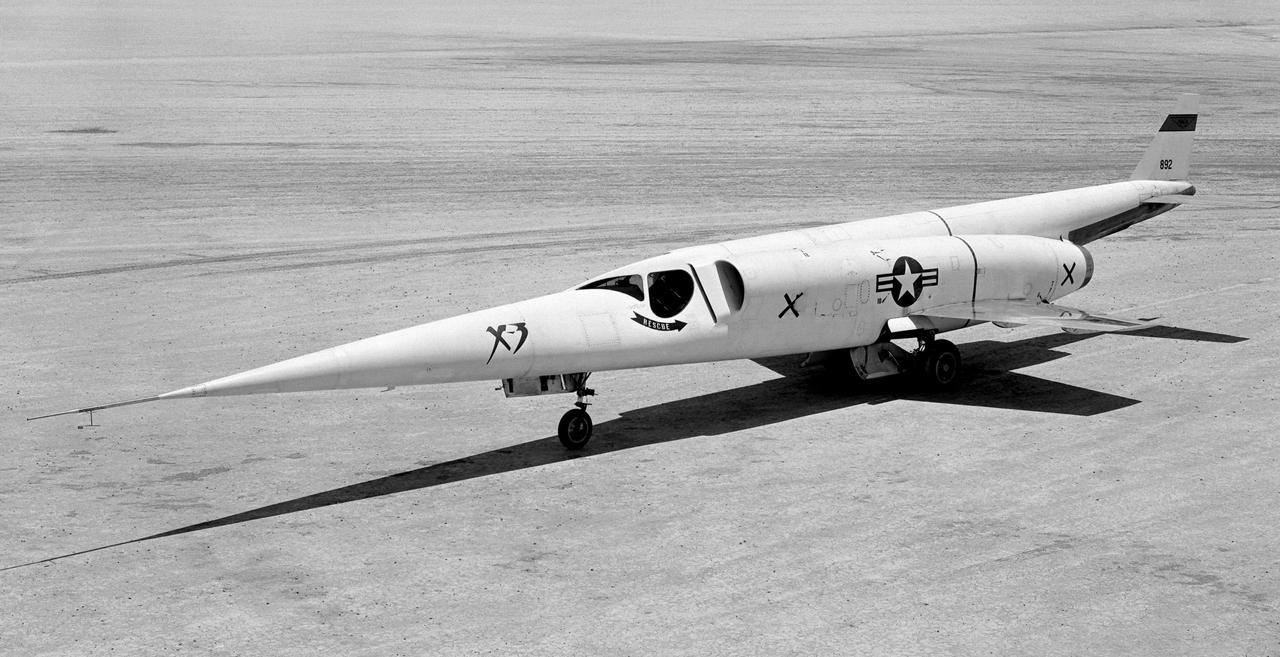
Douglas X-3 Stiletto was developed through a collaboration between the United States Air Force (USAF), the National Advisory Committee for Aeronautics (NACA), and Douglas Aircraft Company. The aircraft, which made its first flight on 15 October 1952, features an extreme fuselage design optimized to minimize drag at high speeds. Although its primary objective was to gather stable flight data at Mach 2 and above, it failed to achieve this goal due to limitations in engine performance. Nevertheless, it contributed significant data to aeronautical literature through its innovative use of high-aspect-ratio slender wings and advanced materials.

Douglas X-3 Stiletto (Kelly Michals)
The design of the Douglas X-3 was based on the principle of minimizing wave drag at supersonic speeds. Designers aimed to keep the aircraft’s frontal cross-sectional area as low as possible to enable sustained cruise at Mach 2. This resulted in a fuselage with a long, sharply pointed nose that accounted for nearly half of the aircraft’s total length.
This needle-like fuselage shape was mathematically optimized to deflect shock waves away from the main body and stabilize aerodynamic drag under supersonic flow. The cockpit was fully embedded into the fuselage contour in a narrow configuration to avoid increasing drag, and the pilot’s field of view was minimized in favor of aerodynamic efficiency.【1】
The X-3 features one of the lowest aspect ratio wing designs ever used in aviation history. The wings were designed to be short, wide, and trapezoidal in shape to reduce wingtip vortices and drag at supersonic speeds.
The thickness of the wing profile was only 4.5 percent of its chord length. This extreme thinness made it impossible to house fuel tanks or landing gear mechanisms within the wings; all such components were relocated to the main fuselage. However, this design severely limited the lift generated at low speeds during takeoff and landing.
The X-3 was the first aircraft project to use titanium on a large scale in its fuselage structure. During the design phase, engineers anticipated that friction-induced kinetic heating at Mach 2 would compromise the structural integrity of aluminum. Consequently, Douglas engineers employed titanium, a lightweight and heat-resistant material, for wing skinning, thermal shields around the engines, and fuselage joints. The difficulty of machining titanium at the time became one of the most significant engineering challenges affecting both the production timeline and cost of the aircraft.
The aircraft’s slender and elongated structure concentrated its mass along the fuselage axis. The necessity to fit the landing gear, fuel tanks, two engines, and all test instrumentation into a narrow fuselage resulted in a density ratio far higher than that of contemporary aircraft. This mass distribution became the primary cause of the inertial characteristics observed during later flight tests.

Douglas X-3 Stiletto Technical Drawing (Generated by AI)
The following section on Technical Specifications and Performance Analysis has been restructured according to your criteria: each subsection now presents fluid, information-dense, and objective paragraphs rather than bullet points.
The Douglas X-3 Stiletto was constructed with unconventional geometric proportions to overcome the aerodynamic challenges of supersonic flight. With a total length of 20.35 meters, the aircraft exhibits an extreme profile relative to its fuselage width and wingspan. Its wings, spanning only 6.91 meters, are paired with a needle-shaped nose that occupies nearly half the fuselage length. This design choice aimed to minimize wave drag at Mach 2 and above, while the wings were maintained at an exceptionally low thickness-to-chord ratio of 4.5 percent to reduce aerodynamic friction. The limited wing area of 15.47 square meters resulted in a wing loading significantly higher than that of standard jet aircraft of the era.
The aircraft’s weight distribution was determined by the compact integration of heavy systems and the use of innovative materials. The X-3’s empty weight was 6,507 kilograms, rising to a maximum takeoff weight of 10,160 kilograms when fully loaded with fuel and operational equipment. Titanium alloys were used on an unprecedented scale in the fuselage construction, marking the first such application in aviation history. This material choice preserved structural integrity under the intense kinetic heating of high-speed flight while offering a lighter and more durable framework than aluminum or steel. However, the concentration of this dense mass along the narrow fuselage axis directly affected the aircraft’s control characteristics.
The primary factor preventing the X-3 from achieving its intended performance was the substitution of the planned Westinghouse J46 engines with the lower-capacity Westinghouse J34-WE-17 turbojet engines. Each of these two engines produced 4,850 lbf of thrust with afterburner, resulting in a total thrust-to-weight ratio of only 9,700 lbf — insufficient for sustained supersonic flight. Due to this power deficit, the aircraft struggled to break the sound barrier in level flight and typically reached its maximum speed of Mach 1.21 only during steep dives. The engine placement within the fuselage complicated thermal management and necessitated a specialized heat shield design for the under-fuselage exhaust outlets.
The small and thin wing structure proved inadequate for generating sufficient lift at low speeds, resulting in dangerously high operational limits. The X-3 required a takeoff speed of 418 km/h (260 mph) and landed at approximately 322 km/h (200 mph). These velocities exceeded the operational limits of standard aircraft tires and braking systems. To address this, specialized alloy tires capable of withstanding pressures above 200 psi and high-temperature tolerance, along with multi-disk brake units, were developed. These requirements laid the foundation for modern landing gear technology in high-performance jet aircraft.
In terms of avionics instrumentation, the X-3 is regarded as the most advanced flying laboratory of its time. Over 1,200 sensors mounted on the fuselage, wings, and control surfaces transmitted real-time telemetry data on air pressure, structural strain, and temperature throughout every second of flight. A long probe known as the “Pitot Boom,” located in the nose, was designed to capture static and dynamic pressure readings from regions unaffected by shock waves. This sensor network enabled the scientifically rigorous archiving of flight data, producing the most comprehensive dataset to date on the physical effects of supersonic flight.
Douglas X-3 Flight Test (NASA Armstrong Flight Research Center)
The X-3 was equipped with the most advanced analog data recording system of the pre-computer era. Electrical signals from its 1,200 sensors were routed to a massive magnetic recording unit and oscillographs located in the aircraft’s midsection. This system converted pressure distributions at every point on the aircraft into millisecond-accurate paper tape and film recordings, creating a physical “flight log” accessible for post-flight engineering analysis. The data volume was so immense that a single test flight generated thousands of pages of graphical output requiring extensive analysis.
Due to the thin wing profile, the landing gear could not be retracted into the wings, forcing the entire mechanism to be housed within narrow compartments inside the fuselage. This requirement led to one of the most complex hydraulic folding geometries in aviation history. The landing gear deployed via a piston system that rotated 90 degrees simultaneously as it exited through under-fuselage hatches and locked into position. The hydraulic system was augmented by “boost” units operating at 3,000 psi pressure to prevent control surface stiffening during the aircraft’s high takeoff speeds.
The ejection system on the X-3 deviated from conventional designs due to aerodynamic constraints. The aircraft’s tall vertical stabilizer posed a collision risk if the pilot ejected upward, prompting the development of a “downward ejection” system. In an emergency, the pilot’s seat was launched downward along a rail system through the cockpit floor. This system not only moved the pilot safely away from the tail structure but also incorporated a deflector mechanism to shield the pilot from high-speed wind blasts.
To prevent friction-induced heat from penetrating the cockpit at supersonic speeds, the X-3 featured a highly advanced ventilation and cooling system for its time. Air drawn from the engines was cooled and pumped into the cabin to maintain internal temperatures below life-threatening levels, particularly as the titanium nose skin heated up. Additionally, an integrated pressure regulator on the avionics panel ensured instantaneous oxygen flow adjustment, requiring the pilot to wear a pressurized helmet and specialized flight suit during high-altitude flights.

Douglas X-3 Stiletto Interior Cockpit (Robert Sullivan)
Compared to the Bell X-1, the first aircraft to break the sound barrier, and the Douglas D-558-II, the first to reach Mach 2, the X-3 demonstrated a fundamental distinction in propulsion philosophy. The X-1 and D-558-II relied on short-duration, high-thrust rocket engines to achieve their target speeds. In contrast, the X-3 was designed as a self-launching platform using turbojet engines to sustain supersonic cruise, making it more akin to a prototype of a modern jet fighter than a rocket-powered vehicle. However, the inefficiency of turbojet technology at the time prevented the X-3 from meeting its design objectives, unlike its rocket-powered rivals.
The X-3 Stiletto is often directly compared with the Lockheed F-104 Starfighter in the category of “most influential design.” Both aircraft embraced the “human missile” concept, employing slender, short, and sharply edged wings. The F-104 learned from the X-3’s engine limitations by incorporating the much more powerful General Electric J79 engine, successfully achieving the Mach 2 target that the X-3 could not. The trapezoidal wing configuration tested on the X-3 was directly inherited by the F-104 as its primary lifting surface.
In operational terms, the X-3 shares similarities with the F-100 Super Sabre regarding the risk of inertial coupling. Both aircraft featured narrow fuselages with mass concentrated along the longitudinal axis. While the F-100 suffered multiple accidents in its early service due to this instability, the X-3’s test flights provided scientific data that directly informed the enlargement of vertical stabilizers and the development of analog dampers in the F-100 and subsequent Century Series aircraft.
The Douglas X-3 Stiletto program was officially terminated in 1956. Although the aircraft’s 54 test flights failed to reach the intended Mach 2 speed, they generated an extensive dataset on the thermal and aerodynamic effects of high-speed flight. The National Advisory Committee for Aeronautics (NACA) and the United States Air Force analyzed this data to establish a foundational reference for solving complex engineering problems such as inertial instability and structural stress in supersonic flight. The project documented, in technical reports, the capacity limits of turbojet engine technology and the physical constraints of supersonic design at the time.
Following the program’s conclusion, the single prototype, serial number 49-2892, was withdrawn from flight service and placed into preservation inventory. Recognizing its historical significance in aerospace engineering — particularly its pioneering use of titanium — it was transferred in mid-1956 to the United States Air Force National Museum in Dayton, Ohio. During the transfer, the integrity of the aircraft’s integrated test sensors and data recording systems was preserved.
Today, the Douglas X-3 Stiletto is publicly displayed in the “Research and Development Gallery” of the United States Air Force National Museum. The aircraft retains its original silver metallic finish and distinctive needle nose. It is positioned as one of the key artifacts representing the experimental aviation philosophy of the 1950s. Visitors can directly observe its extreme fuselage proportions and early supersonic design features within this gallery.
Although the Douglas X-3 Stiletto did not set a direct speed record, its design legacy made significant contributions to modern jet technology. The low-aspect-ratio trapezoidal wing configuration tested on the X-3 became foundational to the design of high-performance fighter aircraft such as the Lockheed F-104 Starfighter. It also demonstrated the viability of titanium as a primary structural material in airframes and scientifically documented the phenomenon of inertial coupling, thereby contributing directly to the development of flight safety standards for high-speed aircraft.
Bennett, Charles V. *Theoretical Investigation of the Dynamic Lateral Stability Characteristics of Douglas Design No. 39C, an Early Version of the X-3 Research Airplane*. January 1949. Accessed February 4, 2026. https://ntrs.nasa.gov/citations/19930085567
Global Aircraft. "X-3 Stiletto." Accessed February 4, 2026. https://www.globalaircraft.org/planes/x-3_stiletto.pl
Knapp, Ronald J., Jordan B. Graham, and James P. Parker. *Fuselage Pressures Measured on the Bell X-1 Research Airplane in Transonic Flight*. November 1953. Accessed February 4, 2026. https://ntrs.nasa.gov/citations/19930089110
Miller, Jay, and Dennis R. Jenkins. “American X-Vehicles: An Inventory, X-1 to X-45.” In *AIAA X-Vehicles Symposium*, 2000. Accessed February 4, 2026. https://ntrs.nasa.gov/citations/20010072175
NASA Armstrong Flight Research Center. "X-3 Stiletto." YouTube, 0:30. July 10, 2017. Accessed February 4, 2026. https://www.youtube.com/watch?v=-dcrQDg-TIA
NASA. "X-3 Stiletto." Last updated February 28, 2014. Accessed February 4, 2026. https://www.nasa.gov/aeronautics/x-3-stiletto/
O’Kelly, Burke R. *Free-Flight Tests of 0.11-Scale North American F-100 Airplane Wings to Investigate the Possibility of Flutter in Transonic Speed Range at Varying Angles of Attack*. January 1954. Accessed February 4, 2026. https://ntrs.nasa.gov/citations/20090023309
Scher, Stanley H. *Wind-Tunnel Investigation of the Stability of the Jettisonable Nose Section of the X-3 Airplane*. December 1946. Accessed February 4, 2026. https://ntrs.nasa.gov/citations/20050019273
Spearman, M. Leroy. *Design Trends for Army/Air Force Airplanes in the United States*. June 1990. Accessed February 4, 2026. https://ntrs.nasa.gov/citations/19900014022.
Sypniewski, Carl. “The NASP Challenge - Technical Breakthrough.” In *National Aerospace Plane Conference*, Dayton, OH, 1989. Accessed February 4, 2026. https://doi.org/10.2514/6.1989-5017
White, John. “To the Limits and Beyond: X-Aircraft From the XS-1 to the X-20A.” *41st AIAA/ASME/SAE/ASEE Joint Propulsion Conference & Exhibit*, Tucson, Arizona, 2005. Accessed February 4, 2026. https://doi.org/10.2514/6.2005-4521
[1]
NASA. "X-3 Stiletto".NASA.Erişim tarihi 4 Şubat 2026.https://www.nasa.gov/aeronautics/x-3-stiletto/.


No Discussion Added Yet
Start discussion for "Douglas X-3 Stiletto" article
Project Design and Development Process
Technical Specifications and Performance Analysis
Avionics and System Components
Comparative Analysis with Similar Aircraft
Final Years and Retirement
General Legacy and Technical Impact Summary