

 Recently Added:
This article was automatically translated from the original Turkish version.
Crash of a U.S. KC-135 Aerial Refueling Aircraft in Iraqi Airspace is a military aviation accident that occurred on 12 March 2026 when a KC-135 Stratotanker aerial refueling aircraft under the command of U.S. Central Command (CENTCOM) crashed west of Iraq. The incident took place during the U.S. campaign against Iran known as the “Epic Fury” operation, during which one of the two involved aircraft landed safely while the other crashed. CENTCOM stated that the crash was not caused by enemy or friendly fire and immediately launched search and rescue operations. Four of the six crew members aboard the aircraft lost their lives.
The crash occurred during a flight supporting U.S. military operations. According to CENTCOM statements two aircraft were involved and according to information attributed to a U.S. military official the other aircraft involved was also a KC-135 aerial refueling aircraft. This second aircraft successfully landed after the incident.
The exact cause of the collision or crash was not initially clear and it has not been officially confirmed whether the incident occurred during a refueling mission. The absence of ejection seats on the crashed Stratotanker increased uncertainty regarding the fate of the crew and prompted immediate search and rescue efforts.
The operation known in U.S. military terminology as “Epic Fury” is part of the campaign launched by the United States and Israel against Iran beginning on 28 February 2026. Under this operation approximately 6,000 targets within Iran were struck and numerous transport and refueling aircraft were deployed to the Middle East to extend the airborne endurance of combat aircraft and provide fuel for transoceanic flights.
In the period preceding the crash U.S. forces suffered various losses during the campaign. Seven U.S. military personnel were killed in combat and approximately 150 personnel were injured. It was reported that the condition of eight of the injured was critical while 108 had returned to duty.
Among the fatalities were soldiers killed in Iranian attacks on the Port Shuaiba facility in Kuwait and the Prince Sultan Air Base as well as a U.S. National Guard soldier who died in Camp Buehring Kuwait due to a medical condition. Additionally some U.S. personnel were reported to have sustained minor injuries in a drone attack on a base in Erbil where British and American forces were stationed.
Regarding losses of aerial platforms three F-15E Strike Eagle fighter jets were accidentally shot down by Kuwaiti aircraft in a friendly fire incident and at least 10 MQ-9 Reaper unmanned aerial vehicles were destroyed. The KC-135 crash is recorded as the fourth reported loss of a manned aircraft by the United States during operations against Iran.
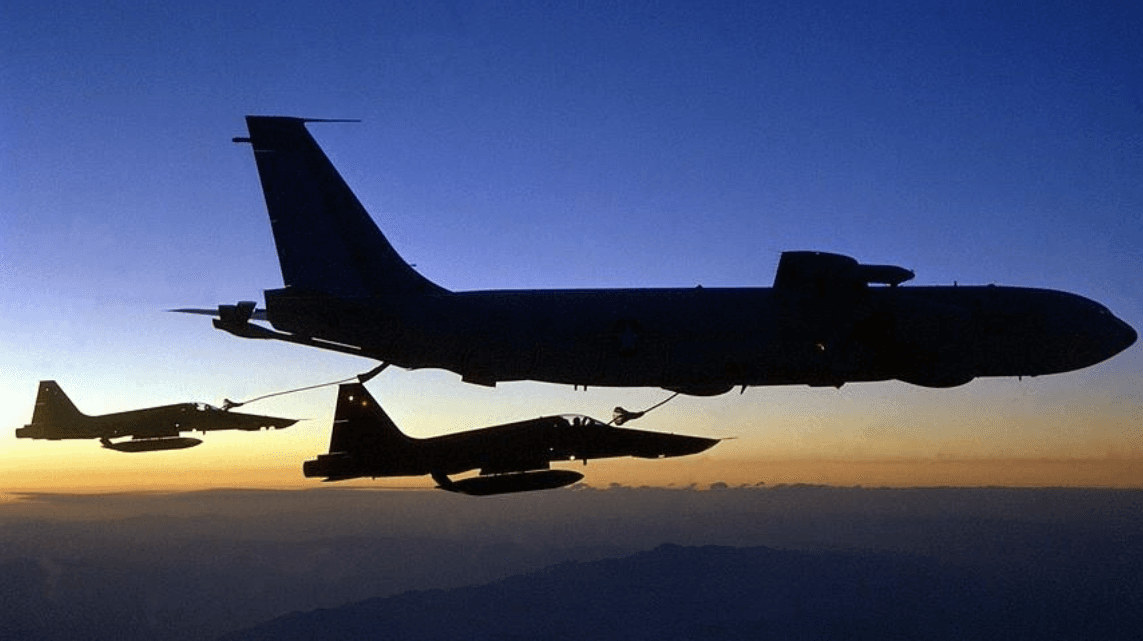
The KC-135 Stratotanker is a large-bodied tanker aircraft forming the backbone of the U.S. Air Force’s aerial refueling fleet with a wingspan of 130 feet (approximately 39.6 meters). These aircraft were developed under a program dating back to the Dwight D. Eisenhower era and have been in service since the 1960s. The average age of KC-135 aircraft currently in the fleet exceeds 66 years.
Due to their greater vulnerability to enemy fire compared to modern combat aircraft and stealth platforms these aircraft typically operate in secure airspace outside conflict zones. Their primary mission is to provide in-flight refueling to military aircraft thereby extending their operational range and mission duration. However KC-135 aircraft can also be used for aeromedical evacuation missions to transport sick and wounded personnel when necessary.
The standard crew consists of three personnel: pilot co-pilot and boom operator. Additional personnel such as a navigator may be included for special missions.
According to U.S. Air Force data the production cost of the aircraft was listed as $39.6 million as of 1998. Adjusted for inflation this amount is estimated to be approximately $79 million today. The U.S. Air Force is gradually replacing its aging KC-135 tanker fleet with the more modern Boeing KC-46 Pegasus aircraft.
The incident on 12 March 2026 marks the first loss of a KC-135 and therefore any tanker aircraft by the U.S. Air Force in the past 13 years. The last fatal accident involving this aircraft model occurred in May 2013 in Kyrgyzstan.
The aircraft which had taken off to support military operations in Afghanistan crashed into a mountainous region shortly after takeoff resulting in the deaths of three aircrew members. The absence of an ejection seat system on KC-135 aircraft which would allow the crew to escape in emergencies is considered a technical factor that reduces survival chances in fatal accidents.
Following the crash U.S. Central Command (CENTCOM) released its first official information regarding the crew of the crashed KC-135 Stratotanker. The statement confirmed that four of the six crew members had lost their lives and that search and rescue operations were ongoing. Authorities stated that activities following the crash were being conducted as an active rescue and debris recovery operation. CENTCOM officials also announced that the identities of the deceased service members would not be released to the public for 24 hours until formal notifications had been delivered to their families.
Following the crash several armed groups operating in Iraq and identifying themselves as the “Islamic Resistance” claimed responsibility for shooting down a U.S. KC-135 aerial refueling aircraft in western Iraq. The group’s statement read: “In defense of our country and our airspace against occupation forces the U.S. KC-135 aircraft was struck with appropriate weapons and brought down in western Iraq.”
Following the crash CENTCOM announced that a formal investigation had been launched to determine the circumstances of the incident. Initial assessments by the command indicated that the crash was not caused by enemy or friendly fire and that the investigation would focus on technical or operational causes.
The crash is reported to have occurred around 14:00 Eastern U.S. Time (19:00 GMT). At the time of the incident the tanker aircraft was reported to be participating in military operations against Iran and was one of two aircraft in the air. It was confirmed that the second aircraft landed safely after the event.
U.S. Secretary of Defense Pete Hegseth described the crew lost in the crash as “American heroes” in his statement. Officials confirmed that a technical investigation is ongoing and that details of the incident will be shared with the public once the investigation is complete.
Air & Space Forces Magazine. "KC-135 Crashes In Iraq While Supporting Iran Ops." March 12, 2026. Accessed March 13, 2026. https://www.airandspaceforces.com/kc-135-crashes-in-iraq-while-supporting-iran-ops/
Anadolu Ajansı. "US says its KC-135 refueling aircraft was lost over Iraq during operation against Iran." Accessed March 13, 2026. https://www.aa.com.tr/en/americas/us-says-its-kc-135-refueling-aircraft-was-lost-over-iraq-during-operation-against-iran/3862480
BBC News. “Four Crew Members Killed After US Refuelling Plane Crashes in Iraq.” BBC News, 2026. Accessed March 13, 2026. https://www.bbc.com/news/articles/cy0dz5ql17vo
Breaking Defense. "KC-135 tanker involved in Epic Fury goes down in Iraq: CENTCOM." March 12, 2026. Accessed March 13, 2026. https://breakingdefense.com/2026/03/kc-135-tanker-involved-in-epic-fury-goes-down-in-iraq-centcom/
Forbes. "U.S. Military Plane Goes Down Over Iraq, Rescue Effort ‘Ongoing’." March 12, 2026. Accessed March 13, 2026. https://www.forbes.com/sites/antoniopequenoiv/2026/03/12/us-military-plane-goes-down-over-iraq-rescue-effort-ongoing/
Stars and Stripes. "KC-135 refueling aircraft lost during Operation Epic Fury, CENTCOM says." Accessed March 13, 2026. https://www.stripes.com/theaters/middle_east/2026-03-12/centcom-kc135-aircraft-loss-incident-21044504.html.
The Guardian. "Rescue effort under way as US military refueling plane crashes in Iraq." March 12, 2026. Accessed March 13, 2026. https://www.theguardian.com/us-news/2026/mar/12/us-military-aircraft-iraq-crash
WTOP News. "US military refueling plane goes down in Iraq and rescue is underway." March 12, 2026. Accessed March 13, 2026. https://wtop.com/world/2026/03/us-military-refueling-plane-goes-down-in-iraq-and-rescue-is-underway/

On March 12, 2026, a U.S. KC-135 aerial refueling aircraft crashed in western Iraq as part of the "Epic Fury" operation targeting Iran. U.S. Central Command (CENTCOM) stated that the incident, which occurred in friendly airspace, was not caused by enemy or friendly fire. In this mid-air encounter involving two aircraft, the other aircraft successfully landed safely, and search and rescue operations have been launched for the crew of the downed aircraft.
No Discussion Added Yet
Start discussion for "Downing of a U.S. KC-135 Aerial Refueling Aircraft in Iraqi Airspace (March 12, 2026)" article
March 12, 2026
Course of the Incident
March 12, 2026
“Epic Fury” Operation and Background
March 12, 2026
Characteristics of the KC-135 Stratotanker Aircraft
March 12, 2026
Historical Context and Previous Accidents
March 12, 2026
Loss of Life
March 12, 2026
Claims by Armed Groups in Iraq Regarding the Downing of the Aircraft
March 12, 2026
CENTCOM’s Statements on the Cause of the Crash and Investigation Process