

This article was automatically translated from the original Turkish version.
+1 More
Length(s) | 41.53 metres | ||||||||
|---|---|---|---|---|---|---|---|---|---|
Status | In active service | ||||||||
First Flight(s) | 31 August 1956 | ||||||||
Cruise Speed | 850 km/h | ||||||||
Maximum Speed | 933 km/h | ||||||||
Empty Weight | Approximately 44,663 kg | ||||||||
Number Produced | 820 | ||||||||
Primary Users | Chile Türkiye France United States Air Force (USAF) | ||||||||
Entry into Service (IOC) | June 1957 | ||||||||
Height(s) | 12.7 metres | ||||||||
Producer(s) | The Boeing Company | ||||||||
Wingspan | 39.88 metres | ||||||||
Crew | 3 (Pilot-co-pilot-bomb operator) | ||||||||
Role | Aerial refueling, strategic cargo/personnel transport | ||||||||
KC-135 Stratotanker (Flickr)
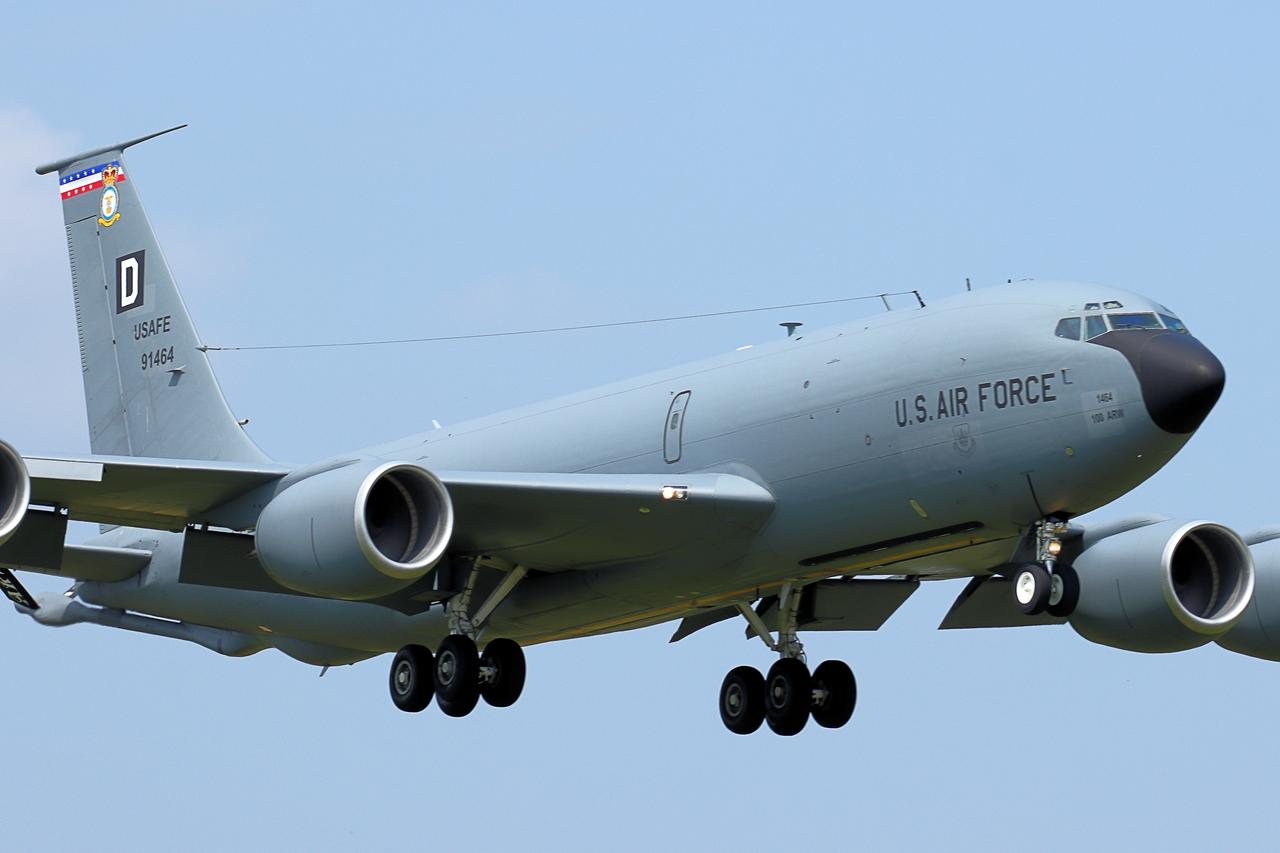
The KC-135 Stratotanker, designed and manufactured by Boeing, is a four-engine jet aircraft developed to provide aerial refueling capability, a fundamental element in modern military aviation and strategic deployments. This aircraft has served the armed forces of various nations, primarily the United States Air Force (USAF), functioning as a strategic platform that extends the range, endurance, and payload capacity of combat and bomber aircraft. The KC-135 is one of the rare fixed-wing aircraft to have remained in continuous service under the same operator for over fifty years.
The concept of aerial refueling in aviation history began with experiments by individuals such as Wesley May, Lowell Smith, and John Richter in the 1920s, and its feasibility was demonstrated in 1929 with the endurance flight of the "Question Mark" aircraft. However, it was only during the Cold War that this capability became a strategic necessity for military operations.
In the early 1950s, the introduction of the B-47 and the eight-engine high-altitude B-52 bombers into the US Air Force inventory, alongside jet fighter aircraft, revealed that the propeller-driven KC-97 tankers of the era could not match their speed. The B-52s were forced to lower their landing gear to slow down for refueling from the slower KC-97s, then expend significant fuel to regain cruising speed, making the need for a jet-powered tanker urgent.
Under the leadership of Strategic Air Command (SAC) commander General Curtis E. LeMay, Boeing won the competition for a jet-powered tanker with its design based on the 367-80 prototype, developed for both civil and military use. The first order was placed in 1954, and the first aircraft, designated KC-135A, made its maiden flight on 31 August 1956. It entered operational service at Castle Air Force Base in California in June 1957. Production continued until 1965–1966, resulting in a total of 820 aircraft built.
The KC-135 is based on the fuselage of the Boeing 707 civil airliner and features 35-degree swept-back wings with four turbofan jet engines mounted beneath them.
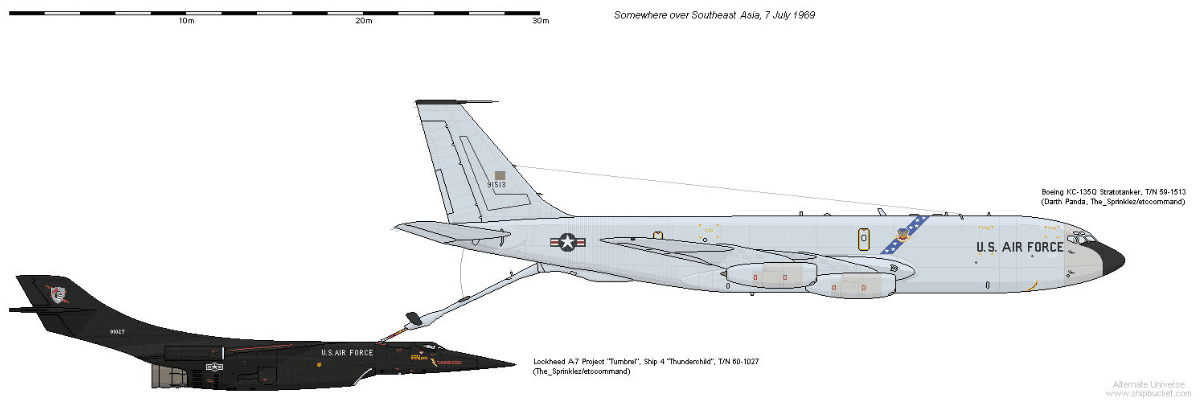
Lockheed A-7 Tumbrel (60-1027 "Thunderchild") and KC-135Q Stratotanker (darthpandanl)
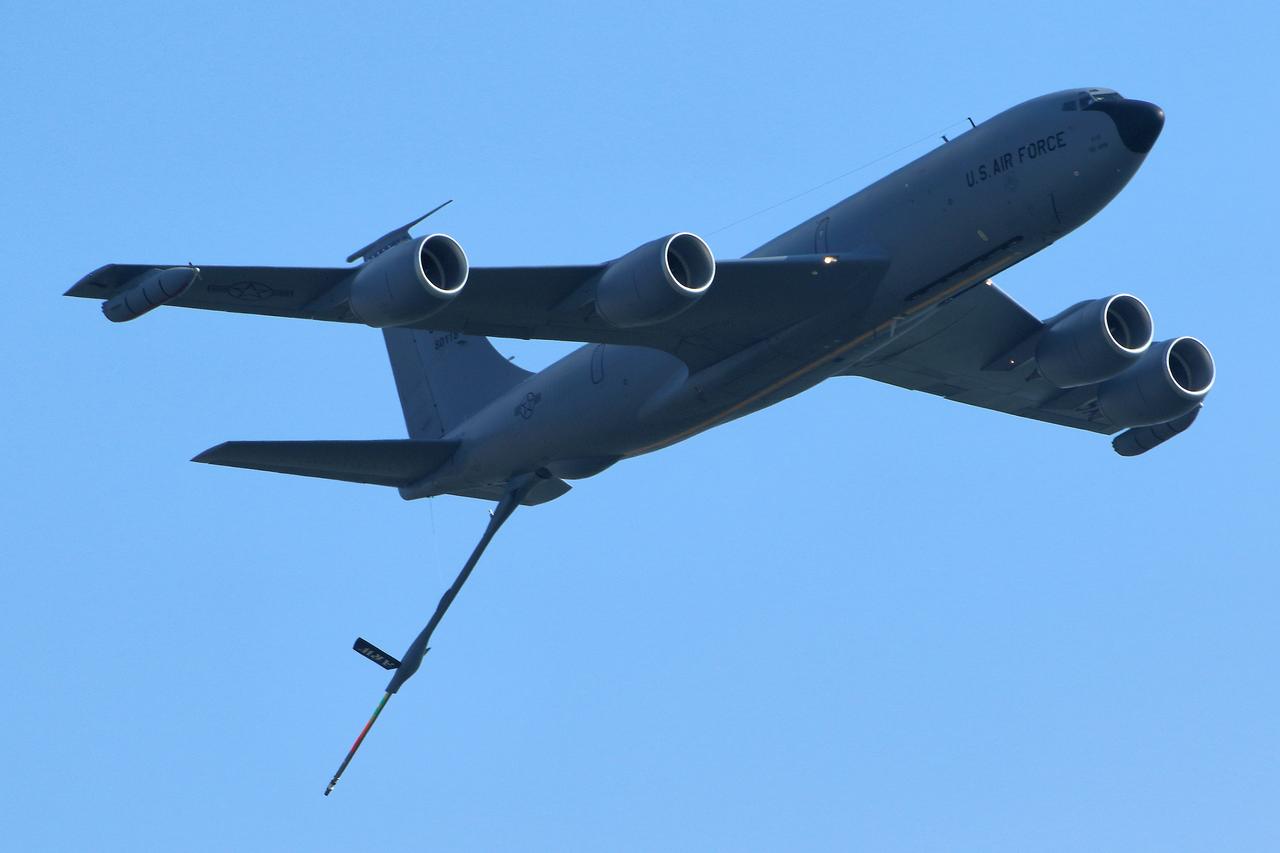
Fuel transfer is conducted via a flying boom system, controlled by a crew member positioned prone in the rear of the aircraft, known as the "boom operator." A drogue basket, shaped like a rocket, can be attached to the end of the boom to enable refueling of aircraft equipped with probe-and-drogue systems. Later modifications integrated Multiple Point Refueling System (MPRS) pods on the wingtips, allowing the aircraft to refuel two fighter jets simultaneously.
The aircraft can transfer all of its onboard fuel—except for 1,000 gallons reserved for its own use—to receiving aircraft. It carries up to 200,000 pounds (approximately 31,000 gallons) of fuel across six wing and four fuselage tanks. In addition to fuel, the main deck can carry up to 83,000 pounds of cargo, approximately 40 passengers, or litter and medical personnel (flight nurses and technicians) for aeromedical evacuation missions.
The aircraft’s basic dimensions and limits are as follows:
The KC-135 began its military career supporting Strategic Air Command bomber aircraft during nuclear alert status in the Cold War. The Vietnam War became known as the first "tanker war" due to the large-scale use of aerial refueling, with the KC-135 playing a pivotal role. Over 100 Stratotankers operated in the theater, completing more than 194,000 sorties and transferring over 1.6 billion gallons of fuel to receiving aircraft. These aircraft not only extended operational ranges but also rescued numerous damaged bombers and fighters by providing emergency fuel, enabling them to return safely to base.
Several such rescue missions have become legendary in aviation literature. In May 1967, a KC-135 under the command of Major Alvin L. Lewis reached two F-105s running out of fuel during a severe storm. One aircraft had shut down its engines due to fuel exhaustion. In violation of standard procedures, Lewis executed a 20-degree vertical dive to deliver the necessary fuel and successfully restarted the engine mid-air, saving both aircraft. That same month, on 31 May 1967, Major John H. Casteel and his crew conducted a complex, unplanned multi-aircraft refueling operation over the Gulf of Tonkin, rescuing two KA-3 Skywarriors, two F-8 Crusaders, and two F-4 Phantom IIs. For this mission, the crew was awarded the Mackay Trophy. During the early days of the Gulf War in 1991, Major David Horton’s crew performed a similar maneuver to rescue an F-117 fighter.
Other notable operations involving the KC-135 fleet include Grenada (Urgent Fury), Panama (Just Cause), Libya (El Dorado Canyon), the Gulf War (Desert Shield and Desert Storm), Kosovo (Allied Force), Afghanistan (Enduring Freedom), and Iraq operations.
The initial standard model, the KC-135A, was powered by Pratt & Whitney J57-P-59W water-injected engines. Over the years, extensive modifications were made to extend the fleet’s service life and improve efficiency. Aircraft in the Air National Guard (ANG) and Air Force Reserve Command inventories were re-engined with TF-33 turbofans and redesignated as KC-135E; the last E-models were retired from operational service in July 2009. A significant portion of active-duty KC-135As and later upgraded aircraft were re-engined with CFM International F108 (CFM-56) engines, becoming the KC-135R and KC-135T (a variant with a different fuel tank configuration). These upgrades resulted in a 25–26 percent improvement in fuel efficiency, a 25 percent reduction in operating costs, a 95 percent reduction in engine noise, and an approximate doubling of thrust compared to the J-57 engines. The aircraft were also modernized with the "Block 45" glass cockpit upgrade, incorporating digital engine indicators, radar altimeters, and modern autopilot systems.
The KC-135 was not limited to tanker duties; its airframe was adapted into several specialized variants:
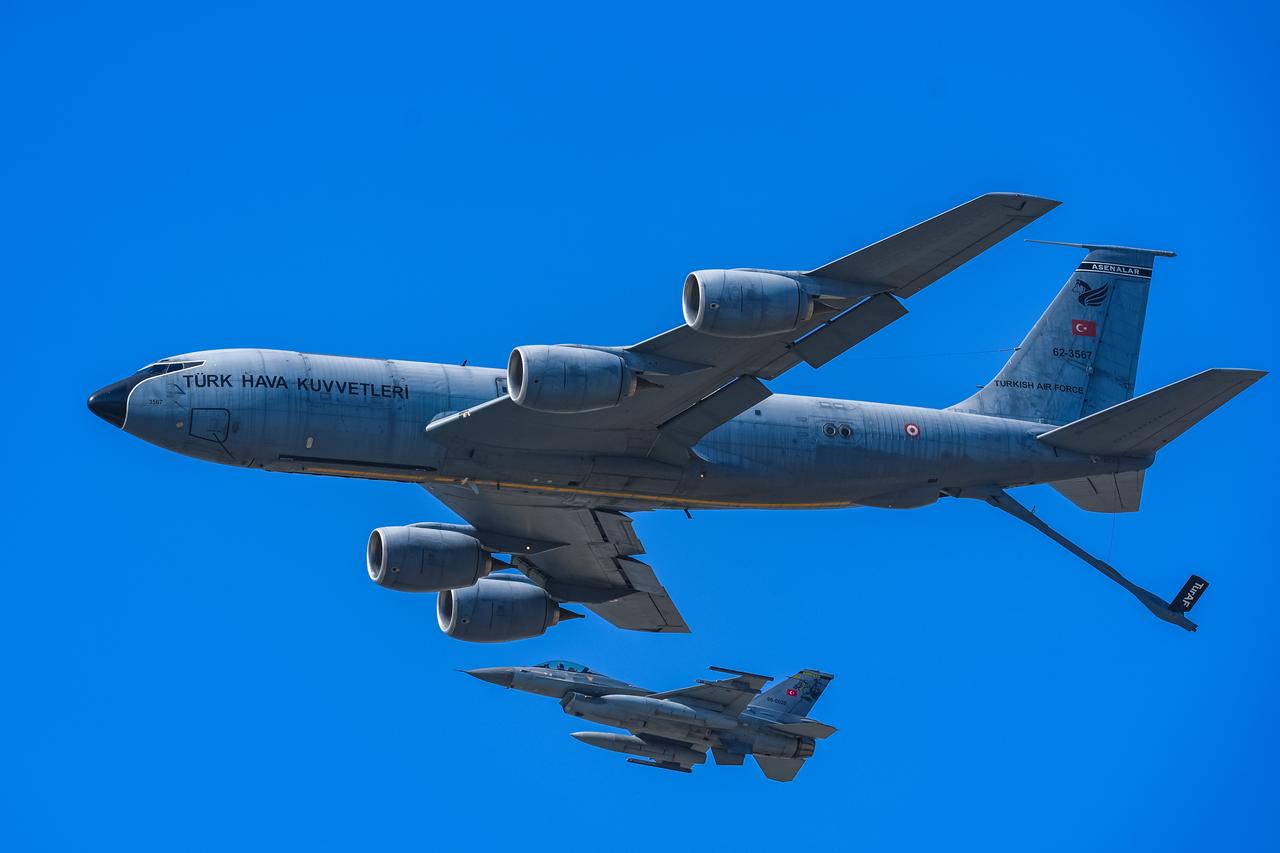
KC-135 Stratotanker and F16 (AA)
In addition to serving as the backbone of the United States Air Force, the KC-135 has been actively operated by the air forces of France, Türkiye, and Chile. Beyond military roles, the United States National Aeronautics and Space Administration (NASA) used it as a zero-gravity training platform under the names "Vomit Comet" and "Weightless Wonder IV." Although the next-generation KC-46 Pegasus and future autonomous/advanced systems (NGAS) are planned, the continuously modernized KC-135 fleet is expected to remain in service with the United States Air Force into the 2040s and possibly the 2050s.
Air & Space Forces Magazine. "KC-135 Stratotanker." Accessed March 13, 2026. https://www.airandspaceforces.com/weapons/kc-135/
Air Mobility Command Museum. "KC-135E Stratotanker." Accessed March 13, 2026. https://www.amcmuseum.org/at-the-museum/aircraft/kc-135e-stratotanker/
Airwolfhound. "KC-135 - Duxford 2016." Flickr. Accessed March 13, 2026. https://www.flickr.com/photos/24874528@N04/25859375445/in/photolist-9P4Dr6-2nXXn6k-2nXUZS3-2iC28Mm-2nhDSbE-2j7Gr8U-Fp74oM-2ofjKK9-2mZYXGV-2j7GqAr-2mUAnRU-2j7EWXB-2j7Gm7w-2j7Gini-2j7CprB-2j7Grqc-2j7CrKu-2j7CrTR-2j7GoDL-2j7Cs3D-2j7ERve-2jNZbvj-2mZU1ue-2n7VPvo-2n7Wg9u-2n11BC5-2rWJPjL-eTq5P6-2hNmJSd-2oficwR-2jJmN6Z-4vo1zf-2p7FNEC-4viYb2-2rUiCMe-2okbYDB-4viXAv-2mUy92b-2qykm1U-2rUq5MS-2rZURtS-2p7BiBr-2oodRNL-2p3LDo3-8xphUz-2mUy93U-2ooeEL9-2mvFMRh-2nATGG9-2rUpdSj
American Aviation Historical Society. "Boeing KC-135 Celebrates 50 Years of Service." Accessed March 13, 2026. https://www.aahs-online.org/pubs/articles/KC-135_turns_50.php
Hill Aerospace Museum. "KC-135E Stratotanker." Accessed March 13, 2026. https://www.aerospaceutah.org/museum/our-collections/aircraft-collection/kc-135e-stratotanker/
HistoryNet. "THE FLYING GAS STATION: HOW THE KC-135 STRATOTANKER SAVED PLANES WHEN THEY WERE IN A PINCH." Accessed March 13, 2026. https://historynet.com/historynet-terms-service/
March Field Air Museum. "KC-135A Stratotanker." Accessed March 13, 2026. https://www.marchfield.org/kc-135a-stratotanker/
Military.com. "KC-135 Stratotanker." Accessed March 13, 2026. https://www.military.com/equipment/kc-135-stratotanker
NATO Days in Ostrava. "KC-135 STRATOTANKER" Accessed March 13, 2026. https://www.natodays.cz/aircraft/kc-135-stratotanker
National Museum of the United States Air Force. "Boeing KC-135R Stratotanker." Accessed March 13, 2026. https://www.nationalmuseum.af.mil/Visit/Museum-Exhibits/Fact-Sheets/Display/Article/3123510/boeing-kc-135r-stratotanker/
Simple Flying. "History: The USAF KC-135 Stratotanker Whose 20-Degree Dive Saved A Fighter Jet." Accessed March 13, 2026. https://simpleflying.com/boeing-kc-135-stratotanker-20-degree-dive-story/
The Aviation Geek Club. "The day a USAF KC-135 Stratotanker saved six US Navy jets over the Gulf of Tonkin." Accessed March 13, 2026. https://theaviationgeekclub.com/the-day-a-usaf-kc-135-stratotanker-saved-six-us-navy-jets-over-the-gulf-of-tonkin/
darthpandanl. "[FD-AU] Tumbrel and Stratotanker." DeviantArt. Accessed March 13, 2026. https://www.deviantart.com/etccommand/art/FD-AU-Tumbrel-and-Stratotanker-1010464983


Length(s) | 41.53 metres | ||||||||
|---|---|---|---|---|---|---|---|---|---|
Status | In active service | ||||||||
First Flight(s) | 31 August 1956 | ||||||||
Cruise Speed | 850 km/h | ||||||||
Maximum Speed | 933 km/h | ||||||||
Empty Weight | Approximately 44,663 kg | ||||||||
Number Produced | 820 | ||||||||
Primary Users | Chile Türkiye France United States Air Force (USAF) | ||||||||
Entry into Service (IOC) | June 1957 | ||||||||
Height(s) | 12.7 metres | ||||||||
Producer(s) | The Boeing Company | ||||||||
Wingspan | 39.88 metres | ||||||||
Crew | 3 (Pilot-co-pilot-bomb operator) | ||||||||
Role | Aerial refueling, strategic cargo/personnel transport | ||||||||
No Discussion Added Yet
Start discussion for "KC-135 Stratotanker" article
Development and Background
Design and Equipment Features
Operational History and Combat Missions
Models, Variants, and Modernization
Users