

This article was automatically translated from the original Turkish version.
+2 More
Duga-1 was part of an early warning network project designed to detect Soviet intercontinental ballistic missile (ICBM) launches by identifying the ionospheric traces left by exhaust plumes immediately after launch. Over-the-horizon radar technology relies on the principle of reflecting radio waves off the ionosphere to extend range thousands of kilometers beyond the line-of-sight limitations of conventional radar. By following a double-hop path—“ground-ionosphere-target-ionosphere-ground”—the system could detect launches even when they occurred thousands of kilometers away from the radar facility.

Duga Operating Principle, (Generated by Artificial Intelligence)
The source of this 10 Hz signal, known as the “Russian Woodpecker” by amateur radio operators and broadcasters due to its repetitive tapping sound, was the massive Duga-1 system located near the Ukrainian town of Chernobyl.
The Soviet authorities’ prolonged refusal to acknowledge the system’s existence only intensified speculation surrounding it. However, behind this enormous structure lay the Duga program, one of the Soviet Union’s most ambitious and costly military projects.
The project was conducted under the scientific leadership of the Institute of Long-Range Radio Research (NIIDAR) and led by chief designer F.A. Kuzmin. In 1969–1970, decrees issued by the Communist Party Central Committee and the Council of Ministers officially approved the construction of two over-the-horizon radar complexes capable of detecting intercontinental ballistic missiles from the moment of launch.
With a cost of approximately half a billion Soviet rubles, the Duga program represented a significant achievement in Soviet engineering and military strategy, notable for both its scale and technical complexity.

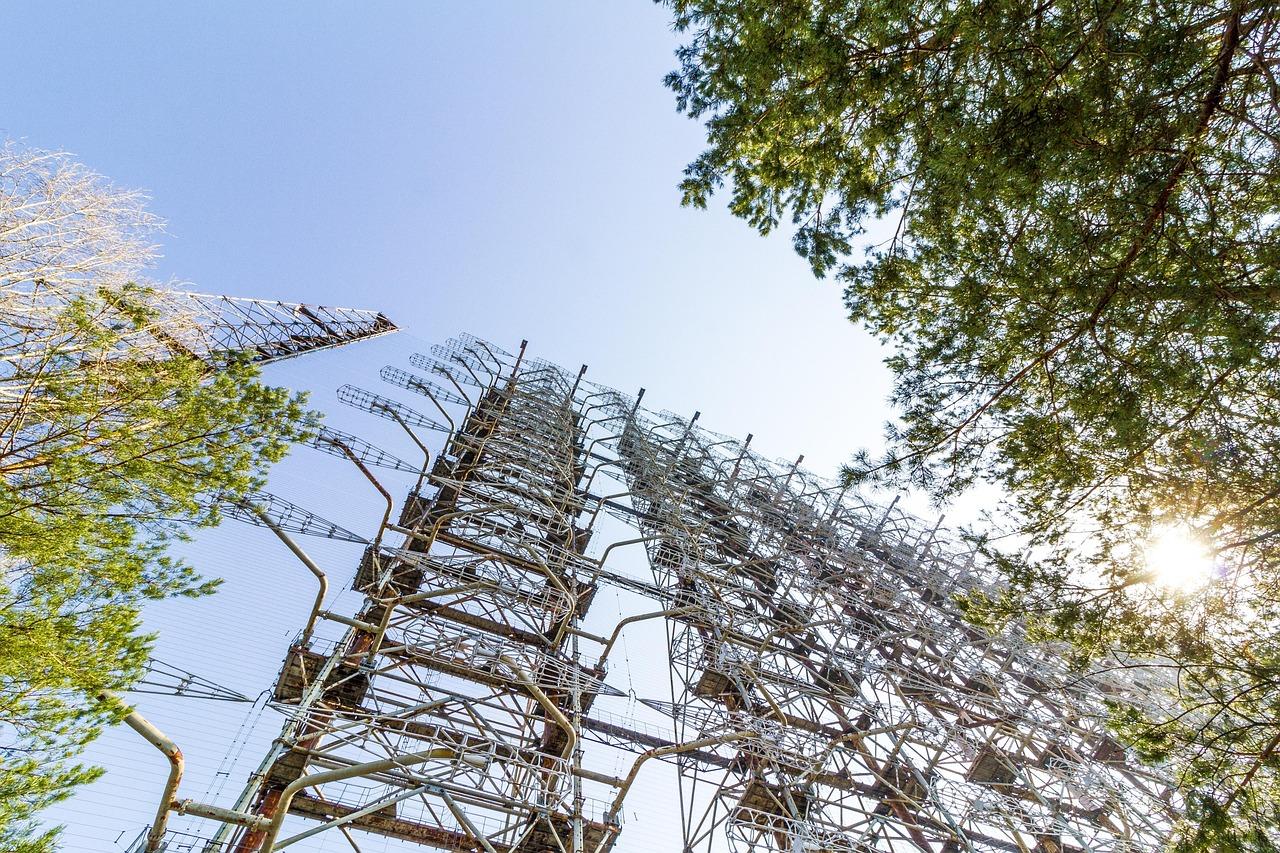
Chernobyl, Duga - (Pexels)
1969–1970: Official approval by the Council of Ministers and commencement of construction.
1976: Duga-1 successfully passed state trials and was formally commissioned by the Soviet Air Defense Forces.
1985: Duga-1 (Chernobyl-2) complex underwent comprehensive modernization to enhance performance.
26 April 1986: The Chernobyl Nuclear Disaster rendered the Duga-1 facility permanently inoperable due to radioactive contamination.
1989: With the end of the Cold War, the project lost its strategic relevance, and Duga-2 was also decommissioned.
The operational effectiveness of the Duga system required extremely high transmission power. An estimated effective radiated power of up to 10 MW was necessary to ensure detectable echoes from targets even after the signal had weakened through ionospheric propagation. The system’s characteristic 10 Hz pulse repetition rate was part of its signal processing algorithms, designed to distinguish Doppler shifts from moving targets and filter out background noise.
However, these technical requirements caused significant global electromagnetic interference【1】. The signal’s wide bandwidth interfered with numerous frequency ranging from civil aviation communications to amateur radio bands. This led to formal complaints from International Telecommunication Union (ITU)【2】. The Soviet Union’s long-standing refusal to confirm the system’s existence or its military purpose turned the “Russian Woodpecker” phenomenon into one of the most famous electromagnetic mysteries of the Cold War.

Duga Radar - 2, (Pexels)
It has been confirmed that the Duga-1 complex stationed at Chernobyl-2 underwent significant modernization in 1985, just one year before the nuclear disaster, followed by renewed state acceptance testing.
This modernization effort stands as the clearest evidence that Soviet military leadership did not consider the system obsolete or a failure. On the contrary, the extensive resources mobilized for such a comprehensive upgrade demonstrate that Duga-1 retained its strategic value up to the moment of the disaster and that continued investment was made to ensure it fulfilled its intended defensive role.
The Duga-1 system successfully completed state trials and was formally commissioned for combat duty in 1976 by Soviet Air Defense Forces (Voyska PVO)【3】. During testing, the system demonstrated its ability to detect both intercontinental and intracontinental missile launches.
However, its practical operational effectiveness was critically dependent on the inherently unstable conditions of the ionosphere's【4】. Geomagnetic storms and ionospheric disturbances in polar regions could cause severe performance degradation or temporary blind spots. This fundamental vulnerability demonstrated that Duga alone could not meet the absolute reliability requirements of a strategic early warning network.
The primary factor leading to the program’s obsolescence was a technological advancement: the Soviet Union’s parallel development of the space-based early warning system "Oko" (US-KS) satellite system【5】, which offered a far more stable and reliable detection platform unaffected by atmospheric conditions. As strategic priorities shifted toward satellite systems, Duga’s importance gradually diminished. The final blow to Duga-1 came on 26 April 1986 with the With the Chernobyl nuclear disaster. The resulting severe radioactive contamination of the region made continued operation impossible, permanently sealing the facility. With the end of the Cold War, the Eastern Complex lost all strategic relevance and was decommissioned and dismantled shortly thereafter.
Batinić, Antonio. “Person Holding Yellow Electronic Device.” Pexels. Accessed August 7, 2025. https://www.pexels.com/photo/person-holding-yellow-electronic-device-4172765/.
Dubrovskiy, I.N., and V.I. Kostyuchenko. “Istoriya zagorizontnoy radiolokatsionnoy sistemy ‘Duga’” [The History of the Over-the-Horizon Radar System ‘Duga’]. *Privolzhskiy nauchnyy vestnik*, no. 7(11), 2012. Accessed August 7, 2025. https://cyberleninka.ru/article/n/istoriya-zagorizontnoy-radiolokatsionnoy-sistemy-duga/viewer.
Ferenc, Gáspár. “Duga Missile Defense in Chernobyl.” Pexels. Accessed August 7, 2025. https://www.pexels.com/photo/duga-missile-defense-in-chernobyl-13717542/.
War History Online. "Russian Duga Radar (Woodpecker)." War History Online, Accessed August 7, 2025. https://www.warhistoryonline.com/instant-articles/russian-duga-radar-woodpecker.html.
“Duga‑1 Radar Station.” Chernobyl.one. Accessed August 7, 2025. https://www.chernobyl.one/duga-1-radar-station/.
[1]
Elektromanyetik enterferans (EMI), bir elektronik cihazın çalışması sırasında çevresindeki başka bir elektronik cihazın performansını bozmasına neden olan istenmeyen elektromanyetik enerji veya gürültüdür.
[2]
Birleşmiş Milletler'e (BM) bağlı en eski uzman kuruluştur. Merkezi İsviçre'nin Cenevre kentinde bulunan ITU, küresel telekomünikasyon ağlarının ve hizmetlerinin uyumlu bir şekilde çalışmasını sağlamak amacıyla hükümetler (üye ülkeler) ve özel sektör (sektör üyeleri, akademisyenler) arasında bir köprü görevi görür.
[3]
Sovyetler Birliği Silahlı Kuvvetleri'nin beş ana kolundan biriydi.
[4]
İyonosfer, atmosferimizin üst katmanlarında, yeryüzünden yaklaşık 60 ila 1.000 kilometre yükseklikte bulunan ve Güneş'ten gelen yoğun ultraviyole (UV) ve X-ışını radyasyonu nedeniyle gaz moleküllerinin ve atomlarının iyonize olduğu (elektronlarını kaybettiği) bir atmosfer tabakasıdır.
[5]
Sovyetler Birliği'nin kıtalararası balistik füzelerin (ICBM) fırlatılışını anında tespit etmek için geliştirdiği ilk nesil balistik füze erken uyarı uydu ağıdır.

No Discussion Added Yet
Start discussion for "Duga-1 Radar Station" article
The Soviet Union’s Mysterious Radar
These two strategic complexes were:
Key Dates
Operational Characteristics and Global Impact
Modernization Before the Disaster
Performance Evaluation and Decommissioning