


This article was automatically translated from the original Turkish version.
+2 More
Location | Kırşehir Kırşehir-Akçakent road 50 km north | ||||||||
|---|---|---|---|---|---|---|---|---|---|
Period(s) | Middle Byzantine (700-900) | ||||||||
Structure(s) | Two-story 202 m length 20 rooms rock-cut | ||||||||
Function(s) | Rock monastery religious center | ||||||||
Tourism | Open to visitors, protected | ||||||||
Dulkadirli Underground City is located approximately 50 kilometers north of the center of Kırşehir Province, along the Kırşehir-Akçakent highway. The underground city is situated on the left edge of a valley within the Kılıçözü Stream basin of the Delice Çayı, a tributary of the Kızılırmak River, in an area characterized by a plateau formed by the branches of Delice Çayı. The region has been shaped by Pleistocene-aged rivers that cut through Pliocene erosion and deposition surfaces.
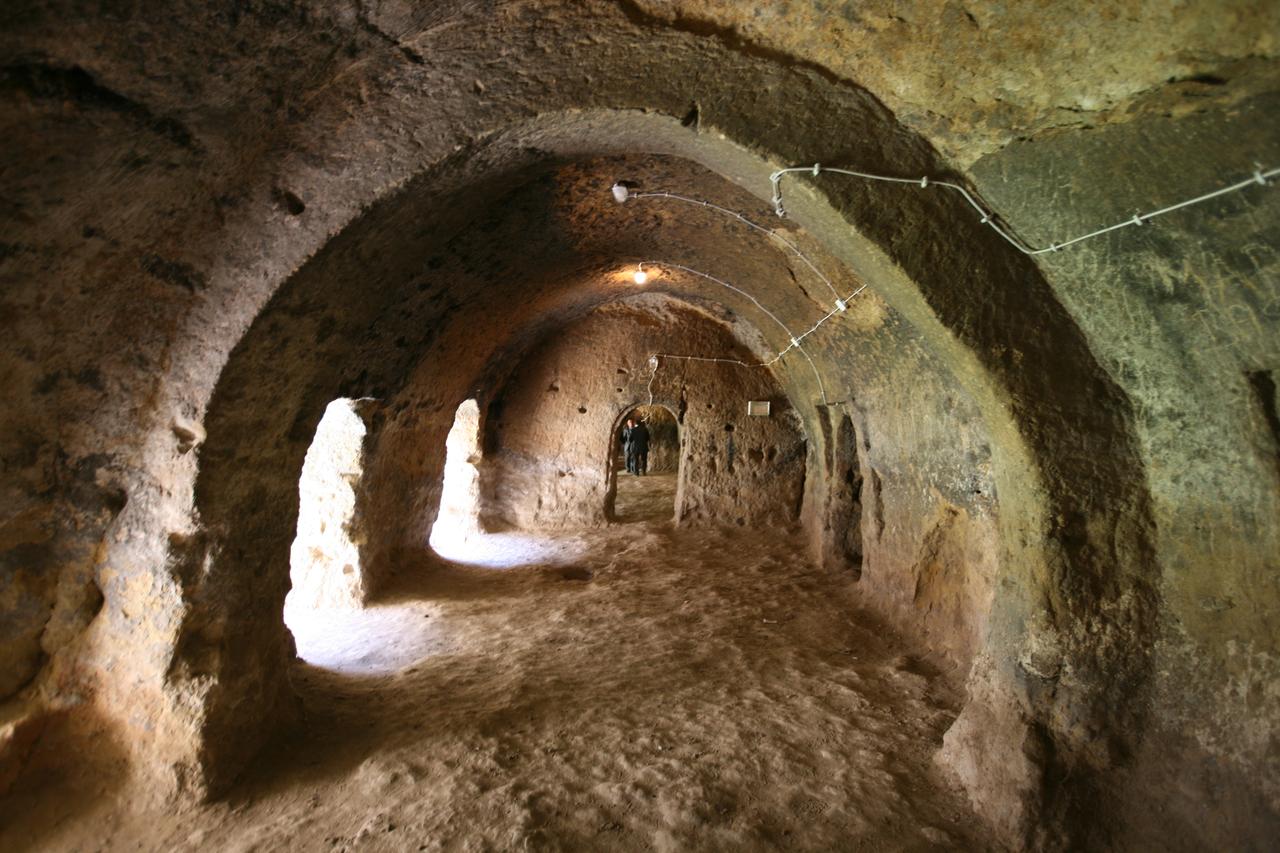
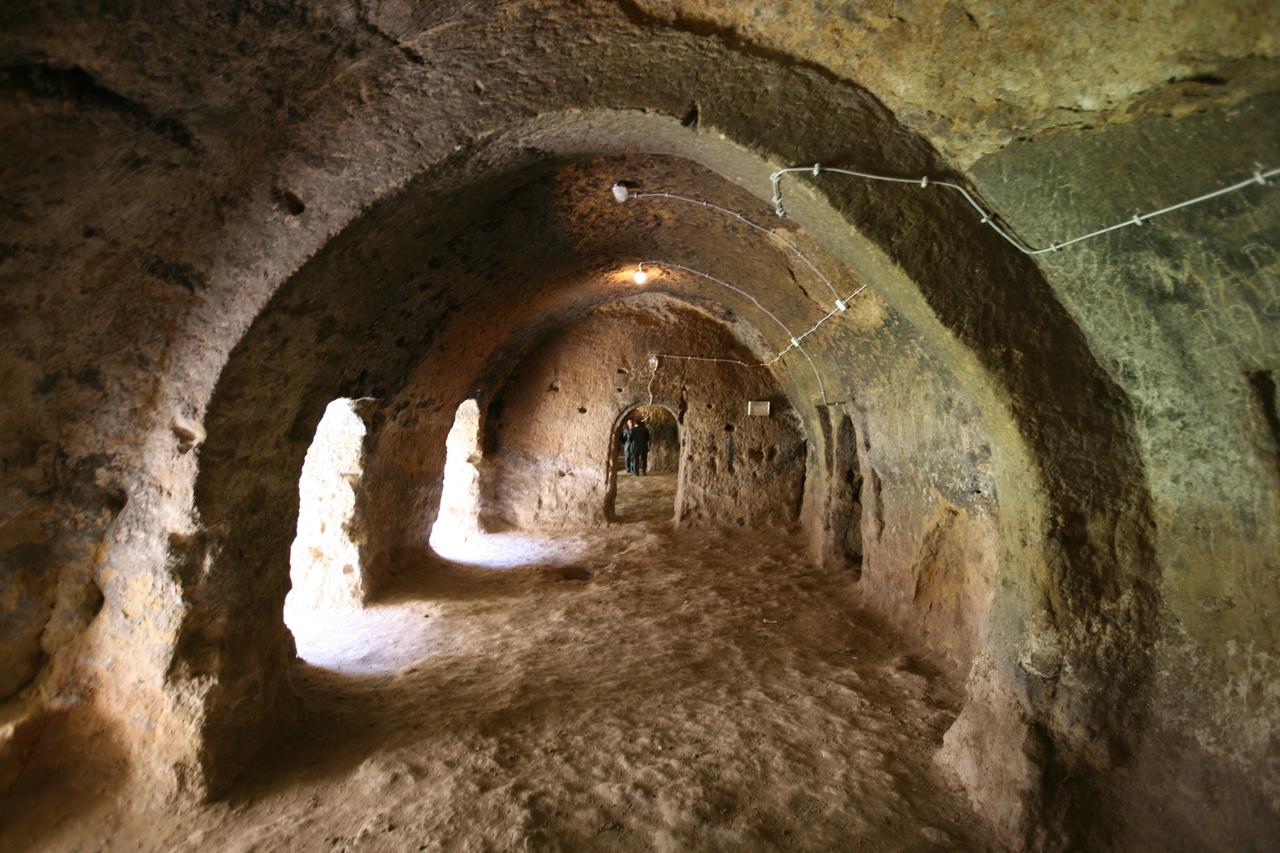
Corridor on the upper level of Dulkadirli Underground City (Ministry of Culture and Tourism of the Republic of Türkiye)
The underground city has been carved into the Arzılar Limestone member of the Eocene-aged Çayraz Formation, which lies atop the Kırşehir Massif composed of Paleozoic metamorphic rocks. This limestone member consists of sandy and silty limestone rich in nummulites, with an average thickness ranging from 5 to 100 meters, and possesses a soft, workable texture.
Dulkadirli Underground City is a two-level structure with a total length of approximately 202 meters. The entrance corridor is 18 meters long, 2 meters wide, and 3 meters high, connecting via small doorways to corridors and rooms on both the upper and lower levels. A central open-air courtyard measuring 15 by 41 meters is located in the middle. The complex contains a total of twenty rooms, fifteen on the upper level and five on the lower level. The rooms and corridors on the lower level are generally filled with soil or water. Two water wells, with depths ranging from 2 to 2.5 meters, are located in the eastern section of the upper level.
After the entrance, a barrel-vaulted tunnel 22 meters long leads to an open-air courtyard measuring 30 by 50 meters and approximately 20 meters high. On the eastern, western, and northern walls of the courtyard, five halls and eight rooms have been carved directly into the rock. Access to the lower level is provided via a fan-shaped staircase descending from Room 5, which also contains a water well. In the gallery section, two stone masses believed to be millstones are present, and at the end of the gallery, a room containing a small millstone within a well and niches carved into the rock is thought to have been a Christian place of worship. Located 130 meters east of the underground city is another settlement with two courtyards.
The structure is believed to have been a rock-cut monastery from the Middle Byzantine period (700–900). This assessment is supported by architectural similarities with the Üçayak Church in nearby Taburoğlu Village and the Hacıfakılı (Akçakent) Ancient City, as well as the Gümüşler Monastery. The region was considered an important religious center during the Byzantine period.
Kırşehir İl Directorate of Culture and Tourism. "Dulkadirli Yeraltı City." T.C.Kültür Turizm Turizm Bakanlığı. Accessed June 16, 2025. https://kirsehir.ktb.gov.tr/TR-195660/dulkadirli-yeralti-sehri.html
Tuncer, Kadir. "Dulkadirli Yeraltı Şehri (Kırşehir)." *Türkiye Turizm Ansiklopedisi*. Accessed June 16, 2025. https://turkiyeturizmansiklopedisi.com/dulkadirli-yeralti-sehri-kirsehir
Türkiye Kültür Portalı. "Dulkadirli Yer Altı Şehri - Kırşehir." *T.C. Kültür ve Turizm Bakanlığı.* Accessed June 16, 2025. https://www.kulturportali.gov.tr/turkiye/kirsehir/gezilecekyer/dulkadrl--yer-alti-sehr

Location | Kırşehir Kırşehir-Akçakent road 50 km north | ||||||||
|---|---|---|---|---|---|---|---|---|---|
Period(s) | Middle Byzantine (700-900) | ||||||||
Structure(s) | Two-story 202 m length 20 rooms rock-cut | ||||||||
Function(s) | Rock monastery religious center | ||||||||
Tourism | Open to visitors, protected | ||||||||
No Discussion Added Yet
Start discussion for "Dulkadirli Underground City" article
Geological Structure
Architectural Plan and Structural Features
Historical Period and Function