


This article was automatically translated from the original Turkish version.
+2 More
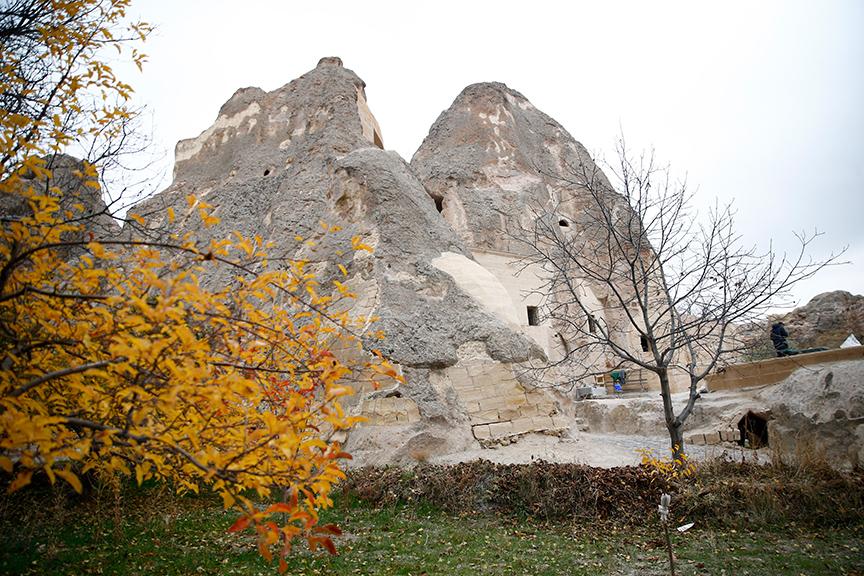
Keşlik Monastery
Location | Near Cemil Village Damsa Dam Area Ürgüp Nevşehir | ||||||||
|---|---|---|---|---|---|---|---|---|---|
History | Monastery Complex from the Early Christian Period (6th–13th centuries) | ||||||||
Architecture(s) | Churches of Archangelos and Hagios Stephanos Monk Cells and Other Common Living Areas Wine Cellar Refectory Ayazma | ||||||||
Visit | Open for Tourism in Summer Months | ||||||||
Keşlik Monastery is located approximately 10 kilometers southeast of the village of Mustafapaşa (formerly Sinasos), in the district of Ürgüp, Nevşehir Province, about two kilometers beyond the village of Cemil (formerly Calela), near the Damsa Dam. The monastery is situated within a rocky area spanning 112,000 hectares that extends toward the Soğanlı Valley.

Keşlik Monastery (Anadolu Agency)
Although definitive information regarding the construction and use of Keşlik Monastery is lacking, assessments based on its architectural features and wall paintings indicate that the structure underwent a prolonged chronological development. The monastery was first documented in the early 20th century by Georges de Jerphanion, who suggested, based particularly on figural decorations in the Church of Hagios Stephanus dating to the Iconoclastic period (8th century), that the site may have origins extending back to the early Byzantine era.
The earliest legal documentation of Keşlik Monastery was issued in 1996 by the General Directorate for the Protection of Cultural and Natural Heritage of the Turkish Ministry of Culture and Tourism, and it was officially approved on 14 March 1997 by the Nevşehir Cultural and Natural Heritage Protection Board under Decision No. 588.

Keşlik Monastery (Anadolu Agency)
The monastery complex comprises two churches (Archangelos and Hagios Stephanus), a chapel, a holy spring, a baptismal pool, cells for monks and priests (lavras), a kitchen, a refectory, a meeting hall, a laundry room, a wine cellar, a textile workshop, a cistern, storage rooms, a fountain, and various utility spaces. All structures were carved directly into the rock, following the natural contours of the formations.
The Church of Archangelos was constructed on a terrace approximately two meters above the main entrance, within a large unified monolithic cone. Beneath the terrace lie a baptistery and the holy spring. The rocky surface to the east of the church was carved to accommodate the refectory and associated rooms. The kitchen is situated within a separate conical formation. Between these two conical structures lies a courtyard without a coherent spatial plan. A third monolithic structure, located approximately 60 meters west of the Church of Archangelos, contains the Church of Hagios Stephanus, a meeting hall, cisterns, utility spaces, and various lavras.
The monastery’s layout reflects a design inspired by Eastern monastic traditions. The dominant position of the main entrance to the Church of Archangelos, the adjacency of the church and the refectory—both regarded as sacred spaces—and the external placement of the kitchen support this planning scheme.

Keşlik Monastery (Anadolu Agency)
Anadolu Ajansı. “Dede Mirası 1700 Yıllık Manastırda Turizm Elçiliği Yapıyor.” Accessed June 14, 2025. https://www.aa.com.tr/tr/kultur/dede-mirasi-1700-yillik-manastirda-turizm-elciligi-yapiyor/2749743.
Anadolu Ajansı. “Keşlik Manastırı FPV Dron ile Görüntülendi.” Accessed June 14, 2025. https://www.aa.com.tr/tr/yasam/keslik-manastiri-fpv-dron-ile-goruntulendi/2775281.
Soybaş, Nazife. *Ürgüp Keşlik Manastırı Belgeleme Çalışmaları ve Koruma Önerileri*. Master's thesis,Erciyes Üniversitesi Institute of Science, 2021. Accessed June 14, 2025. https://tez.yok.gov.tr/UlusalTezMerkezi/tezDetay.jsp?id=e1Fy_92UPYC_QHUfhSJmHA&no=CT3jKzI8FtjsKzGoc4fAiw.
Ürgüp Municipality. "Keşlik Manastırı – Mimari Özellikler." *Ürgüp Belediyesi Resmî Web Sitesi*. Accessed June 14, 2025. https://urgup.bel.tr/tr/sosyal-tesis/keslik-manastiri.

Keşlik Monastery
Location | Near Cemil Village Damsa Dam Area Ürgüp Nevşehir | ||||||||
|---|---|---|---|---|---|---|---|---|---|
History | Monastery Complex from the Early Christian Period (6th–13th centuries) | ||||||||
Architecture(s) | Churches of Archangelos and Hagios Stephanos Monk Cells and Other Common Living Areas Wine Cellar Refectory Ayazma | ||||||||
Visit | Open for Tourism in Summer Months | ||||||||
History
Architectural Features