
This article was automatically translated from the original Turkish version.
+2 More
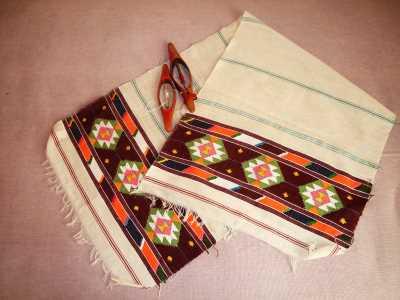
Durağan mahraması is a traditional textile art originating from the Durağan district of Sinop, rooted in a long-standing local hand-weaving tradition. In the past, these fabrics, woven by women in nearly every household, were used as towels or waistbands; however, production has declined over time due to technological advancements and changing living conditions. Today, the craft is being preserved through limited home-based production and courses offered by the Sinop Public Education Center and the Durağan Women’s Empowerment Association. Registered on 3 August 2021 following an application submitted by the Durağan Municipality on 3 December 2018, Durağan mahraması is protected under Geographical Indication within the framework of Law No. 6769 on Industrial Property.
Durağan mahraması is one of the tangible examples of Anatolia’s rich hand-weaving heritage. Within Turkish handicrafts, weaving is among the oldest art forms, serving not only to meet basic human needs but also to express aesthetic aspirations. Historically, mahramas produced widely in homes in Durağan were woven by women both to fulfill daily requirements and to transmit cultural values. However, due to industrial production and economic shifts, this tradition lost its former prominence, and many looms were removed from households. Today, various courses are organized to revive this art, and mahramas are now produced not only with traditional patterns but also with modern designs.
Durağan Mahraması (Culture Portal)
Durağan mahramas are woven on two-shaft shuttle looms known as “düzzen,” combining techniques of plain weave and kilim weaving. The weaving process involves vertically tensioning the warp threads and manually passing the weft threads through them to form patterns. Mahramas are typically woven as single pieces, measuring approximately 40–54 cm in width and 92–152.5 cm in length. The warp uses 20/1 twisted cotton yarn, while the weft is made of cotton or linen; historically, cotton was used for motifs, whereas today acrylic or domino yarn is preferred. Warp density ranges from 12 to 18 threads per centimeter, and weft density from 16 to 25 threads per centimeter.
During weaving, motifs are formed on the reverse side, with yarn ends secured and hidden between the warp threads. At the edges of the mahramas, fringe is created by twisting or leaving the warp threads loose; in some examples, fringe forms naturally during use. Production occurs exclusively within the boundaries of the Durağan district, and the geographical indication ensures the preservation of these traditional methods.
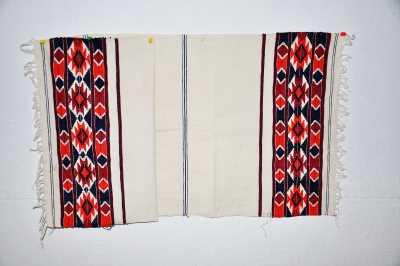
Durağan Mahraması (Culture Portal)
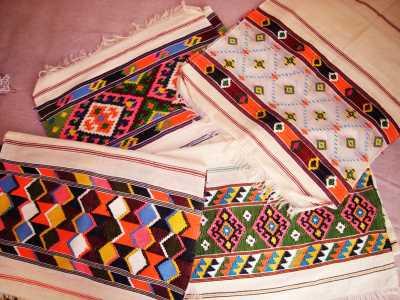
The motifs of Durağan mahramas are predominantly geometric, including shapes such as squares, triangles, hexagons, diamond-shaped “baklava,” and zigzags. These motifs serve both decorative and symbolic purposes; in particular, the “hac” (cross) and “çengelli” (S-shaped) motifs are believed to offer protection against the evil eye.
The composition of mahramas consists of symmetrical patterns arranged on the ground fabric. Designs are placed between narrow borders called “su” along the two short edges. Main motifs are arranged either in continuous or spaced rows, while filler motifs typically consist of triangular or cross shapes. The ground is usually cream-colored, and motifs incorporate colors such as navy blue, red, yellow, green, orange, burgundy, blue, pink, purple, gold, and silver thread. Thin lines created by colored weft threads divide the composition into sections, achieving aesthetic unity. Hexagonal motifs are frequently combined with cross motifs, while S-shaped motifs appear either connected or disconnected within the borders.
Although Durağan mahraması has lost its former widespread popularity, it has re-emerged through efforts to sustain regional culture. Courses offered by the Sinop Public Education Center and the Durağan Women’s Empowerment Association aim to preserve this art and provide economic opportunities for women. In addition to traditional patterns, new designs inspired by kanaviçe embroidery are being produced, expanding the use of mahramas into modern products such as cushions, curtains, and garments. The geographical indication safeguards the uniqueness and regional value of Durağan mahraması, contributing to its sustainable continuation.
Bakır, Gamze, and Hülya Serpil Ortaç. “Sinop İli Durağan İlçesi Mahrama Dokumalarının Motif ve Kompozisyon Özellikleri.” *Motif Akademi Halkbilimi Dergisi* 12, no. 27 (September 20, 2019): 716–733. Accessed July 13, 2025. https://dergipark.org.tr/tr/pub/mahder/issue/48776/579768.
T.C. Ministry of Culture and Tourism. "Mahrama." *Kültür Portalı*. Accessed July 13, 2025. https://kulturportali.gov.tr/turkiye/sinop/nealinir/mahrama.
Turk Patent and Trademark Office. "Durağan Mahraması – Coğrafi İşaret Detayı." Accessed July 13, 2025. https://ci.turkpatent.gov.tr/cografi-isaretler/detay/38662.

History and Cultural Significance
Production Process and Technical Features
Patterns and Composition Characteristics
Current Status