

This article was automatically translated from the original Turkish version.
Height(s) | 1.8–2 m | ||||||||
|---|---|---|---|---|---|---|---|---|---|
Weight(s) | 70–85 kg | ||||||||
Color | Top dark gray-blue black, bottom white, sides gray | ||||||||
Habitat | Southern Hemisphere Kerguelen Island southern Australia South Africa South America New Zealand coastal and open ocean waters | ||||||||
Conservation Status | Least Concern (IUCN) | ||||||||
Common dolphin, scientifically known as Lagenorhynchus obscurus, is a species of marine mammal. It is distributed in the Southern Hemisphere and can be observed along the coasts of South America, South Africa, the Kerguelen Islands, southern Australia, and New Zealand. It typically inhabits coastal areas of warm and cool temperate waters but may occasionally be found in pelagic (open ocean) regions.
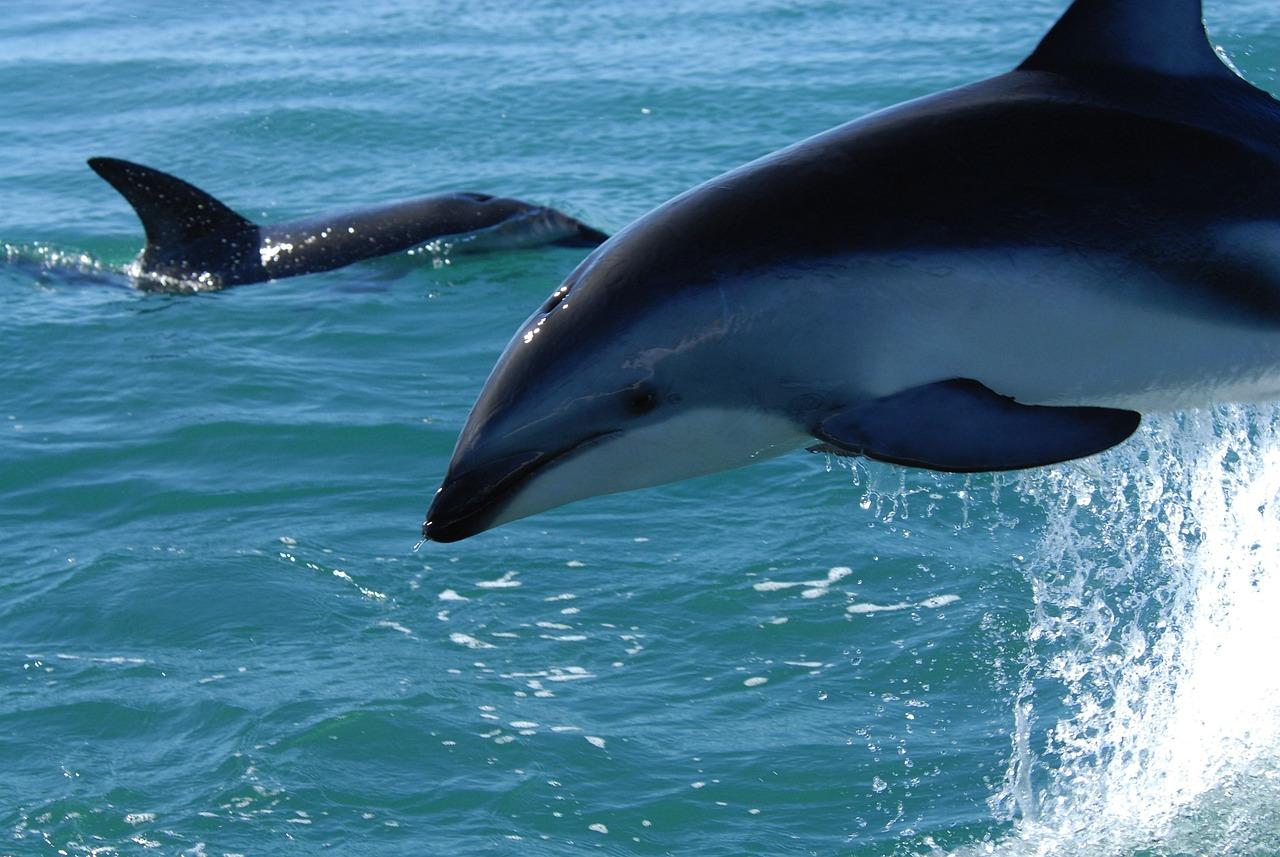
The common dolphin is a medium-sized dolphin, measuring between 1.8 and 2 meters in length and weighing 70 to 85 kilograms. Its body is characterized by distinct coloration: the back ranges from dark gray to bluish-black, the belly is white, and the sides are shades of gray. The head has a uniform slope from the blowhole to the tip of the snout and lacks a distinct beak. The dorsal fin is long, curved, and pointed; the flukes are also sharply pointed. Each jaw contains 24 to 36 pairs of small, sharp teeth.

Common dolphin (pixabay)
Common dolphins are highly social animals. They typically live in groups of 20 to 500 individuals and sometimes form larger aggregations of 1000 to 2000 animals. Within their social structure, they cooperate while feeding and exhibit acrobatic behaviors such as high leaps, somersaults, and spins, which are characteristic of this species. They have been observed showing interest in humans and boats and have been reported to protect other dolphins in distress and, in some cases, even humans.
Common dolphins feed on schooling fish such as anchovies, mackerel, and sardines, as well as cephalopods like squid. During feeding, they coordinate in groups to herd schools of fish. Their dives can reach depths of up to 150 meters, and they forage both at the surface and in mid-water layers.
Mating typically occurs in spring, and females can become pregnant between the ages of 4.3 and 6.3 years. Gestation lasts approximately 11 to 12.9 months, and one calf is born per pregnancy. Calves are nursed for about one year, and females rest for 3 to 4 months before becoming pregnant again. Precise information on sexual maturity, lifespan, and population size remains limited; the estimated lifespan is approximately 21 years.
The International Union for Conservation of Nature (IUCN) classifies the species as “Least Concern.” Major threats include entanglement in pelagic fishing gear, lost or discarded nets, illegal dolphin hunting, and marine pollution. Illegal fishing in certain regions of Peru and Chile has historically caused significant population declines.
Common dolphins are a popular attraction for tourists, particularly along the coast of Kaikoura in New Zealand, where dolphin-watching tours are abundant. Although their fresh meat is occasionally sold in some markets, this practice can impose additional pressure on the species.
Dolphin Research Australia. “Dolphin & Whale Species Fact Files.” dolphinresearchaustralia.org. Accessed August 16, 2025.
Pixabay. "Gölgeli Yunus JPG." Accessed August 16, 2025. https://pixabay.com/tr/photos/g%C3%B6lgeli-yunus-yunuslar-deniz-79849/
Pixabay. "Yunus, Deniz memelisi, Hayvan görseli JPG." Pixabay. Accessed August 16, 2025. https://pixabay.com/tr/photos/yunus-deniz-memelisi-hayvan-deniz-1818853/
Whale & Dolphin Conservation. "Dusky Dolphin." WDC. Accessed August 16, 2025. https://us.whales.org/whales-dolphins/species-guide/dusky-dolphin/
Yu, Helen. “Lagenorhynchus obscurus.” *Animal Diversity Web.* Accessed August 16, 2025. https://animaldiversity.org/accounts/Lagenorhynchus_obscurus/

Height(s) | 1.8–2 m | ||||||||
|---|---|---|---|---|---|---|---|---|---|
Weight(s) | 70–85 kg | ||||||||
Color | Top dark gray-blue black, bottom white, sides gray | ||||||||
Habitat | Southern Hemisphere Kerguelen Island southern Australia South Africa South America New Zealand coastal and open ocean waters | ||||||||
Conservation Status | Least Concern (IUCN) | ||||||||
No Discussion Added Yet
Start discussion for "Dusky Dolphin (Lagenorhynchus obscurus)" article
Physical Characteristics
Behavior and Social Structure
Diet
Reproduction and Life Cycle
Conservation Status and Threats
Human Interactions