


This article was automatically translated from the original Turkish version.
An earthquake isolator is a passive structural control element placed between a building’s foundation and superstructure with the aim of reducing the horizontal acceleration the structure experiences during an earthquake. It seeks to prevent damage to both the load-bearing system and non-structural components by reducing the seismic forces transmitted to the building.
The principle of seismic isolation is to increase the building’s natural period and dissipate seismic energy to enhance structural performance. The isolators absorb and dampen seismic waves before they reach the superstructure. As a result:
As stated in the MEGEP module, isolation applications are particularly effective in short-period (rigid) structures. A period extension of typically 2–3 seconds is targeted.

Seismic Earthquake Isolator (Semra Orkan - Anadolu Agency)
Earthquake isolators consist of various components designed to provide flexibility not only in the horizontal direction but also in the vertical direction in some designs:
These components are optimized for both load-bearing capacity and energy absorption.
These isolators are made by bonding rubber and steel layers together, providing flexibility in the horizontal direction and stiffness in the vertical direction. They are commonly preferred due to their low maintenance requirements, long service life, and cost advantages.
In this type of isolator, a lead core embedded within the elastomeric structure provides energy dissipation through plastic deformation. According to sources, these isolators have energy dissipation capacities of 30–40 percent.
These isolators move along a curved surface. Energy is dissipated through the swinging motion. They stand out for their high energy resistance and ability to be reused after seismic events.
These isolators dissipate energy through sliding on low-friction surfaces. They can be designed according to the direction of seismic motion—for example, as unidirectional or bidirectional sliding types.
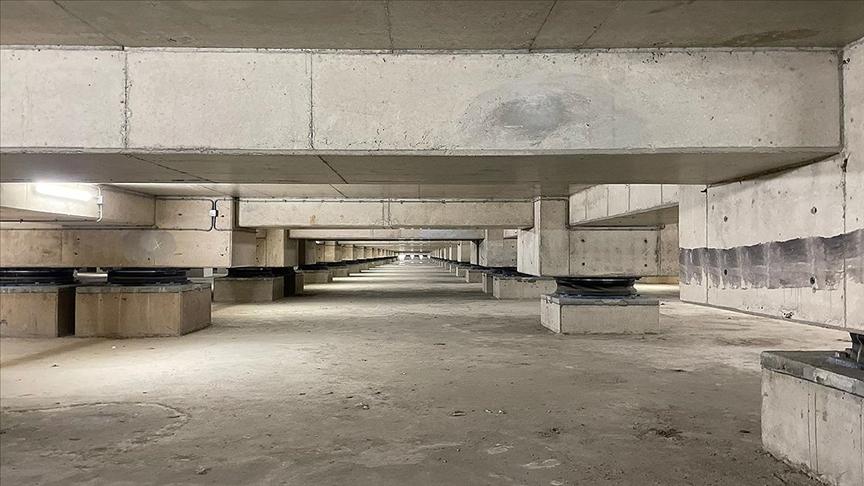
Seismic Earthquake Isolators (Mehmet Kara, Elif Küçük - Anadolu Agency)

Adana City Hospital Earthquake Isolators (Abdullah Doğan - Anadolu Agency)
The MEGEP module published by the Ministry of National Education provides comprehensive educational content covering theoretical knowledge, application principles, and technical drawings related to earthquake isolators. Key topics covered in the training include:
Earthquake isolator systems are a technology that offers high efficiency in minimizing earthquake damage from an engineering perspective and are increasingly common today, especially in hospitals and public buildings. With various types such as elastomeric, lead-core, and friction pendulum isolators, they can be adapted to different building types. Supported by educational modules and technical presentations, these systems are being implemented in Türkiye with growing momentum, both in new constructions and in the seismic strengthening of existing structures.

No Discussion Added Yet
Start discussion for "Earthquake Isolator" article
Basic Principles of Seismic Isolation
Components of Seismic Isolation
Types of Earthquake Isolators
Elastomeric Rubber Isolators
Lead Rubber Bearing Isolators (LBRB)
Friction Pendulum Bearing Isolators
Sliding Bearings
Effects of Seismic Isolation on Structures
Structural Performance
Non-Structural Components
Comfort and Continuity
Application Areas and Examples
Design and Installation Principles
Education and Standards