


This article was automatically translated from the original Turkish version.
Strengthening with Carbon Fiber is a modern structural strengthening method based on wrapping existing reinforced concrete structural elements with carbon fiber-reinforced polymer (CFRP) sheets or fabrics to increase their load-carrying capacity, enhance seismic resistance, and improve overall structural performance. Unlike traditional methods such as concrete jacketing or additional reinforcement, this technique can be applied without disrupting the building’s existing function.
This method is preferred due to its ability to be applied without removing the structure from service, its compatibility with very thin cross-sections, its negligible addition of weight to the load-bearing system, and its resistance to environmental conditions.
Carbon fiber is produced by subjecting polyacrylonitrile (PAN) or pitch-based raw materials to controlled thermal processes that convert them into a carbon structure. The resulting fibers are typically woven into fabric using a plain weave technique. These fabrics are then bonded to concrete surfaces using epoxy-based adhesives.
Epoxy-based adhesives are used to ensure adhesion between carbon fiber and the concrete surface. The epoxies used are typically elastic products that cure within 24 hours at 23 °C, exhibit durability between -40 °C and +80 °C, and possess an elongation at break of 250%.
In a second study, samples wrapped with two layers of CFRP demonstrated an average 25% higher strength and increased ductility (deformation capacity) compared to single-layer applications. This improvement provides a significant advantage in seismic-resistant structural design.
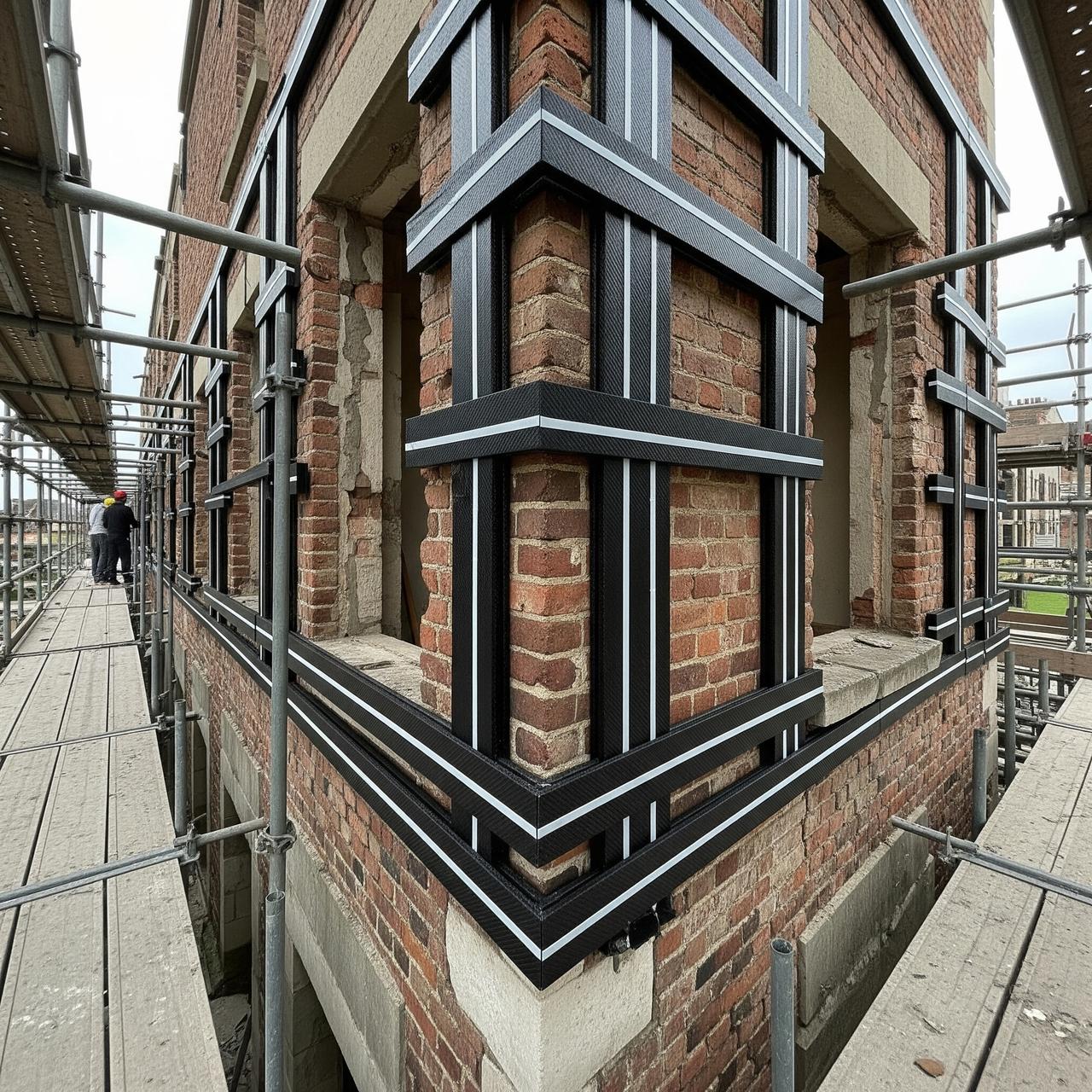
Representative Image of Carbon Fiber Strengthening (Generated by Artificial Intelligence.)
Structural strengthening with carbon fiber offers a more effective, lighter, and less invasive solution compared to traditional methods. Both laboratory experimental data and field application experiences demonstrate that CFRP-wrapped reinforced concrete elements achieve significant improvements in strength, ductility, and energy absorption capacity. The increase in ductility, in particular, positively influences structural behavior during earthquakes, playing a critical role in reducing loss of life and property damage.
Akyıldız, Ayhan, and Ahmet Özcan Ağırgan. "KARBON ELYAF KUMAŞ İLE SARGILANMIŞ BETONLARIN DAYANIMININ İNCELENMESİ." *Ejovoc Electronic Journal of Vocational Colleges* 6, no. 3 (2016): 99–107. Accessed June 19, 2025. https://dergipark.org.tr/tr/download/article-file/460624
Çelik, Karan, Veysel, and Halim Karaşin. “Karbon Elyaf ile Betonun Güçlendirilmesi.” *Dicle Üniversitesi Mühendislik Fakültesi Dergisi* 5, no. 1 (2014): 1–12. Accessed June 19, 2025. https://dergipark.org.tr/tr/download/article-file/302729

No Discussion Added Yet
Start discussion for "Strengthening with Carbon Fiber" article
Material Technology and Structural Components
Carbon Fiber
Technical Properties
Epoxy Adhesive
Application Stages
Experimental Findings and Performance Improvement
Sample Types and Classification
Experimental Results
Multi-Layer Wrapping
Advantages and Disadvantages
Advantages
Disadvantages
Applications