


This article was automatically translated from the original Turkish version.
Seismic isolation (earthquake isolation) is an engineering solution that aims to reduce the seismic energy transferred to a structure by placing specialized systems between the foundation and the superstructure, thereby protecting buildings from the destructive effects of earthquakes. The primary objective of this system is to increase the natural vibration period of the structure, preventing it from entering resonance with the dominant period of the ground. As a result, the structure experiences lower accelerations during an earthquake, and the impact of shaking is diminished.
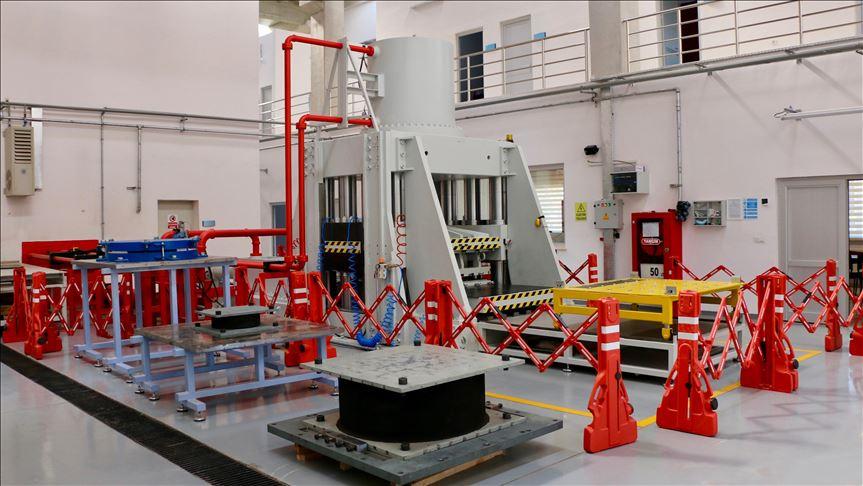
Seismic Isolator. (AA)
During an earthquake, the ground typically generates sudden horizontal movements. In conventional structures, these movements are directly transmitted to the building, subjecting the load-bearing system to high levels of acceleration and displacement. In a seismically isolated structure, however, these horizontal movements are absorbed by the isolator layer. Isolators are designed to be flexible in the horizontal direction and rigid in the vertical direction. This design ensures that:
The first conceptual foundations of seismic isolation were laid by John Milne in 1876. Milne worked on systems that placed steel balls beneath buildings to absorb vibrations. From the 1980s onward, lead-rubber isolators developed in New Zealand enabled the industrial application of this technology. The first large-scale application in Türkiye was the modernization of the Atatürk Airport International Terminal.
Seismic isolation systems are generally classified into two main categories:
These isolators, based on rubber, typically consist of natural rubber and steel plates. Some types include a lead core that provides damping. Subtypes include:
In these systems, a controlled sliding surface is created between the structure and the foundation, dissipating seismic energy through friction. The most well-known type is the Friction Pendulum System (FPS). The FPS system is an effective solution due to its high energy absorption capacity and ability to return to center.
For isolators to function effectively, they must possess specific technical properties. The foremost requirement is high vertical stiffness to safely support the weight of the superstructure. Equally important is low horizontal stiffness, which enables the dissipation of energy generated during an earthquake. Isolators must also have high energy absorption capacity to enhance the building’s resistance to seismic forces. Additionally, the ability to return to its original position after an earthquake—known as recentering—is of great importance. The capacity to maintain stability after an earthquake and resistance to long-term deformations are also essential technical characteristics for ensuring the safe and long-term functionality of isolators.
Seismic isolation systems are primarily used in the following types of structures:

Seismic Isolator Application, Adana City Hospital. (AA)
Although early applications in Türkiye were limited, the importance of seismic isolation has been increasingly recognized in recent years, leading to its adoption in public investment projects, particularly hospital constructions. Many city hospitals in Istanbul have been built using seismic isolation technology. The goal is to protect buildings not only for life safety but also to ensure operational continuity and prevent economic losses.
As in developed countries, seismic isolation is beginning to be more widely incorporated into Türkiye’s building codes. Given the growing recognition of the importance of structures that remain standing and functional after an earthquake, it is expected to achieve broader application in the future.
Anadolu Ajansı. “Adana Şehir Hastanesini 1512 Sismik İzolatör Depremin Yıkıcı Etkisinden Korudu.” Anadolu Ajansı, March 8, 2023. https://www.aa.com.tr/tr/asrin-felaketi/adana-sehir-hastanesini-1512-sismik-izolator-depremin-yikici-etkisinden-korudu/2818803.
Anadolu Ajansı. “Depremin Zararını Azaltmak İçin Yurt Dışına da Test Yapıyorlar.” Anadolu Ajansı, September 5, 2019. https://www.aa.com.tr/tr/turkiye/depremin-zararini-azaltmak-icin-yurt-disina-da-test-yapiyorlar/1604427.
Aydın, Tunahan. *Sismik İzolasyon*. Sakarya Üniversitesi Fen Bilimleri Enstitüsü, 2023.
Millî Eğitim Bakanlığı. Deprem İzolatör Sistemleri Modülü. Ankara: MEB Yayınları, 2011.
TÜBİTAK Bilim Genç. “Sismik İzolatör Depremde Binaların Yıkılmasını Nasıl Engelliyor?” Accessed May 8, 2025. https://bilimgenc.tubitak.gov.tr/makale/sismik-izolator-depremde-binalarin-yikilmasini-nasil-engelliyor
Özdemir, Nur Banu, Akçer, Gonca, and Soyluk, Asena. “Günümüz Mimarisinde Sismik İzolasyon Teknolojisi.” *3. Türkiye Deprem Mühendisliği ve Sismoloji Konferansı*, 14–16 October 2015, DEÜ – İzmir. https://www.tdmd.org.tr/pdf/pdf2015/TDMSK_232.pdf
Özpalanlar, Cemal Gürol. Depreme Dayanıklı Yapı Tasarımında Sismik İzolasyon ve Enerji Sönümleyici Sistemler. İstanbul Teknik Üniversitesi, 2004.

Working Mechanism
History
Types of Isolators
1. Elastomeric Isolators
2. Frictional (Sliding) Isolators
Technical Characteristics of Seismic Isolation
Applications
Advantages
Applications in Türkiye and Future Projections