


This article was automatically translated from the original Turkish version.
Ebru is an art form created by transferring colors, which float and blend together on the surface of a thickened liquid prepared with kitre, in such a way that the pigments remain on the surface. In this unique art, masters have demonstrated great skill not only in producing patterns such as waves, ripples, and veins on paper but also in creating ornamental designs, flowers like carnations and tulips.

Beginning the Art of Ebru. (Ministry of Culture and Tourism of the Republic of Türkiye)

A carnation created using Ebru. (Ministry of Culture and Tourism of the Republic of Türkiye)
When examining the origins of Ebru, the term derives from the Persian word “ebr,” meaning “cloud,” to which the suffix “-î” was added, resulting in “ebrî,” signifying “cloud-like.” Over time, this evolved into the form “Ebru.”

Example of Cloud-like Ebru. (Photo: Çiğdem Alparslan)
In Turkish art history, Ebru holds a special place. Thanks to the dedication of artists working in traditional arts to preserve the permanence of their works, Ebru has also contributed to the advancement of knowledge and science in art.
Although the exact historical origins of Ebru are not fully known, it reached its peak between the years 1600 and 1700. European demand for what they called “Turkish paper,” “Turkish marble paper,” and “the Turkish art of marbling paper” led to the widespread export of Ebru examples to Europe during this period, significantly contributing to its development.

Example of Ebru. (Photo: Çiğdem Alparslan)
Ebru art possesses distinctive materials and techniques. All materials and tools used in Ebru are prepared by the artist themselves. The pigments are entirely obtained from nature through natural methods. The kitre, a plant-based primary material, thickens the water and imparts a viscous, adhesive consistency. This sizing agent is derived from the stems of the geven plant, which grows in Anatolia. The natural acid that enables the pigments to spread on the kitre surface is bile, extracted from the gallbladder of animals. Thus, patterns created using naturally prepared pigments on the thickened water surface are transferred onto paper.
Over time, Ebru art has undergone significant changes. For instance, bile water, once used to prevent colors from mixing, has been replaced by synthetic chemical liquids. Both the pigments and application techniques, as well as the chemical substances now employed, have strengthened the connection between Ebru art and chemistry within the context of traditional arts.
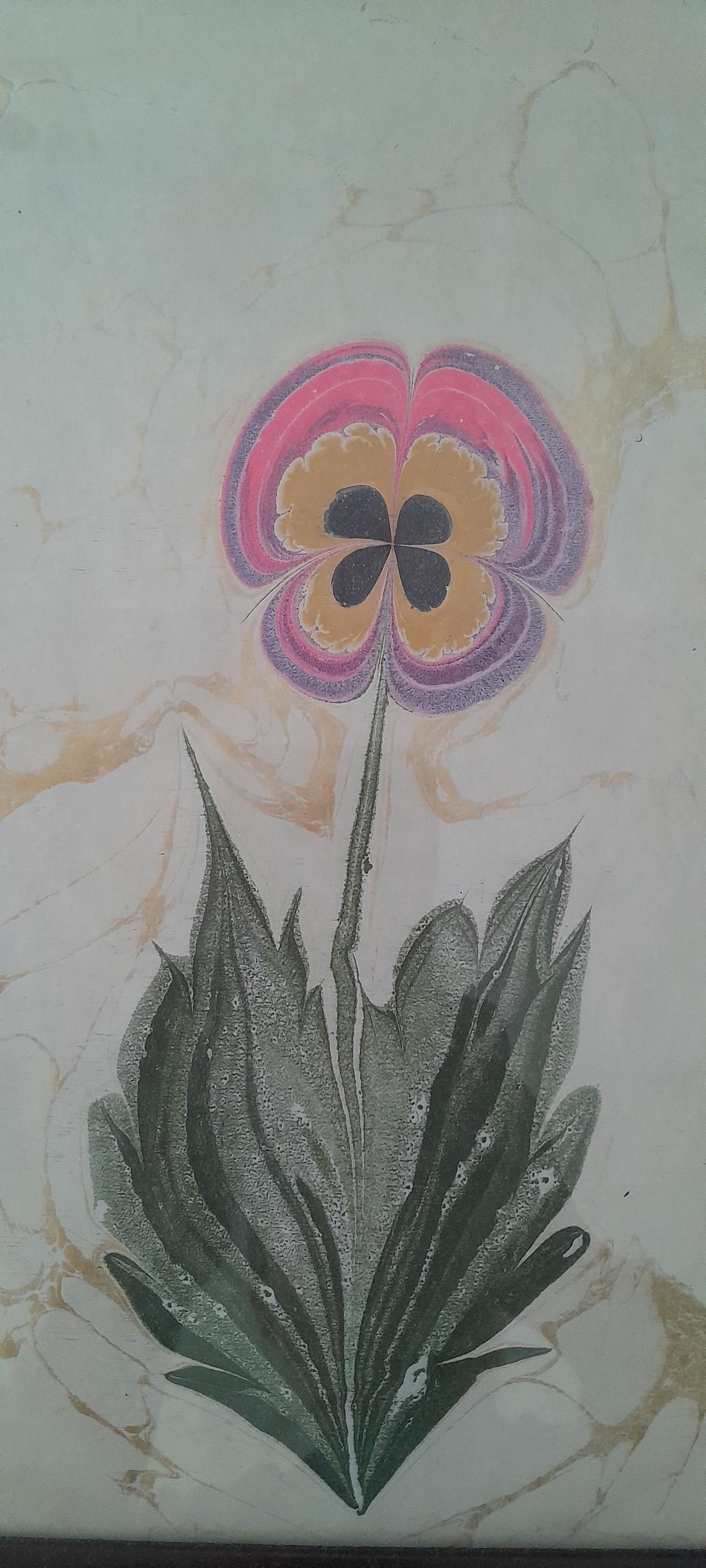
Ebru example made with chemical liquids. (Photo: Çiğdem Alparslan)
Ebru artists, guided by the master-apprentice tradition, transmit specialized knowledge and experience from generation to generation. Their unique expertise in producing materials and tools and in applying the technique plays a vital role in preserving and advancing Ebru.

Tulip example in Ebru art. (Photo: Çiğdem Alparslan)
Rich in Turkish and Islamic historical significance and closely linked to illumination and calligraphy, Ebru art holds an important place historically. For this reason, courses are now organized specifically to teach Ebru and pass it on to new generations, ensuring that both Turkish heritage and the art formed by the dance of colors in water are transmitted across generations.

Ebru Course Exhibition, 2024. (Photo: Çiğdem Alparslan)
Ebru, the Turkish art of paper decoration, was inscribed in 2014 on UNESCO’s Representative List of the Intangible Cultural Heritage of Humanity under Türkiye’s nomination, becoming a source of pride among our traditional arts.
Culture Portal. "Ebru Sanatı." Accessed August 19, 2025.
Kubbealtı Lügatı. “Ebrû.” Accessed August 19, 2025.
Ministry of Culture and Tourism of the Republic of Türkiye. "Ebru: Türk Kağıt Süsleme Sanatı." Accessed August 19, 2025.
Tübitak. “Sanat ve Kimya Bir Arada: Ebru.” Accessed August 19, 2025.
