
+1 More

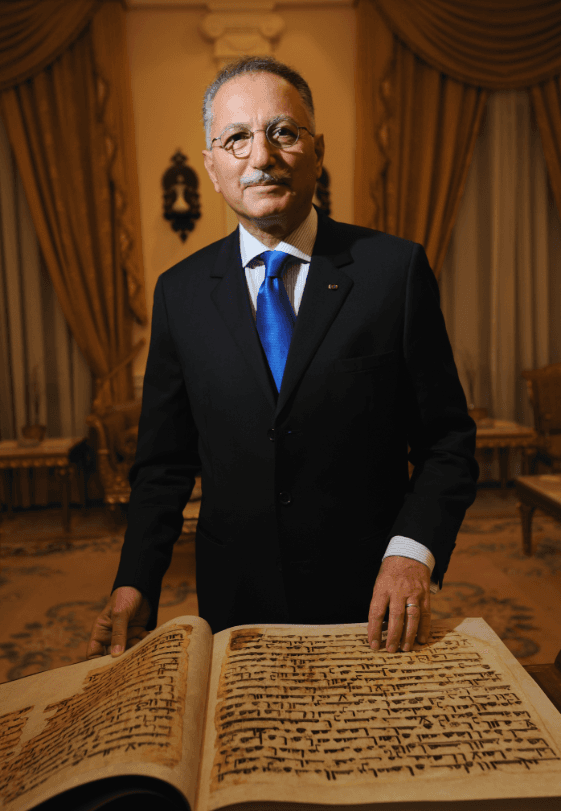
Doğum tarihi | 1943-12-26 | ||||||||
|---|---|---|---|---|---|---|---|---|---|
Babası | Mehmed İhsan Efendi | ||||||||
Annesi | Seniye Hanım | ||||||||
Eş (ler) | Nazife Füsun İhsanoğlu | ||||||||
Çocuk (lar) | Mehmed Orhan İhsanoğlu Emin Aziz İhsanoğlu Osman Tuğrul İhsanoğlu | ||||||||
Place of Birth(Text) | Cairo, Egypt | ||||||||
Ekmeleddin İhsanoğlu was born in Cairo on 26 December 1943 to Turkish parents. Having been exposed at an early age to diverse linguistic and culture environments, İhsanoğlu developed a deep interest in Turkish culture and Ottoman literature under the guidance of his family. Under his father’s mentorship, he learned Ottoman Turkish and gained an understanding of Turkish and the nuances of Ottoman culture within a house environment. Throughout his education, he studied Arabic, English and French, and had the opportunity to read the leading works of Turkish and Arab literature at an early age.
Because his father was not an Egyptian citizen, the family did not receive a pension after his death, and thus İhsanoğlu was compelled to contribute to the family’s livelihood at a young age. During his schooling, with the help of University friends, he began working part-time in the Cataloguing of father Works section at the Cairo National Library. There, for four years, he was responsible for cataloguing Ottoman Turkish manuscripts and printed works, while simultaneously taking Persian lessons from Nasrullah Mübeşşir el-Tırazi, a Turkistani scholar, to expand his linguistic knowledge. During this period, he worked directly with Arabic and Turkish manuscripts and gained the opportunity to study the Islamic and Ottoman scientific heritage.
This four-year duration period became one of the phases İhsanoğlu regarded as a second phase of education in the fields of scientific history and Islamic culture. At the same time, he expanded his intellectual circle by meeting prominent scientists from the east and west worlds. During these years, he focused intensely on the history of science and literature, publishing his first articles on Mehmet Akif Ersoy and Muhammad Iqbal in 1964, and in 1969 translating a play by Nazım Hikmet into Arabic and publishing it in Cairo. While still a university student, he won a prize for his research on the Andalusian surgeon Abu’l-November al-Zahrawi, thereby completing his first academic work in the history of science.
İhsanoğlu completed his undergraduate education in Physics and Chemistry at the Faculty of Science, Ain Shams University, in 1966. In 1970, he earned a master’s degree in organic chemistry at Al-Azhar University, deepening his studies in the history of science and the Ottoman scientific heritage during this period.
In 1970, he came to Türkiye and served as an assistant at the Faculty of Science, Ankara University. He completed his doctorate in chemistry in 1974, and then continued his research at the University of Exeter (United Kingdom) between 1975 and 1977, broadening his academic horizons. While serving as a Research Fellow at the University of Exeter, he gained extensive experience in Western scientific thought and methodology.
In 1980, he was appointed as Director General of the Research Centre for Islamic History, Art and Culture (IRCICA), established in Istanbul under the Organisation of the Islamic Conference, and oversaw the institution’s consolidation. This process marked a pivotal turning point in his commitment to the discipline of the history of science.
Under the auspices of IRCICA, he ensured the publication of important works under the series title “Sources and Studies in the History of Science,” and edited foundational works such as the “Catalogue of Islamic Medical Manuscripts in Turkish Libraries.” The project he initiated in 1985, titled “History of Ottoman Scientific Literature,” was among the first comprehensive efforts to systematically examine scientific production during the Ottoman period. He also organized international academic conferences on the history of science, thereby promoting global interest in the field.
In 1984 he founded the Department of History of Science at the Faculty of Letters, Istanbul University, establishing the history of science as an academic discipline in Türkiye. In 1989, he also founded the Turkish Society for the History of Science (TBTK), creating an academic platform for historians of science. In 1999, he assumed the founding presidency of the İSAR Foundation.
İhsanoğlu also held prominent international academic roles: from 1998 to 2001 he served as Vice President of the International Union of History and Philosophy of Science (IUHPS), and from 2001 to 2005 as its President. He served as a member of advisory boards for numerous international academic institutions and science centers, and contributed to editorial boards of academic journals in various Western and Islamic countries.
İhsanoğlu’s work made a major contribution to the reassessment of the Ottoman scientific heritage, demonstrating that the Ottoman scientific world offered a distinct scientific production model beyond Western-centric narratives of the history of science.
He has authored numerous works on science, the history of science, Turkish culture, Ottoman history, Islam and the Western world, Islamophobia, and Turkish-Arab relations. His major publications include “Darülfünun” (two volumes) and “Turks in Egypt and Their Cultural Heritage.” Among the works he edited are “History of the Ottoman State and Civilization” (two volumes), “History of Ottoman Scientific Literature Series” (eighteen volumes), and “The Different Aspects of Islamic Culture Volume Five: Culture and Learning in Islam,” published by UNESCO. His book “Islamophobia: From Confrontation to Cooperation, the Way Ahead” is regarded as one of the principal reference works in this field.
For his research on the history of science and Islamic culture, he has received numerous national and international awards. In 1990, he was awarded the First Class Order of Merit by the Arab Republic of Egypt, and in 1994, he received the honorary title of Doctor Honoris Causa from Architect Sinan University. He has also been honored by the Turkish Petroleum Foundation for his contributions to science and culture.
Ekmeleddin İhsanoğlu has become one of the pioneering figures in the history of science due to his contributions and the systematic approach he brought to Ottoman scientific studies. He is fluent in Turkish, English and Arabic, and possesses a strong command of French and Persian. His works have been translated into Russian, Bosnian, Albanian, French, Japanese, Malay and Korean, reaching a wide academic audience.
"Prof. İhsanoğlu TÜBA Üyesi Seçildi," *Türkiye Bilimler Akademisi (TÜBA)*, Accessed February 10, 2025. https://tuba.gov.tr/tr/haberler/akademiden-haberler/prof.-ihsanoglu-tuba-uyesi-secildi.
Ekmeleddin İhsanoğlu Official Website. Accessed February 10, 2025. http://www.ihsanoglu.org
Günergün, Feza. "Ekmeleddin İhsanoğlu: Biyografisi, Bilim Tarihi Ile Ilgili Çalışmaları Ve Yayınları." Osmanli Bilimi Arastirmalari (Studies in Ottoman Science), no. 1 (December 1995): 19-45.

Doğum tarihi | 1943-12-26 | ||||||||
|---|---|---|---|---|---|---|---|---|---|
Babası | Mehmed İhsan Efendi | ||||||||
Annesi | Seniye Hanım | ||||||||
Eş (ler) | Nazife Füsun İhsanoğlu | ||||||||
Çocuk (lar) | Mehmed Orhan İhsanoğlu Emin Aziz İhsanoğlu Osman Tuğrul İhsanoğlu | ||||||||
Place of Birth(Text) | Cairo, Egypt | ||||||||
No Discussion Added Yet
Start discussion for "Ekmeleddin İhsanoğlu" article
Early Life
Academic Education and Early Works
History of Science Research and the Foundation of IRCICA
Establishment of the Department of History of Science and Academic Contributions
International Research in the History of Science and Its Impact
Awards and Honorary Titles
Academic Legacy and Impact
Major Works
Books