


This article was automatically translated from the original Turkish version.
El Niño and La Niña are climate phenomena caused by deviations in sea surface temperatures in the Pacific Ocean, resulting in global-scale climatic effects. El Niño refers to the period when sea surface temperatures in the central and eastern Pacific are higher than normal, while La Niña describes the period when sea surface temperatures in the same region fall below normal.
During an El Niño event, the rise in sea surface temperatures alters atmospheric circulation systems, causing anomalies in temperature, precipitation, and wind patterns worldwide. This can lead to extreme droughts in some regions and intense rainfall and storms in others. La Niña, as the opposite of El Niño, results from a drop in sea surface temperatures, causing atmospheric patterns to deviate in the opposite direction. These two opposing phenomena drive global climatic fluctuations and regional weather events.
The development and duration of El Niño and La Niña events typically range from several months to several years. These events arise from the interaction between anomalies in Pacific Ocean surface temperatures and tropical wind systems. Temperature changes affect ocean currents, wind directions, and atmospheric pressure patterns, thereby transforming global weather systems.
The impacts of these climate phenomena directly affect numerous sectors including agriculture, water resource management, fisheries, and disaster planning. In particular, advance prediction of El Niño and La Niña in areas such as agriculture and water management can help reduce potential damages. For this reason, meteorologists continuously monitor these events using advanced monitoring and forecasting models based on data collected from satellites, buoys, and ground stations.

El Niño and La Niña Representation (Generated by Artificial Intelligence)
El Niño typically begins with a weakening of the trade winds that normally blow from west to east across the tropical Pacific Ocean. Under normal conditions, these winds push warm surface waters toward the west, causing cold water to rise (upwelling) in the eastern Pacific. However, when the winds weaken, warm water shifts eastward and upwelling decreases, leading to an abnormal increase in sea surface temperatures in the eastern Pacific.
This temperature increase alters atmospheric pressure systems. For example, atmospheric pressure drops along the western coast of South America while it rises over Australia and Indonesia. This shift in pressure gradient weakens the Walker circulation, a large-scale atmospheric flow. As a result, regions such as Australia and Indonesia experience drought, while coastal areas of South America face excessive rainfall and flooding.
El Niño events usually last several months, but their effects can persist much longer. They cause significant losses in nature-dependent sectors such as agriculture, fisheries, and energy production. The collapse of fish populations off the coast of Peru, reduced agricultural yields, and declining water reserves are direct consequences of this process.
El Niño also contributes to an increase in global average temperatures. While many regions worldwide become warmer and drier, some areas experience abnormal snowfall and storms. Therefore, El Niño is recognized not only as a local phenomenon but as a global climatic threat.
La Niña is defined as the exact opposite of El Niño and occurs when sea surface temperatures in the eastern tropical Pacific fall below average. During this phase, trade winds strengthen, pushing warm surface waters further west and enhancing upwelling in the eastern Pacific. This alters ocean-current balances.
During La Niña, Southeast Asia and Australia experience increased rainfall, while the western coast of South America faces drought. The southern United States tends to become drier and warmer, while the north becomes cooler and more humid. These changes directly affect numerous areas from agricultural production to energy consumption.
The impacts of La Niña are not limited to the Pacific basin. Atlantic Ocean hurricane seasons are also influenced by this cycle. Particularly during La Niña years, stronger and more frequent hurricanes can form in the Atlantic. Thus, La Niña poses a hazard not only in terms of temperature but also as a threat increasing storm risk.
Additionally, La Niña can temporarily reduce global average temperatures. However, this cooling does not reverse the long-term warming trend caused by climate change. La Niña years provide important insights into how the climate system responds alongside greenhouse gas effects.
To monitor these complex natural phenomena, advanced observation systems are employed. The TOGA-TAO buoy network collects real-time data on sea surface temperature, salinity, currents, and winds across the tropical Pacific. This system is critical for providing initial data for forecasting models.
Satellites provide large-scale data on sea surface temperature and cloud structure. In addition, ARGO floats collect data from deeper ocean layers, enabling a more three-dimensional monitoring system. These data are processed using dynamic atmosphere-ocean models to generate ENSO forecasts.
One of the most widely used models is CFSv2 (Climate Forecast System version 2). This model simulates the coupled atmosphere and ocean systems to produce ENSO predictions. Models typically provide warnings 6 to 9 months in advance, although their reliability varies depending on seasonal variability.
Scientists note that predictions are particularly challenging during transition periods, such as shifts from El Niño to La Niña. Therefore, continuous improvement of models and updating of observational infrastructure are essential.
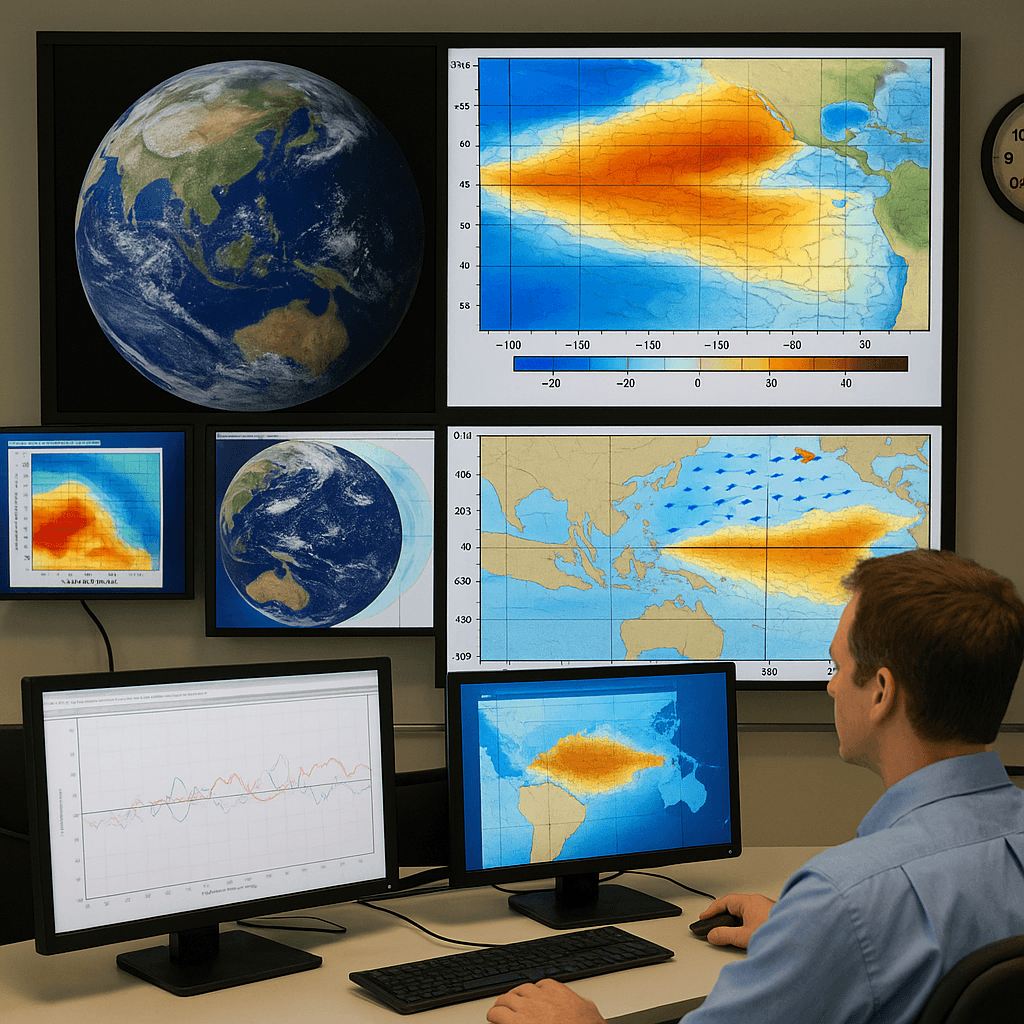
Representation of Monitoring and Modeling (Generated by Artificial Intelligence)
Throughout history, El Niño and La Niña have triggered numerous major climatic events. For instance, the 1997–1998 El Niño event is considered the strongest El Niño of the century. During this period, thousands of people died worldwide and billions of dollars in economic losses were incurred. Extreme flooding in Peru and Ecuador, along with massive wildfires in Indonesia and Australia, were among its consequences.
The 2010–2011 La Niña caused devastating floods in Australia and landslides in Brazil. During the same period, severe droughts affected parts of the United States, leading to significant damage to agricultural production. Such events demonstrate that ENSO has substantial practical impacts beyond theoretical interest.
ENSO events typically occur every 2 to 7 years and vary in intensity. Therefore, analysis of past events is crucial for preparing for future similar occurrences. Historical data guide archival research, model validation, and risk assessment.
It is also known that these events affect global economic markets. For example, a decline in agricultural production due to El Niño can lead to rising food prices, impacting both local populations and global trade balances.
Cane, Mark A. "Understanding and Predicting the World’s Climate System." *Bulletin of the American Meteorological Society* 84, no. 4 (2003): 485–496. https://link.springer.com/chapter/10.1007/978-94-015-9351-9_3.
L'Heureux, Michelle L., et al. "Observing and predicting the 2015/16 El Niño." *Bulletin of the American Meteorological Society* 98, no. 7 (2017): 1363–1382. https://doi.org/10.1175/BAMS-D-16-0009.1
McPhaden, Michael J., Scott E. Zebiak, and Mark H. Glantz. "ENSO as an integrating concept in Earth science." *Science* 314, no. 5806 (2006): 1740–1745. https://doi.org/10.1126/science.1132588
Philander, S. George. *El Niño, La Niña, and the Southern Oscillation*. Academic Press, 1990. https://www.sciencedirect.com/book/9780125532358/el-nino-la-nina-and-the-southern-oscillation
Trenberth, Kevin E. "The Definition of El Niño." *Bulletin of the American Meteorological Society* 78, no. 12 (1997): 2771–2777. https://journals.ametsoc.org/downloadpdf/view/journals/bams/78/12/1520-0477_1997_078_2771_tdoeno_2_0_co_2.pdf.


No Discussion Added Yet
Start discussion for "El Niño and La Niña" article
Formation and Characteristics of El Niño
Mechanism and Impacts of La Niña
Monitoring and Modeling of El Niño and La Niña
Historical ENSO Events