This article was automatically translated from the original Turkish version.
+2 More
Elazığ Cherry Marble
Property | Its exclusive occurrence in Elazığ, along with its original color and durability | ||||||||
|---|---|---|---|---|---|---|---|---|---|
Applications | Architectural cladding, decoration, kitchen countertops, sculpture, and monument construction | ||||||||
Export | Monthly exports of approximately 65 thousand tons | ||||||||
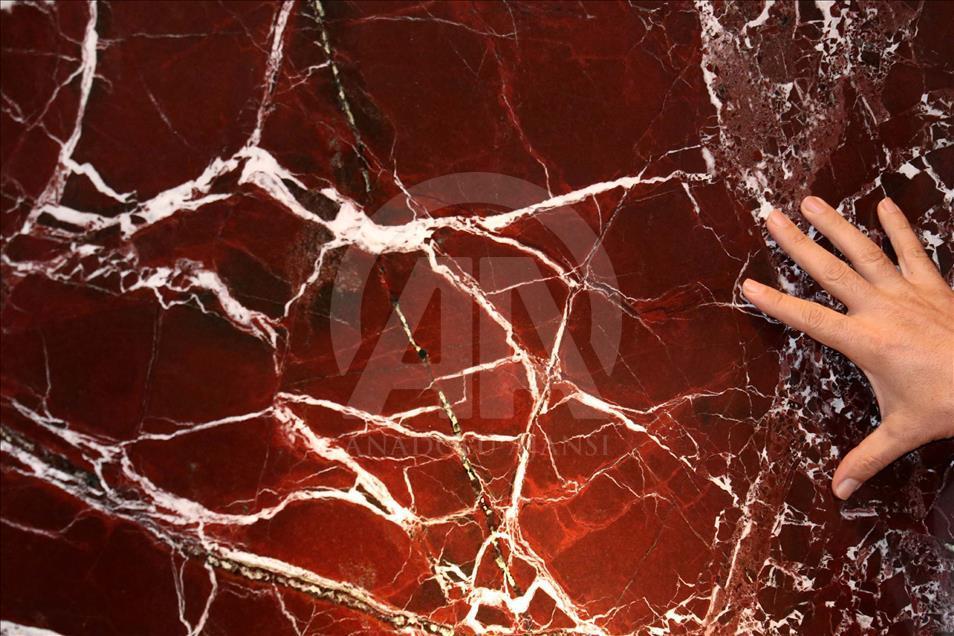
Elazığ Vişne marble is a natural stone type unique to Elazığ Province in Türkiye and is used worldwide. It attracts attention from geological, economic, and industrial perspectives due to its distinctive burgundy color, calcite-veined brecciated structure, and exclusive occurrence in Elazığ. Known internationally as “Rosso Levanto,” this stone has found extensive application in architectural decoration since the last quarter of the 20th century.
Elazığ Vişne marble is extracted primarily around the Alacakaya district (formerly Guleman) of Elazığ Province, especially near the villages of Altıoluk and Kelhasi. This area is geologically situated within the eastern segment of the Taurus Orogenic Belt, between the Bitlis Suture Zone and the Adıyaman Fault Zone. The formation of the marble is attributed to hydrothermal fluids circulating along fracture systems generated by intense tectonic activity in the region. Petrographically classified within the “ophicalcite” group, Elazığ Vişne consists of mineral assemblages containing magnesium, iron, calcium carbonate, and silica.
The characteristic burgundy color of the marble originates from reddish rock fragments derived from the Maden Karması volcanic unit and the presence of iron oxide minerals such as hematite. Black and green tones are associated with fragments originating from the Guleman Ophiolite’s gabbros and serpentinized ultramafic rocks (dunite and harzburgite). Elazığ Vişne exhibits a brecciated structure, with natural cementation primarily provided by calcite and micritic carbonate minerals.
Elazığ Vişne marble has been subjected to various tests in accordance with TS EN and BS EN standards. Its physical and mechanical properties are as follows:
Other properties including water absorption, apparent density, open porosity, flexural strength, freeze-thaw resistance, and fire behavior have also been tested according to national and international norms. Low water absorption under capillary action and under atmospheric pressure indicates low permeability and high durability.

Elazığ Vişne marble adorning interiors in the United States (Anadolu Agency)
Reserve studies conducted in the Kelhasi Village area of Maden District indicate that for Area No. 1, the apparent reserve is 200,000 m³ and the economic reserve is 26,000 m³. In Area No. 2, the apparent reserve is 55,000 m³ and the economic reserve is 27,500 m³. The extraction process involves removing overburden approximately 12.5 meters thick.
Elazığ Vişne was first introduced in 1969 by Mehmet Arslan, and its recognition increased after its use in the interior spaces of İzzet Paşa Camii during the 1970s. Industrial production began in 1984 with the establishment of Alacakaya Mermer A.Ş., and the first export to Italy occurred in the same year. Today, large-scale factories processing this marble operate within the Elazığ Organized Industrial Zone.
Elazığ Vişne marble is currently widely used in architectural and decorative applications. It is preferred for interior and exterior cladding, staircase treads, kitchen and balcony flooring, sculpture, monument construction, and souvenir production.
Distinguished by its unique color and pattern, this marble has been exported to more than 60 countries across four continents. Notable structures where it has been used include:
The monthly export capacity averages around 65,000 tons.
Aksoy, Ercan. “Mermerler İçinde Bir Güzel: Elazığ Vişnesi.” Mavi Gezegen 2019, no. 26. Accessed June 26, 2025. https://www.jmo.org.tr/resimler/ekler/42b8e3c20687f80_ek.pdf
Eser, Ayten, and Esma Kahraman. “Elazığ Vişne Mermerlerinin Kaplama Taşı Olarak Kullanılabilirliğinin Belirlenmesi.” Çukurova Üniversitesi Mühendislik-Mimarlık Fakültesi Dergisi 28, no. 2 (2013): 91–104. Accessed June 26, 2025. https://muhendislik.cu.edu.tr/tr/Dergi/(28_2_2013)/8.pdf
“Elazığ Mermeri Raporu.” Kalkınma Kütüphanesi. Accessed June 26, 2025. https://www.kalkinmakutuphanesi.gov.tr/assets/upload/dosyalar/elazig-mermer-raporu.pdf
“Elazığ’dan Beyaz Saray’a.” Alacakaya Mermer. Accessed June 26, 2025. https://www.alacakaya.com/haberler/bizden-haberler/beyaz-saraya-mermer.html
“Elazığ’s Cherry Marble Has Become a Favorite Product of the Middle East.” Anadolu Ajansı. Accessed June 26, 2025. https://www.aa.com.tr/tr/pg/foto-galeri/elazigin-visne-mermeri-orta-dogunun-gozde-urunu-oldu
“Elazığ’s Cherry Marble Will Decorate Spaces in the USA.” Anadolu Ajansı. Accessed June 26, 2025. https://www.aa.com.tr/tr/ekonomi/elazigin-visne-mermeri-abdde-mekanlari-susleyecek/1187470
“Geographical Indications Bulletin:Elazığ Vişne Marble.” Turkish Patent and Trademark Office. Accessed June 26, 2025. https://ci.turkpatent.gov.tr/Files/GeographicalSigns/2e9e8bf2-caa7-43b1-a57b-3e789c8823ff.pdf

Elazığ Cherry Marble
Property | Its exclusive occurrence in Elazığ, along with its original color and durability | ||||||||
|---|---|---|---|---|---|---|---|---|---|
Applications | Architectural cladding, decoration, kitchen countertops, sculpture, and monument construction | ||||||||
Export | Monthly exports of approximately 65 thousand tons | ||||||||
No Discussion Added Yet
Start discussion for "Elazığ Cherry Marble" article
Geological Characteristics and Formation
Physical and Mechanical Properties
Reserve Status
History and Industrial Development
Applications and Export