


This article was automatically translated from the original Turkish version.
+1 More
Electrical and Electronics Engineering
Field | Engineering | ||||||||
|---|---|---|---|---|---|---|---|---|---|
Duration of Education | 4 years (undergraduate level) | ||||||||
Subfields | Biomedical Communication Control Electronics Electrical | ||||||||
Educational Content | Communication systems Electromagnetic Microcontrollers Circuit design Signal processing | ||||||||
Work Areas | Manufacturing Health Information technology Communication Automotive Defense Energy | ||||||||
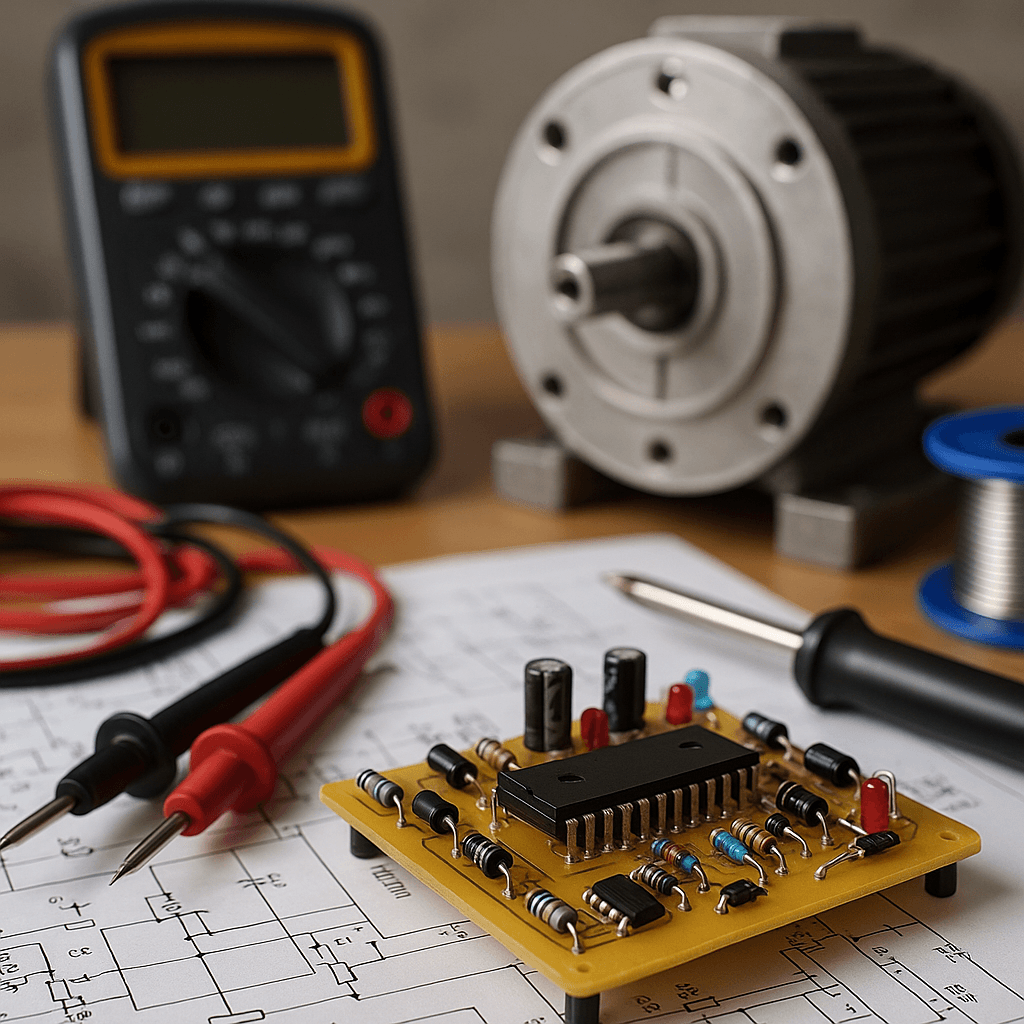
Electrical and Electronics Engineering is a engineering discipline focused on the generation, transmission, and distribution of electrical energy as well as the design, development, and implementation of electronic systems. This field encompasses topics such as electronic circuits, communication systems, computer hardware and software, integrated technologies, biomedical systems, microprocessors and microcontroller, image and audio processing systems, high voltage techniques, and electromagnetic waves.
Electrical and Electronics Engineering emerged as a discipline toward the end of the 19th century with the advent of electrical energy production and utilization. Its foundations were laid in the 1800s through Michael Faraday’s work on electromagnetism and James Clerk Maxwell’s equations describing electromagnetic waves. At the beginning of the 20th century, as electrification became widespread in industry and daily life, electrical engineering established itself as a distinct specialization within academic structures.
Over time, classical electrical engineering, which originally focused solely on power systems, incorporated the subfield of “electronic engineering” due to the development of radio, television, radar, and computer technologies. Thus, the discipline evolved into a multidisciplinary engineering field encompassing not only electrical energy but also the design of electronic systems and communication technologies. Today, it is one of the fundamental engineering disciplines shaping numerous sectors including communications, healthcare technology, defense, and automation.
Electrical and Electronics Engineering in Türkiye developed in parallel with industrialization and modernization, particularly accelerating during the second half of the 20th century. In the early years of the Republic, electrical engineering education was conducted under limited resources, but as industrial infrastructure expanded and energy demand increased, the need for technical experts in this field became evident.
By the late 1980s, Electronic Engineering was introduced as an independent department in the curricula of several Turkish universities. For instance, the Department of Electronic Engineering established at Istanbul University-Cerrahpasa Faculty of Engineering in 1989 began offering 100% English-language instruction in 1990; a Turkish-language Electrical and Electronics Engineering program was added in 1993. These two programs were merged in the 2001–2002 academic year to form a comprehensive discipline.
Today, Electrical and Electronics Engineering is one of the most widespread and foundational fields of engineering education in Türkiye, with undergraduate, graduate, and doctoral programs offered at numerous state and foundation universities. In addition to its educational infrastructure, academic research and industrial applications are conducted in an integrated manner through collaborations with institutions such as TÜBİTAK, ASELSAN, HAVELSAN, TEİAŞ, BOTAŞ, and TUSAŞ. In this context, the discipline plays an active role in sectors such as energy, communications, defense industry, and automation in Türkiye.
Electrical and Electronics Engineering is an engineering discipline composed of numerous technical subfields. These subfields cover a broad spectrum of applications and research ranging from the generation of electrical energy to the design of high-frequency communication systems. Each area focuses on different aspects of electronic and electrical processes, providing students and researchers with opportunities for specialization. The core areas are:
Electrical and Electronics Engineering education consists of theoretical courses, laboratory applications, engineering projects, and internships. Programs typically begin with foundational engineering courses and continue with elective courses in specialized areas. Students receive both theoretical and experimental training in subjects such as signal processing, electromagnetics, control, microelectronics, communications, microwaves, and biomedical engineering.
Throughout the educational process, practical experience is provided in various laboratory environments. These laboratories include the Circuits Laboratory, Electrical Machines Laboratory, High Voltage Laboratory, Communication Laboratory, Control and Automation Laboratory, Antennas and Microwaves Laboratory, and Industrial Circuit Design R&D Laboratory.
Graduates of Electrical and Electronics Engineering can work in a wide range of technical and administrative roles in both public and private sectors. Potential industries include energy, defense industry, automotive, communications, information technology, electronics manufacturing, healthcare technology, construction, food, and tourism. Possible positions include:
Electrical and Electronics Engineering is a discipline that conducts both theoretical and applied research. Research efforts aim to analyze, model, test, and optimize electrical and electronic systems. These areas form the foundational building blocks of modern technology. Major research topics include:
Electrical and Electronics Engineering is one of the key engineering disciplines responsible for the design and operation of fundamental components of modern technology. It is applied across a wide range of domains including electrical infrastructure, communication technologies, automation systems, information networks, defense systems, medical devices, and consumer electronics.
Today, rapid digitalization and technological transformation in engineering are increasing the demand for electrical and electronics engineering, ensuring its central role in multidisciplinary applications.
Istanbul University-Cerrahpasa. "Elektrik-Elektronik Mühendisliği nedir?" cdn.iuc.edu.tr. Accessed July 17, 2025. https://cdn.iuc.edu.tr/FileHandler2.ashx?f=eem_aday_ogrenci_rehberi_2022.pdf
Koç Üniversitesi Career Development Center. "Elektronik bölümünden mezun olduktan sonra neler yapabilirim?" career.ku.edu.tr. Accessed July 17, 2025. https://career.ku.edu.tr/wp-content/uploads/2016/10/Elektrik_final.pdf
Middle East Technical University. "Sıkça Sorulan Sorular." eee.metu.edu.tr. Accessed July 17, 2025. https://eee.metu.edu.tr/tr/sss
Sakarya Uygulamalı of Applied Sciences. "Elektrik-Elektronik Mühendisliği Bölümü Nedir / Ne İş Yapar / Çalışma Alanları?" SAYEM. Accessed July 17, 2025. https://sertifika.subu.edu.tr/elektrik-elektronik-muhendisligi-bolumu-nedir-ne-is-yapar-calisma-alanlari

Electrical and Electronics Engineering
Field | Engineering | ||||||||
|---|---|---|---|---|---|---|---|---|---|
Duration of Education | 4 years (undergraduate level) | ||||||||
Subfields | Biomedical Communication Control Electronics Electrical | ||||||||
Educational Content | Communication systems Electromagnetic Microcontrollers Circuit design Signal processing | ||||||||
Work Areas | Manufacturing Health Information technology Communication Automotive Defense Energy | ||||||||
No Discussion Added Yet
Start discussion for "Elect Electrical and Electronics Engineering" article
History
Development in Türkiye
Core Areas
Curriculum and Program Structure
Career Paths
Research Areas
Contemporary Importance and Application Areas