


This article was automatically translated from the original Turkish version.
+2 More
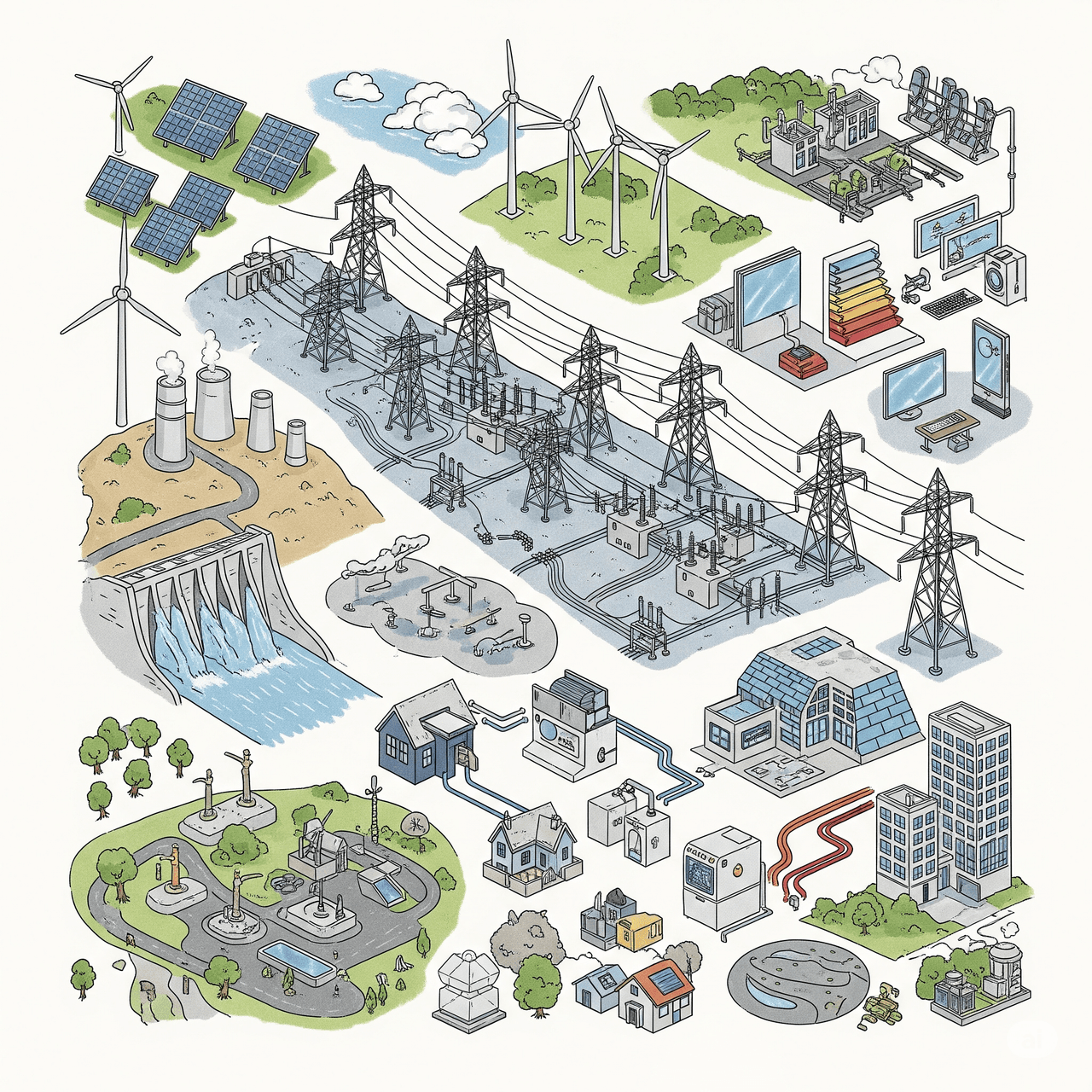
Energy Engineering (Generated with Artificial Intelligence)
Discipline | Engineering | ||||||||
|---|---|---|---|---|---|---|---|---|---|
Related Field(s) | Mechanical Engineering Economics Environmental Engineering Electrical Engineering Chemistry Physics | ||||||||
Focus Areas | Energy Production, Renewable Energy, Energy Efficiency, Sustainability | ||||||||
Core Technologies | Solar Panels, Wind Turbines, Hydroelectric Power Plants, Fuel Cells, Geothermal Systems | ||||||||
Duration of Education (Undergraduate) | Typically 4 years | ||||||||
Energy engineering is a multidisciplinary field of engineering that provides technical solutions to ensure the efficient production, management, distribution, and utilization of energy, with the goal of using resources such as fossil fuels and renewable energy in a safe, sustainable, and environmentally friendly manner. This discipline plays a critical role in meeting the growing global energy demand driven by population growth and industrialization, improving the efficiency of existing energy systems, and minimizing environmental impacts. Energy engineering draws fundamentally from diverse fields such as mechanical engineering, physics, chemistry, mathematics, and economics, applying principles from these disciplines to the design, analysis, and optimization of energy systems.
Energy engineering encompasses a broad range of activities covering all stages of the energy journey from source to end user. These areas vary according to the type of energy source, conversion processes, and intended uses.
Renewable energy is energy derived from natural sources that are continuously replenished and inexhaustible. Energy engineers develop projects to maximize the benefits from sources such as solar, wind, hydroelectric, geothermal, wave, and biomass energy. Within this scope, they manage the design, optimization, and installation of technologies such as wind turbines, solar panels, hydroelectric power plants, and biomass energy production systems. The objective is to generate electricity efficiently, economically, and in an environmentally friendly way from these sources. Engineers analyze the climatic characteristics of specific regions to develop projects that enhance energy efficiency and assess the environmental impacts of these systems.
One of the most important focuses of energy engineering is the more efficient use of energy in both production and consumption stages. Energy engineers propose solutions to improve efficiency and reduce costs by monitoring energy use in buildings and industrial facilities. In this process, they design solutions such as heating, ventilation, and air conditioning (HVAC) systems that conserve energy, insulation technologies, and energy-efficient lighting systems. Additionally, they actively participate in the implementation of standards such as ISO 50001 Energy Management System and in green building certification processes such as LEED (Leadership in Energy and Environmental Design).
Traditional energy production systems based on fossil fuels (coal, oil, natural gas) continue to meet a significant portion of global energy demand. Energy engineers work to enhance the efficiency of these plants, reduce their environmental impacts, and control emissions. They also conduct research on conventional yet carbon-free energy sources such as nuclear energy. Topics such as the design, operation, and safety of nuclear power plants fall within the scope of energy engineering.
The design and operation of energy systems cannot be considered independently of economic and political factors. Energy engineers perform cost analyses of energy projects, evaluate their economic viability, and provide a technical basis for investment decisions. At the same time, they contribute to the formulation of national and international energy policies by developing strategies that promote the use of sustainable energy sources. This requires understanding the dynamics of energy markets and integrating technological solutions with economic realities.
Energy engineers apply their theoretical knowledge to practical applications and assume diverse roles across the energy sector. Their fundamental responsibility is to meet society’s energy needs by utilizing energy resources in the most efficient, sustainable, and economical manner.
Their primary roles and responsibilities include:
To become an energy engineer, one must graduate with a bachelor’s degree from an Energy Systems Engineering or Energy Engineering department within the engineering faculties of universities. In Türkiye, students are admitted to these programs based on the Numerical (SAY) score type.
The undergraduate program in energy engineering typically lasts four years (eight semesters). This education includes an interdisciplinary curriculum designed to teach students the fundamental principles and applications of energy systems. Core engineering courses that students are required to take include Thermodynamics, Fluid Mechanics, Heat Transfer, Materials Science, Engineering Mechanics, System Analysis and Control. In addition, specialized courses such as Renewable Energy Technologies (Solar, Wind, Geothermal), Nuclear Energy, Fuel Cells, Energy Economics, and Heating and Cooling Technologies are included. Courses such as Computer Programming, Technical Writing, and Communication are also essential components of the curriculum.

Energy Engineering Areas (Generated by Artificial Intelligence)
In Türkiye, many state and foundation universities offer programs in Energy Engineering or Energy Systems Engineering. Additionally, some universities provide open education programs for those without access to traditional on-campus education.
Abroad, countries such as Canada, the United Kingdom, Germany, and Italy stand out for their strong university programs in energy engineering. Undergraduate programs abroad typically last three or four years, while master’s programs last one or two years.
Graduates of energy engineering have broad career opportunities across all areas where energy is produced, distributed, and consumed. Numerous career prospects exist in both the public and private sectors. The global focus on sustainability and clean energy continues to increase demand for professionals in this field.
The main sectors and institutions where graduates can work include:
Graduates may work under titles such as energy engineer, energy efficiency specialist, project manager, or energy consultant. Proficiency in a foreign language provides a significant advantage for graduates seeking positions in international companies or overseas projects.
Boyle, Godfrey. Renewable Energy: Power for a Sustainable Future. 4th ed. Oxford: Oxford University Press, 2012.
Dincer, Ibrahim and Mark A. Rosen. Exergy: Energy, Environment and Sustainable Development. 2nd ed. Amsterdam: Elsevier, 2013.
ICES Turkey. "Yurtdışında Enerji Mühendisliği Okumak." Accessed July 14, 2025. https://www.icesturkey.com/yurtdisinda-enerji-muhendisligi-okumak.
Kalogirou, Soteris A. Solar Energy Engineering: Processes and Systems. 2nd ed. London: Academic Press, 2014.
Karayaka, Hamza. "Enerji Mühendisliği." Piagrid.com. Accessed July 14, 2025. https://www.piagrid.com/rehber/enerji-muhendisligi.
Lund, Henrik. Renewable Energy Systems: A Smart Energy Systems Approach to the Choice and Modeling of 100% Renewable Solutions. 4th ed. London: Academic Press, 2022.
Sorensen, Bent. Energy Systems: A Very Short Introduction. Oxford: Oxford University Press, 2019.
Tester, Jefferson W., Elisabeth M. Drake, Michael J. Driscoll, Michael W. Golay, and William A. Peters. Sustainable Energy: Choosing Among Options. 2nd ed. Cambridge, MA: MIT Press, 2012.
Wengenmayr, Roland and Thomas Bührke, eds. Renewable Energy: Sustainable Energy Concepts for the Future. Weinheim: Wiley-VCH, 2013.

Energy Engineering (Generated with Artificial Intelligence)
Discipline | Engineering | ||||||||
|---|---|---|---|---|---|---|---|---|---|
Related Field(s) | Mechanical Engineering Economics Environmental Engineering Electrical Engineering Chemistry Physics | ||||||||
Focus Areas | Energy Production, Renewable Energy, Energy Efficiency, Sustainability | ||||||||
Core Technologies | Solar Panels, Wind Turbines, Hydroelectric Power Plants, Fuel Cells, Geothermal Systems | ||||||||
Duration of Education (Undergraduate) | Typically 4 years | ||||||||
Scope and Core Areas
Renewable Energy Systems
Energy Efficiency and Management
Conventional Energy Systems and Technologies
Energy Policies and Economics
Roles and Responsibilities of an Energy Engineer
Education
Undergraduate Education and Courses
Education in Türkiye and Abroad
Career Opportunities and Work Areas