


This article was automatically translated from the original Turkish version.
+2 More
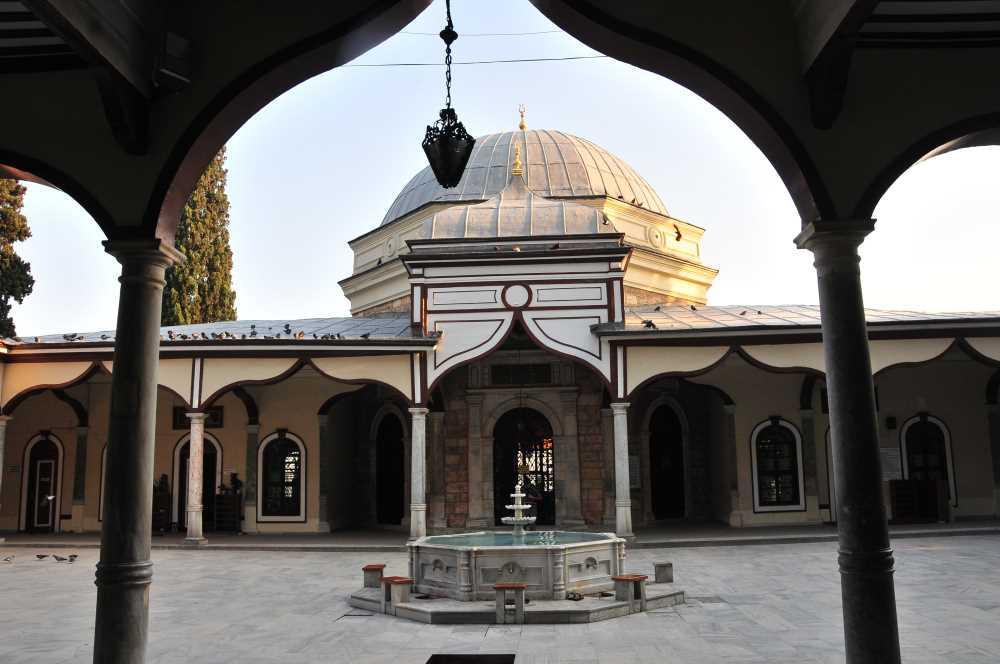
Emir Sultan Camii
Location | Yıldırım Türkiye Bursa | ||||||||
|---|---|---|---|---|---|---|---|---|---|
Construction Date(s) | Early 15th century (original) 1804–1805 (reconstructed) | ||||||||
Founder(s) | Hundi Fatma Hatun (wife of Emir Sultan daughter of Yıldırım Bayezid) | ||||||||
Reconstruction | During the reign of Selim III (1219/1804–1805) | ||||||||
Architectural Style(s) | Classical Ottoman plus Baroque influences | ||||||||
Plan Type | Square plan, single dome | ||||||||
Dome | Octagonal drum, lead-covered, transition via pendentives | ||||||||
Minarets | Two, cut stone, cylindrical shafts | ||||||||
Construction Material | Cut stone, brick, alternating wall masonry | ||||||||
Şadırvan | Octagonal plan, fountain-equipped, dome-shaped metal cage | ||||||||
Hamam Feature | Rectangular plan, three-iwan, domed warm space | ||||||||
Emir Sultan Camii is a historically and religiously significant Ottoman structure located in the Yıldırım district of Bursa, Türkiye, at the foothills of Uludağ. The mosque was likely constructed during the reign of Sultan Mehmed Çelebi, following the death of the Sufi mystic Emir Sultan, by his wife Hundi Fatma Hatun, daughter of Yıldırım Bayezid. Situated on a hilltop within the Emir Sultan Mahallesi neighborhood, surrounded by plane and chestnut trees, the mosque is visible from many points across the city. Today, it remains one of the most visited religious sites in Türkiye, second only to the Eyüp Sultan Türbesi, due to both its architectural features and its enduring culture of pilgrimage.

Emir Sultan Camii (Yıldırım District Governorship, Republic of Türkiye)
The current structure of the Emir Sultan Camii was rebuilt in 1219 AH / 1804–1805 CE under the orders of Sultan Selim III. The building has a square plan measuring 15.20 by 15.20 meters and features a single dome resting on an octagonal drum, with transitions to the dome achieved through squinches. The lead-covered dome rests on piers that project from the main walls both inward and outward. These piers serve as dynamic elements in the façade composition while also contributing to the structural system of the building.
The mosque’s interior is exceptionally well-lit, with a total of forty-four windows in the main walls and twelve additional windows in the drum of the dome. The lower row of windows is rectangular with rounded relieving arches above them, while the upper row features round arches with tracery. This window arrangement not only ensures ample illumination but also adds visual richness to the façade composition.
The wall construction employs a technique of alternating cut stone and brick. The inscription above the entrance on the north façade documents the restoration carried out during the reign of Selim III and bears the date 1219 (1804–1805). Within a concave band above the inscription, baroque-style landscape paintings appear, representing one of the examples of late Ottoman decorative art.

Emir Sultan Camii (Yıldırım District Governorship, Republic of Türkiye)
The interior of Emir Sultan Camii is richly adorned with intricate penwork characteristic of the Ottoman Baroque style. The mihrab was originally covered with Iznik tiles in the 17th century but has undergone several restorations and is now reconstructed in marble. On either side of the mihrab stand columns with capitals resembling Corinthian order. Above the mihrab, ornamental panels featuring rumi motifs are prominently visible. The areas surrounding the windows are decorated with muqarnas, making the overall ornamentation exceptionally elaborate.
Two square-based minarets, constructed of cut stone, rise from the northeast and northwest corners of the mosque. These cylindrical minarets are supported by consoles shaped like acanthus leaves and feature balconies reminiscent of the Corinthian order. The minaret caps are also made of cut stone. Both minarets were destroyed in the 1855 Bursa earthquake and were rebuilt between 1868 and 1869 during the reign of Sultan Abdülaziz.
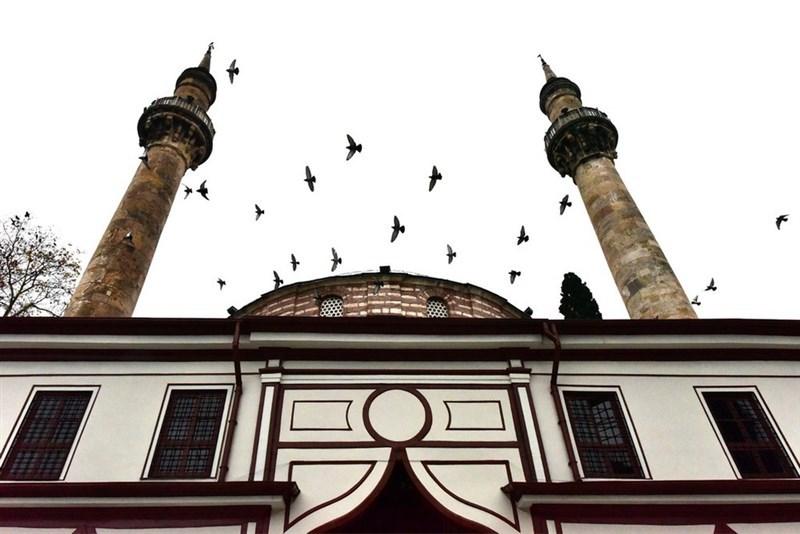
Emir Sultan Camii (Yıldırım District Governorship, Republic of Türkiye)
The mosque is accessed via elevated staircases from the west. The main entrance is situated between two columns. The şadırvan courtyard exhibits a rectangular plan oriented east-west. It is surrounded by arcades connected by false arches resting on white marble columns and constructed with Baghdad plaster. These arcades are covered with mirrored vaults. The southern arcade has been arranged as the final prayer space of the mosque, with additional upper floors later added over some of its units.
In the center of the courtyard stands an octagonal şadırvan surrounded by baroque-profiled columns. The basin is fed by a fountain and covered with a wire mesh dome. Rectangular rooms are located in the northeast and northwest corners of the courtyard; these were used by mosque staff.
The Emir Sultan Türbesi is situated north of the mosque, aligned on the same axis. The tomb contains the sarcophagi of Emir Sultan, his wife Hundi Hatun, their sons Emir Ali, and two daughters. The entrance to the türbe is on the eastern façade, while the other three façades feature large round-arched windows. The türbe is notable for its simple architecture, yet the sarcophagi inside are visited with great reverence by the public.
A külliye was constructed adjacent to Emir Sultan Camii, comprising a medrese, hamam, dervish cells, and various auxiliary structures. Over time, many of these components were damaged or lost. However, the hamam remains standing. Originally covered by a dome, the cold section of the rectangular hamam was later re-roofed with a flat ceiling. Around the warm room are halvet cells and a hela, while the hot room follows a three-ayvan plan. The ceiling of the hot room is covered by a dome with a drum and undulating bands.
Emir Sultan Camii has undergone multiple restorations over the centuries due to earthquakes and natural disasters. Following a major earthquake in 1795–96, the structure was completely destroyed and subsequently rebuilt by Selim III between 1804 and 1805. After the 1855 Bursa earthquake, repairs preserved the overall plan of the mosque, with only minor modifications made to certain details.
There are differing opinions regarding the original form of Emir Sultan Camii. Some researchers argue that the initial structure had six domes, while others suggest it began as a square-plan, single-domed building that was later expanded with a three-domed arcade. According to Evliya Çelebi’s account, the courtyard was originally surrounded by dervish cells, indicating that the complex also functioned as a tekke.
Emir Sultan Camii holds great importance not only architecturally but also in religious and social life. Especially during lamp-lit nights and religious holidays, as well as on mevlit days, the mosque and türbe attract large crowds. Locals frequently visit the site before significant life events such as weddings and circumcisions to offer prayers. In this way, the mosque has transformed into a site of popular devotion and vow-making, becoming an inseparable part of local religious life.
T.C. Ministry of Culture and Tourism. "Emir Sultan Camii." *Kültür Portalı*. Accessed May 20, 2025. https://www.kulturportali.gov.tr/turkiye/bursa/gezilecekyer/emir-sultan-cami.
T.C. Yıldırım Municipality. “Emir Sultan Camii.” Yıldırım Belediyesi Resmi Web Sitesi. Accessed May 20, 2025. https://www.yildirim.bel.tr/sayfa/emir-sultan-camii.html.
T.C.Yıldırım Kaymakamlığı Governorship. “Emir Sultan Camii.” Yildirim.gov.tr. Accessed May 20, 2025. http://www.yildirim.gov.tr/emir-sultan-camii.

Emir Sultan Camii
Location | Yıldırım Türkiye Bursa | ||||||||
|---|---|---|---|---|---|---|---|---|---|
Construction Date(s) | Early 15th century (original) 1804–1805 (reconstructed) | ||||||||
Founder(s) | Hundi Fatma Hatun (wife of Emir Sultan daughter of Yıldırım Bayezid) | ||||||||
Reconstruction | During the reign of Selim III (1219/1804–1805) | ||||||||
Architectural Style(s) | Classical Ottoman plus Baroque influences | ||||||||
Plan Type | Square plan, single dome | ||||||||
Dome | Octagonal drum, lead-covered, transition via pendentives | ||||||||
Minarets | Two, cut stone, cylindrical shafts | ||||||||
Construction Material | Cut stone, brick, alternating wall masonry | ||||||||
Şadırvan | Octagonal plan, fountain-equipped, dome-shaped metal cage | ||||||||
Hamam Feature | Rectangular plan, three-iwan, domed warm space | ||||||||
Architectural Structure and Plan Features
Ornamentation and Decorative Elements
Minarets
Şadırvan and Courtyard Layout
Türbe
Külliye Components and Hamam
Restorations and Historical Development
Cultural and Religious Significance
