

This article was automatically translated from the original Turkish version.
Date(s) | 2 November - 10 December 1932 | ||||||||
|---|---|---|---|---|---|---|---|---|---|
Planner | Sir George Pearce (Minister for Defence) | ||||||||
Purpose(s) | Reduce local emu populations to reduce crop loss | ||||||||
Main Equipment | Lewis automatic rifles, 10,000 rounds | ||||||||
Current Status of Emulations | Protected species (since 1999) | ||||||||
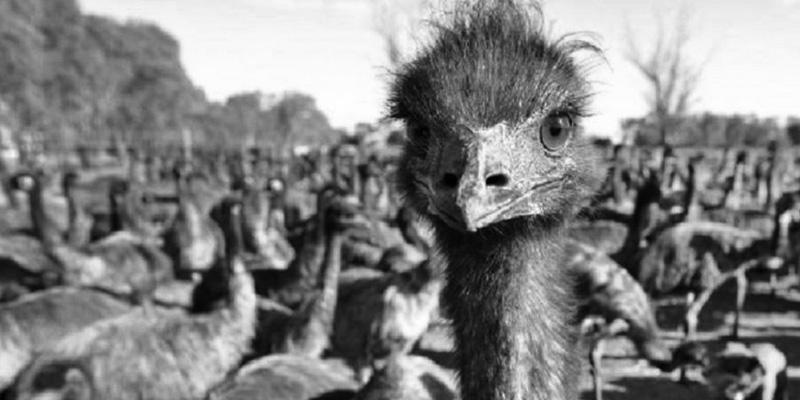
The event known as the Emu War constituted an extraordinary example of tension between natural wildlife and human settlement, occurring in 1932 in Western Australia. During this period marked by the economic hardships of the Great Depression, former soldiers who had settled in the Campion region of Western Australia under post-First World War settlement schemes were attempting to sustain themselves through wheat farming. However, the global economic downturn had driven wheat prices to record lows, and insufficient government subsidies plunged farmers into deep debt. Adding to these harsh conditions, a severe drought in the region caused approximately 20,000 emus, normally inhabiting inland areas, to migrate toward farmland in search of food and water. This massive flock did not merely consume crops; it also trampled fields and destroyed farm fences, inflicting significant economic damage on farmers. Desperate, the farmers appealed to the Australian government for military assistance, and Defence Minister Sir George Pearce responded positively, paving the way for a military operation.
The military operation against the emus was carried out by a three-person team under the command of Major G.P.W. Meredith. The team was equipped with two Lewis machine guns and 10,000 rounds of ammunition allocated for the operation. The primary objective of this unusual mission, which began on 2 November 1932, was to protect farmers’ crops from emu incursions and alleviate the regional economic crisis. Initial tactics involved driving emus into open areas and then neutralizing them with machine gun fire. However, these strategies quickly encountered major difficulties. Emus are agile animals capable of reaching speeds of up to 50 kilometres per hour, and their erratic, unpredictable movements made them extremely difficult targets. Their surprising resilience to machine gun fire further reduced the operation’s effectiveness. Additionally, frequent mechanical jams in the machine guns, combined with the rugged and challenging terrain of Western Australia, severely hampered the military team’s mobility and the overall success of the operation.
The tactics employed by Major Meredith and his team in response to the emus’ unexpected behaviour and difficult terrain led to significant operational deadlocks. Despite adopting a military approach, knowledge of the battlefield was overshadowed by human limitations.
The limited success achieved in the operation’s early weeks and the low rate of emu casualties quickly attracted national and international media attention. The media ridiculed the situation, dubbing it the “Emu War”, and the event rapidly became a major source of public humour. The Australian military’s perceived “ineptitude” in this struggle against birds was met with both mockery and serious criticism. Considering the economic hardships of the Great Depression, the allocation of scarce military resources to what was seen as a “trivial” problem sparked public debate over resource waste and misplaced priorities. The media’s exaggerated and satirical portrayals further emphasized the absurdity of the event, completely eroding already low public support and damaging the operation’s credibility.
After approximately one month of military operations, the armed forces were withdrawn on 10 December 1932. Official reports and independent observations revealed that the operation had failed to achieve its intended impact and caused no significant decline in the emu population. Only a few hundred emus were killed during the operation, at the cost of tens of thousands of rounds of ammunition. This outcome not only questioned the operation’s cost-effectiveness but also highlighted the limitations of military solutions when confronting complex issues such as wildlife management. The Emu War entered history as an example of how military force can prove inadequate when intervening in natural ecosystems and how poorly understood animal behaviour can lead to unforeseen difficulties. The incident prompted a reassessment of wildlife management strategies in Australia and laid the groundwork for more effective, long-term solutions for farmers. Subsequently, alternative methods such as the construction of protective fencing and the implementation of bounty programs for emu hunters were adopted to combat emu damage.
Cook, Richard J., and M. Jovanovic. "The Emu strikes back: An inquiry into Australia Peculiar military action of 1932." *Romanian Journal of Historical Studies* 2, no. 1. 2019. https://www.ceeol.com/search/article-detail?id=795870.
Johnson, Murray. "'Feathered Foes': Soldier Settlers and Western Australia's 'Emu War' of 1932." Journal of Australian Studies 30(88), 2006. https://www.tandfonline.com/doi/pdf/10.1080/14443050609388083.
Jones, Pattrice. "Provocations from the Field-Derangement and Resistance: Reflections from Under the Glare of an Angry Emu." *Animal Studies Journal* 8, no. 1 (2019). https://www.uowoajournals.org/asj/article/id/381/.
Sanctuary, Vine. "Derangement and Resistance: Reflections from Under the Glare of an Angry Emu." 2019. Accessed Linki.

Date(s) | 2 November - 10 December 1932 | ||||||||
|---|---|---|---|---|---|---|---|---|---|
Planner | Sir George Pearce (Minister for Defence) | ||||||||
Purpose(s) | Reduce local emu populations to reduce crop loss | ||||||||
Main Equipment | Lewis automatic rifles, 10,000 rounds | ||||||||
Current Status of Emulations | Protected species (since 1999) | ||||||||
Military Intervention and Challenges Faced
Tactical Deadlocks and Operational Failures
Public and Media Reaction
End of the Operation and Its Consequences