


This article was automatically translated from the original Turkish version.
+5 More
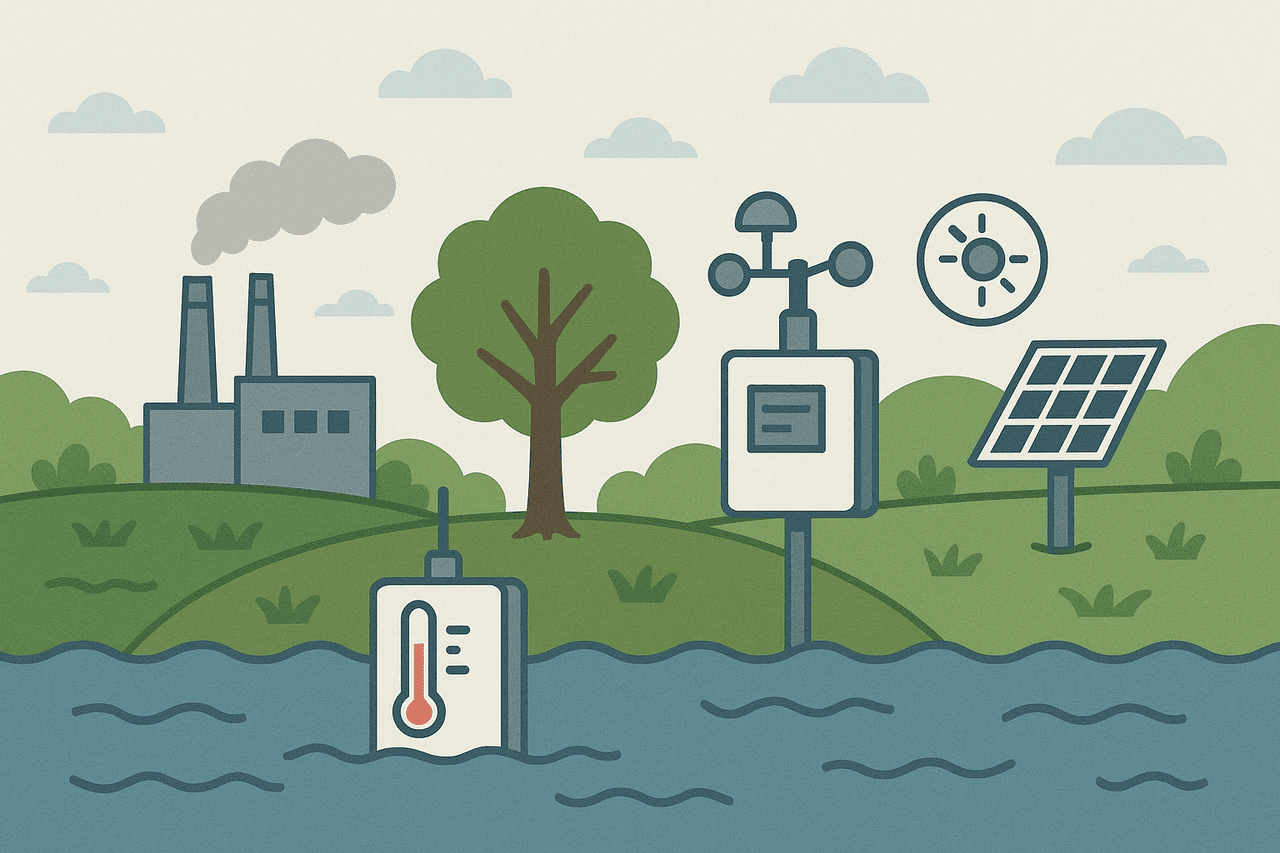
Generated with artificial intelligence support
Environmental Quality Monitoring Systems
Basic Monitoring Areas | Air Quality, Water Quality, Emission, Noise | ||||||||
|---|---|---|---|---|---|---|---|---|---|
Primary Pollutants Measured (Air) | PM10, PM2.5, SO₂, NO₂, CO, O₃, VOC | ||||||||
Primary Parameters Measured (Water) | pH, Conductivity, BOD, COD, Turbidity, Dissolved Oxygen | ||||||||
Legal Basis (Türkiye) | Ministry of Environment, Urbanization and Climate Change notices and regulations | ||||||||
Technological Foundation | Internet of Things (IoT), Sensor networks, Cloud computing, Data analytics | ||||||||
National Monitoring Network (Türkiye) | Coordinated by the Continuous Monitoring Center (SİM) | ||||||||
Environmental quality is a fundamental concept that determines the health and sustainability of ecosystems. The current state of natural resources, pressures arising from human activities, and key environmental components such as air, water, soil, and biological diversity can be measured. Environmental quality is a critical indicator that directly affects not only ecological balance but also human health, the continuity of economic activities, and social well-being.
Today, urbanization, industrialization, population growth, increased energy consumption, intensification of agricultural activities, and climate change are the main factors threatening environmental quality. Therefore, monitoring and assessing environmental quality form the foundational basis of sustainable development policies. Monitoring systems are infrastructures that regularly measure environmental parameters, identify trends, and provide scientific data to decision-makers.
The components of environmental quality can be examined under four main categories: air quality, water quality, soil quality, and biological diversity. Monitoring each of these components provides a holistic perspective for environmental management.
Air quality refers to the concentration of gaseous and particulate pollutants in the atmosphere. Major parameters include sulfur dioxide (SO₂), nitrogen dioxide (NO₂), carbon monoxide (CO), ozone (O₃), particulate matter (PM10, PM2.5), and volatile organic compounds (VOCs). Degradation of air quality can lead to short-term respiratory irritation and, in the long term, chronic diseases and premature deaths in human populations.
Water quality indicates the suitability of water for drinking, agricultural irrigation, and ecosystem functions. Parameters determining water quality are classified as physical (temperature, turbidity), chemical (pH, dissolved oxygen, nitrate, phosphate, heavy metals), and biological (microorganism density).
Soil quality is assessed based on agricultural productivity, organic matter content, pollutant load, erosion, and carbon sequestration capacity. Soil pollution is increasing, particularly in regions with intense industrial activity, through accumulation of heavy metals, pesticide residues, and organic contaminants.
Biological diversity is one of the elements that ensure the resilience and sustainability of ecosystems. A decline in species diversity is an indicator of environmental quality degradation. Habitat loss, pollution, climate change, and invasive species are the main factors threatening biological diversity.

Environmental Quality and Monitoring Systems (Generated by artificial intelligence.)
Air quality monitoring systems occupy a central position in environmental management due to the impacts of atmospheric pollutants on human health and ecosystems. Millions of people worldwide die each year from health problems linked to air pollution.
Legal regulations in Türkiye aimed at protecting air quality are aligned with European Union (EU) and World Health Organization (WHO) standards. The National Air Quality Monitoring Network consists of over 300 fixed monitoring stations across the country. These stations continuously measure parameters such as PM10, PM2.5, SO₂, NO₂, CO, and O₃, and make the data publicly available online.
The AQI consolidates measured pollutant concentrations into a single indicator to simplify risk levels for public health. AQI levels are categorized as “good,” “moderate,” “risk for sensitive groups,” “unhealthy,” and “very unhealthy.”
Temperature, wind speed and direction, relative humidity, and atmospheric pressure directly influence the dispersion and accumulation of pollutants in the atmosphere. For example, under conditions of low wind speed and temperature inversion, pollutants concentrate in the atmosphere, increasing pollution levels.

Environmental Quality and Monitoring Systems (Generated by artificial intelligence.)
Clean water sources are indispensable for essential activities such as drinking water supply, agricultural production, and energy generation. Water pollution is one of the most significant environmental threats to public health.
Water quality assessments rely on physical (turbidity, temperature), chemical (pH, dissolved oxygen, heavy metals), and biological (coliform bacteria, pathogenic microorganisms) parameters. National and international standards have established limit values for these parameters.
Water quality monitoring systems include fixed measurement stations, mobile laboratories, biosensors, and remote sensing techniques. Automated sensors deployed in lakes and rivers continuously measure water levels alongside chemical parameters.

Environmental Quality and Monitoring Systems (Generated by artificial intelligence.)
Soil is a critical component for ecosystem services such as nutrient cycling, water cycling, and carbon storage. Decline in soil quality reduces agricultural production capacity and contributes to loss of biological diversity.
Regularly monitored parameters in soil include heavy metals (lead, cadmium, arsenic), pesticide residues, pH, organic matter content, nutrient elements (nitrogen, phosphorus, potassium), and erosion indicators.
Industrial waste, mining activities, and chemical fertilizers and pesticides used in agriculture are the main sources of soil pollution.
Internet of Things (IoT) technology enables real-time and low-cost monitoring of environmental parameters. IoT sensors transmit measurements of air, water, and soil quality to cloud-based databases, ensuring continuous data flow.
Machine learning algorithms are used to predict environmental trends from large datasets. Models forecasting future pollutant levels assist in developing preventive policies.
Satellite-based monitoring systems enable the assessment of environmental quality over large areas. They are particularly effective in monitoring forest fires, water pollution, and air pollution events.
Early warning mechanisms have been developed, supported by data from air and water quality monitoring systems, to detect environmental disasters in advance.
Habitat integrity, species diversity, and population densities are indicators used in monitoring biological diversity.
Genetic analysis, automated camera traps, acoustic recording devices, and habitat quality assessments are employed in biological diversity monitoring activities.
National monitoring networks coordinated by the Ministry of Environment, Urbanization and Climate Change in Türkiye simultaneously track parameters related to air, water, soil, and biological diversity.
The integration of IoT, artificial intelligence, and big data technologies into the national monitoring infrastructure has increased data collection capacity and expanded the coverage of monitoring systems.
Türkiye’s environmental quality monitoring systems have made significant progress when compared with the European Union’s Environmental Information and Observation Network (EIONET) and World Health Organization standards. However, areas requiring further improvement remain, particularly in terms of station coverage and integration of next-generation technologies.
Environmental quality and monitoring systems are indispensable for achieving sustainable development. Integrated monitoring of air, water, soil, and biological diversity parameters enables early detection of environmental risks and supports the development of preventive policies.
In the future;
will make environmental monitoring systems more effective and comprehensive.
Gangwar, Amisha., Singh, Sudhakar., Mishra, Richa and Prakash, Shiv. “The State-of-the-Art in Air Pollution Monitoring and Forecasting Systems using IoT, Big Data, and Machine Learning.” *Wireless Personal Communications.* Accessed July 26, 2025. https://arxiv.org/pdf/2304.09574.
Gryech, Ihsane., Asaad, Chaimae., Ghogho, Mounir, and Kobbane, Abdellatif. “Applications of Machine Learning & IoT for Outdoor Air Pollution Monitoring and Prediction: A Systematic Literature Review.” Journal Not Specified. Accessed July 26, 2025. https://arxiv.org/pdf/2401.01788.
Karakuş, Can Bülent, and Yıldız, Sayiter. “Hava Kalite İndeksi ile Meteorolojik Parametreler Arasındaki İlişkinin Çoklu Regresyon Yöntemi ile Belirlenmesi.” *ÖHÜ Mühendislik Bilimleri Dergisi*. Accessed July 26, 2025. https://dergipark.org.tr/tr/download/article-file/773070
Liu, Xiaoli, et al. “Low-Cost Outdoor Air Quality Monitoring and Sensor Calibration: A Survey and Critical Analysis.” *ACM Transactions on Sensor Networks*. Accessed July 26, 2025. https://arxiv.org/pdf/1912.06384.
Zeydan, Özgür and Pekkaya, Mehmet. “Evaluating air quality monitoring stations in Turkey by using multi criteria decision making.” Accessed July 26, 2025. https://www.sciencedirect.com/science/article/abs/pii/S1309104221001069.

Generated with artificial intelligence support
Environmental Quality Monitoring Systems
Basic Monitoring Areas | Air Quality, Water Quality, Emission, Noise | ||||||||
|---|---|---|---|---|---|---|---|---|---|
Primary Pollutants Measured (Air) | PM10, PM2.5, SO₂, NO₂, CO, O₃, VOC | ||||||||
Primary Parameters Measured (Water) | pH, Conductivity, BOD, COD, Turbidity, Dissolved Oxygen | ||||||||
Legal Basis (Türkiye) | Ministry of Environment, Urbanization and Climate Change notices and regulations | ||||||||
Technological Foundation | Internet of Things (IoT), Sensor networks, Cloud computing, Data analytics | ||||||||
National Monitoring Network (Türkiye) | Coordinated by the Continuous Monitoring Center (SİM) | ||||||||
No Discussion Added Yet
Start discussion for "Environmental Quality and Monitoring Systems" article
Components of Environmental Quality
Air Quality
Water Quality
Soil Quality
Biological Diversity
Air Quality Monitoring Systems
Importance of Air Quality Monitoring
Legal Framework and National Monitoring Network in Türkiye
Air Quality Index (AQI) and Its Use
Role of Meteorological Parameters
Water Quality Monitoring Systems
Strategic Importance of Water Resources
Water Quality Parameters and Limit Values
Monitoring Methods and Technologies
Soil Quality Monitoring Systems
Monitoring Parameters
Sources of Soil Pollution
Next-Generation Monitoring Technologies
IoT-Based Sensor Systems
Machine Learning and Big Data Applications
Remote Sensing and Satellite Technologies
Early Warning Systems
Biological Diversity and Ecosystem Monitoring
Monitoring Ecosystem Health
Monitoring Methods
Current Status of Environmental Quality Monitoring Systems in Türkiye
Integration of Digitalization and New Technologies
International Comparisons
Future Perspective