

This article was automatically translated from the original Turkish version.
+1 More
Geographical Indication Type(s) | Mahreç Sign | ||||||||
|---|---|---|---|---|---|---|---|---|---|
Registration Date | 05.11.2024 | ||||||||
Geographical Boundary | Van Erciş | ||||||||
Applicant/Registrant(s) | Van Chamber of Commerce | ||||||||
Product / Product Group(s) | Cabbage (processed and unprocessed vegetable) | ||||||||
Production Method | Seed stock, seedling planting, row spacing 70 cm / row width 90 cm, 4 fertilizations | ||||||||
Harvest | 15 October–15 November | ||||||||
Inspection | Van Chamber of Commerce and related agricultural units | ||||||||
Erciş Cabbage is a variety of cabbage belonging to the species Brassica oleracea, cultivated in the Erciş district of Van Province. This product is protected under a geographical indication registered on 5 November 2024, following an application submitted on 30 March 2022. The registration was carried out by the Van Chamber of Commerce. Erciş Cabbage can be consumed as a wrapped vegetable, pickled, or in kapuska. Producers obtain their own seeds and continue production through selective breeding.

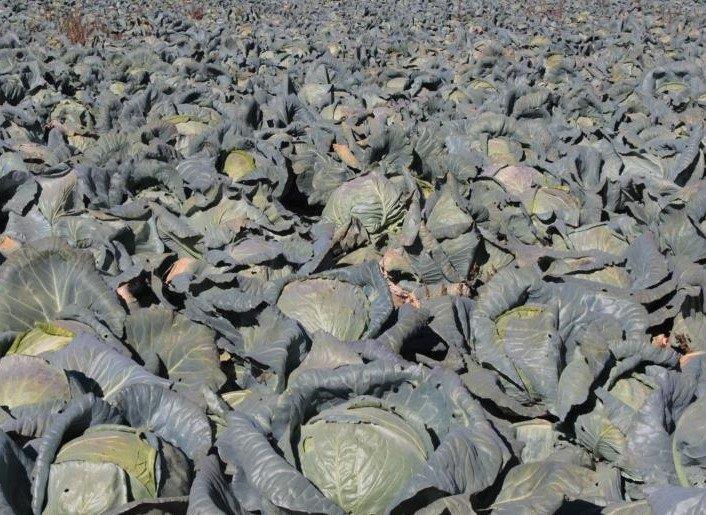
Erciş Cabbage (Anadolu Agency)
The outer leaves of Erciş Cabbage are glossy gray in color and have a large, waxy structure. The parts where the leaf stalks attach to the stem are thick, while the leaf veins are fine. The leaves surrounding the top of the head are a glossy gray close to green, while the inner leaves are bright white. The leaves are tightly stacked, elliptical in shape, and can be removed as a single unit. The inner leaves, which receive no light, remain white and gradually shrink over time. The head structure of Erciş Cabbage is slightly conical, with head weight ranging from 10 to 30 kg. Head firmness is medium to very good, with no tendency to crack.
Per 100 grams, Erciş Cabbage contains 8–10 g of dry matter, 21–26 cal of energy, 1.20–1.40 g of protein, 0.10–0.14 g of fat, and 3.80–4.20 g of total sugars. In terms of vitamins, it contains 200–250 IU of vitamin A, 0.05–0.07 mg of vitamin B1, 0.03–0.04 mg of vitamin B2, 0.30–0.40 mg of niacin, and 38–45 mg of vitamin C. Mineral content includes 60–75 mg of calcium, 0.4–0.6 mg of iron, 22–34 mg of magnesium, 34–42 mg of phosphorus, 220–300 mg of potassium, 20–28 mg of sodium, and 70–74 mg of sulfur.
The Erciş district lies at an altitude of 1,727 meters within the Van Lake basin. As a result, the region is influenced by a continental climate, with cool summers and cold winters. Even in July, the average temperature is 21°C. The area features fertile soils and numerous water sources. The high altitude and cool climate contribute to larger cabbage heads and crisper leaves. The gray, waxy layer on the outer leaves enhances cold tolerance and supports plant growth throughout the vegetative period.
Seeds are sown in April using the broadcast method on trays of 5–10 m². In November, the largest and firmest heads are selected for seed stock, their roots are removed, and they are stored in the soil until spring planting. Seedlings are transplanted to the field in May–June at a spacing of 90 cm between rows and 70 cm within rows. Operations such as hearting, fertilization, and weeding are applied during production. Fertilization is carried out four times in total, using urea and N-P-K fertilizers.
Harvesting takes place between 15 October and 15 November. Erciş Cabbage is cut at the root while preserving the outer leaves and then stored. It can be kept in cold storage or left in the field with the head facing the ground. During marketing, it is typically loaded onto trucks without packaging.
The production and marketing process of Erciş Cabbage is monitored under the coordination of the Van Chamber of Commerce. The monitoring body consists of experts from Van Yüzüncü Yıl University Faculty of Agriculture, Van Provincial Directorate of Agriculture and Forestry, Erciş District Directorate of Agriculture and Forestry, and Erciş Chamber of Agriculture. Monitoring is conducted twice annually on a regular basis and may also be carried out upon complaint. Inspections cover the physical and morphological characteristics of the product, production methods, and compliance with storage and packaging standards, as well as proper use of the geographical indication.
Anadolu Ajansı. “Erciş Lahanası Coğrafi İşaret Belgesi Aldı.” Accessed August 16, 2025. .
Turk Patent and Trademark Office. "Erciş Lahanası – Coğrafi İşaret Detay." Accessed August 16, 2025. https://ci.turkpatent.gov.tr/cografi-isaretler/detay/6444.
Turk Patent and Trademark Office. "Erciş Lahanası – Tescil Belgesi PDF." Turk Patent and Trademark Office. Accessed August 16, 2025. https://ci.turkpatent.gov.tr/Files/GeographicalSigns/dcdd7009-995a-4c1b-96f1-11e36d7b4caa.pdf.

Geographical Indication Type(s) | Mahreç Sign | ||||||||
|---|---|---|---|---|---|---|---|---|---|
Registration Date | 05.11.2024 | ||||||||
Geographical Boundary | Van Erciş | ||||||||
Applicant/Registrant(s) | Van Chamber of Commerce | ||||||||
Product / Product Group(s) | Cabbage (processed and unprocessed vegetable) | ||||||||
Production Method | Seed stock, seedling planting, row spacing 70 cm / row width 90 cm, 4 fertilizations | ||||||||
Harvest | 15 October–15 November | ||||||||
Inspection | Van Chamber of Commerce and related agricultural units | ||||||||
Morphological and Physicochemical Properties
Geographical and Climatic Characteristics
Production Method
Harvesting, Packaging, and Storage
Monitoring and Protection