


This article was automatically translated from the original Turkish version.
+1 More
Erguvan is a plant species that attracts attention not only for its distinctive features but also for its cultural significance. A member of the Mediterranean flora, this plant has become an aesthetic symbol in the landscape of the Bosphorus Strait in Istanbul. Both the color of its flowers and its presence in mythological religious and historical narratives have endowed erguvan with a unified set of meanings.
Erguvan is a deciduous plant belonging to the Fabaceae family, typically growing between 2 and 10 meters in height. Its Latin name, Cercis siliquastrum, is derived from the words “siliqua” (pod) and “kerkis” (weaver’s shuttle). Its most distinctive morphological feature is the clustering of flowers that bloom directly on the trunk and thick branches before the leaves emerge. The flowers are usually pink to purplish in color, though white variants are occasionally observed. April and May are the flowering months of erguvan. The buds form on the trunk and older branches, enabling the abundant and simultaneous blooming of flowers. The leaves are kidney-shaped and turn yellow before falling at the end of autumn. The fruits are pod-like and mature by late summer, dropping in autumn.

Erguvan-Atatürk Forest Farm Directorate
Erguvan prefers temperate and warm climates. It can thrive in fully sunny or partially shaded environments. Although it is not highly selective about soil type, it shows healthier development in humus-rich, well-drained, and calcareous soils. It also tolerates calcareous and heavy clay soils. Although adapted to the Mediterranean climate, erguvan can be cultivated in northern regions of Türkiye, provided it is sheltered from strong winds. It has moderate drought tolerance but is vulnerable to extreme cold. It is sensitive to late frosts and severe freezes.
The natural distribution area of erguvan is listed as the Mediterranean Basin, Western Asia and North America. In Türkiye, it is widely found across a broad geographical range, especially in the Marmara and Aegean regions. Natural or cultivated populations are commonly found on both shores of the Bosphorus Strait, particularly in the districts of Beykoz, Çubuklu and Üsküdar. On the European continent, it is also observed as a native species in France and Italy.
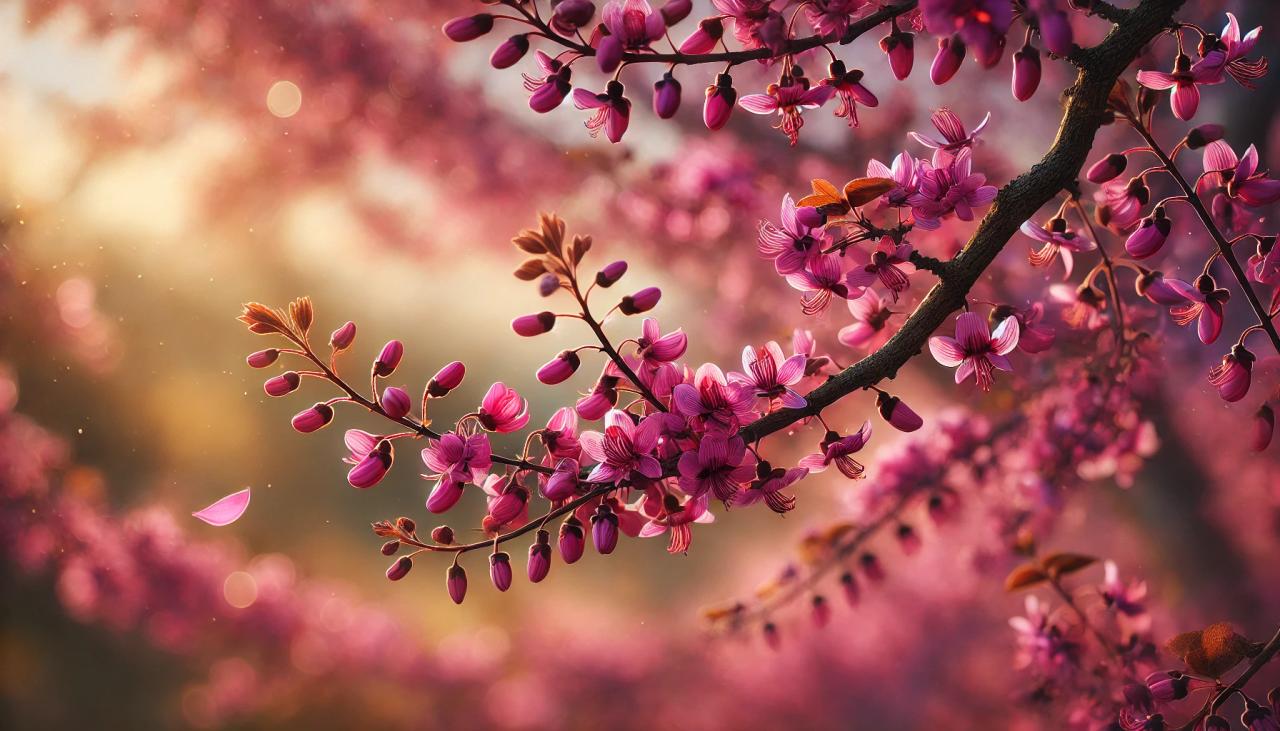
(Erguvan, This Image Was Generated by Artificial Intelligence)
Throughout history, erguvan has acquired meanings beyond its botanical identity. Since Roman and Byzantine times, it has been associated with nobility and sacredness, and the purplish hue of its flowers was used as a color reserved exclusively for emperors. Concepts such as “erguvan-blooded” illustrate the historical depth of this symbolism. During the Ottoman period, erguvan trees were frequently planted in palace gardens and mosque precincts. In Istanbul, erguvan is regarded as one of the most characteristic elements of Bosphorus culture. Since the Tulip Era, it has been especially planted in waterfront gardens and groves. The “erguvan gatherings” held in Emir’s palace and continuing until the 19th century exemplify the spiritual and cultural dimensions of this plant.
Although primarily cultivated as an ornamental plant, erguvan carries symbolic meanings in cultural practices. Erguvan tours held in Istanbul highlight the natural and cultural richness of the Bosphorus. Due to its growth structure, it is not used in large-scale afforestation but is instead valued as individual specimens or in small groups within parks and private gardens. Although its wood and leaves have no significant economic value, it holds great worth in terms of aesthetics and symbolism.

Erguvan-Anadolu Agency in the Istanbul Strait
Erguvan is one of the plant species where nature and culture are deeply intertwined. The color it adds to the silhouette of the Bosphorus, its historical representation spanning from Byzantium to the Ottoman era, and its role as a symbol of spring in local culture, render erguvan significant both scientifically and culturally. Its adaptability to cultivation in various regions of Türkiye further enhances its potential in landscape design.
Anadolu Ajansı. “İspanyolcadaki anlamı 'Aşk Ağacı' olan erguvan, antik dönemden bu yana birçok sanatçıya ilham verdi.” Accessed April 3, 2025. https://www.aa.com.tr/tr/kultur/ispanyolcadaki-anlami-ask-agaci-olan-erguvan-antik-donemden-bu-yana-bircok-sanatciya-ilham-verdi/3209057.
Anadolu Ajansı. “İstanbul’da Erguvan Vakti.” Accessed April 3, 2025. https://www.aa.com.tr/tr/pg/foto-galeri/istanbulda-erguvan-vakti.
Aydın, Salim. "İstanbul Boğaziçi Erguvan Kültürü: Beykoz Burunbahçe Örneği." İstanbul: Beykoz 2021 Sempozyumu Tebliğler Kitabı, 2022. Accessed April 3, 2025. https://www.researchgate.net/publication/363926054_Istanbul_Bogazici_Erguvan_Kulturu_Beykoz_Burunbahce_Ornegi
Genç, Mehmet. “Boğaz’ın Mor Güzeli Erguvan Çiçeği.” Plant Dergisi. Accessed April 3, 2025. https://www.plantdergisi.com/haber-bogaz%E2%80%99in-mor-guzeli-erguvan-cicegi--2447.html
Koçak, Aynur, and Serdar Gürçay. “Soyluluk Çiçeği Erguvan’a Kültürel Bir İnceleme.” Folklor/Edebiyat 21, no. 84 (2015): 33–38. Accessed April 3, 2025. https://www.researchgate.net/publication/320686165_SOYLULUK_CICEGI_ERGUVANA_KULTUREL_BIR_INCELEME
T.C. Kültür ve Turizm Bakanlığı. "İstanbul Ağaçları." Accessed April 3, 2025. https://istanbul.ktb.gov.tr/TR-276822/istanbul-agaclari.html.
TRT Haber. “İstanbul’da Erguvan Zamanı Başladı.” Accessed April 3, 2025. https://www.trthaber.com/haber/yasam/istanbulda-erguvan-zamani-basladi-578264.html.
Yeşil İstanbul. "İstanbul Boğazı’nın Baharı Müjdeleyen Simgesi Erguvan." Accessed April 3, 2025. https://yesil.istanbul/haber_istanbul-bogazinin-bahari-mujdeleyen-simgesi-erguvan

Botanical Characteristics
Growth Conditions
Historical and Cultural Use