



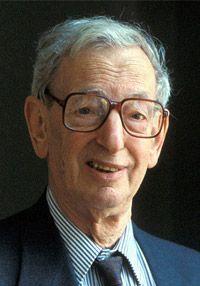
Eric John Ernest Hobsbawm
Doğum tarihi | 1917-06-09 | ||||||||
|---|---|---|---|---|---|---|---|---|---|
Eş | Marlene Schwartz (b. 1962) d. 1951) Muriel Seaman (b. 1943 | ||||||||
Ölüm tarihi | 2012-10-01 | ||||||||
Çocuk | Julia Hobsbawm Andrew John Hobsbawm | ||||||||
Type(s) | European History World History | ||||||||
Profession(s) | Historian | ||||||||
Citizenship | English | ||||||||
Eric John Ernest Hobsbawm is a British historian who focused on the rise of industrial capitalism, socialism and of nationalism. Among his most important works are the four-volume series he termed the “Long 19th Century” (The Age of Revolution: Europe 1789-1848, The Age of Capital: 1848–1875, The Age of Empire: 1875–1914 and The Age of Extremes). Throughout his life a Marxist, Hobsbawm’s sociopolitical beliefs shaped the character of his writings.
Hobsbawm was born in 1917 in Alexandria, Egypt. His father, Leopold Percy Hobsbaum, was a merchant of Polish and Jewish descent from the East End. His mother, Nelly Hobsbaum, was a middle-class Austrian Jew. His early childhood was spent in Vienna, Austria, and Germany. Due to an error by a civil registrar, his surname remained as “Hobsbawm” rather than “Hobsbaum”.
His father died in 1929 when Hobsbawm was twelve years old. To support his family, he began working as an English teacher. After his mother’s death in 1931, he and his siblings were taken in by his aunt and uncle. Following the Nazi Party’s rise to power, he moved to Britain with his stepfamily. He did not consider himself a refugee, as he believed he was born in Britain and his father was British. Although he grew up in German-speaking countries, his native language became English.
In 1936, Hobsbawm began his studies at King’s College, Cambridge. There he joined the university club of the Communist Party of Great Britain. He earned his doctorate from Cambridge University with a thesis on the Fabian Society.
After serving in World War II, he completed his doctorate in history at Cambridge University. In 1988, he was awarded the Honorary Order of Merit. From 2002 until his death, he served as president of Birkbeck, University of London. In 2003, he received the Balzan Prize for his work in the history of Europe after 1900.
Hobsbawm, regarded as one of the leading historians of United Kingdom, produced extensive works on a wide range of subjects. As a Marxist historian, he focused his analyses particularly on the “dual revolution”—the political French Revolution and the British Industrial Revolution. He viewed these revolutions as the driving forces behind the dominant trend toward liberal capitalism in the modern era. Another recurring theme in his writings was “social banditry”.
Hobsbawm placed this phenomenon within its social and historical context, demonstrating that, contrary to traditional views, it was not a primitive or spontaneous form of rebellion. He also introduced the term “Long 19th Century” into scholarly literature to describe the period beginning with the French Revolution of 1789 and ending with the outbreak of the First World War in 1914.
He published articles in various intellectual journals on topics such as violence in the modern age, the challenges facing labor movements, and the conflict between anarchism and communism. Among his later works are Globalization, Democracy and Terrorism (2007), On Empire (2008), and How to Change the World: Marx and Marxism 1840–2011 (2011), a collection of essays.
In addition to academic historiography, Hobsbawm wrote a regular jazz column for the magazine New Statesman under the pseudonym Francis Newton, inspired by Billie Holiday’s communist trumpeter Frankie Newton. He became interested in jazz in the 1930s, at a time when the Communist Party looked down on the genre. Hobsbawm occasionally wrote about other popular music forms, including the Beatles.
Chabal, Emile. “How Eric Hobsbawm Helped Shape the Global Marxist Imagination.” *Aeon*, January 17, 2019. Accessed April 24, 2025. https://aeon.co/essays/how-eric-hobsbawm-helped-shape-the-global-marxist-imagination.
Eric Hobsbawm 1917–2012: Magnificent Historian and Colleague. London: Birkbeck, University of London, October 1, 2012. Accessed April 24, 2025. https://www.bbk.ac.uk/news/eric-hobsbawm-1917-2012.
Kettle, Martin and Dorothy Weddeburn. “Eric Hobsbawm: The History Man.” *The Guardian*, October 1, 2012. Accessed April 24, 2025. https://www.theguardian.com/books/2012/oct/01/eric-hobsbawm.
Palmer, Bryan D. “Hobsbawm’s Century.” *Catalyst*. Accessed April 24, 2025. https://catalyst-journal.com/vol4/no1/hobsbawms-century.

Eric John Ernest Hobsbawm
Doğum tarihi | 1917-06-09 | ||||||||
|---|---|---|---|---|---|---|---|---|---|
Eş | Marlene Schwartz (b. 1962) d. 1951) Muriel Seaman (b. 1943 | ||||||||
Ölüm tarihi | 2012-10-01 | ||||||||
Çocuk | Julia Hobsbawm Andrew John Hobsbawm | ||||||||
Type(s) | European History World History | ||||||||
Profession(s) | Historian | ||||||||
Citizenship | English | ||||||||
No Discussion Added Yet
Start discussion for "Eric John Ernest Hobsbawm" article
Life
Works