

This article was automatically translated from the original Turkish version.
+1 More
Type of Geographical İndication | Mahreç Sign | ||||||||
|---|---|---|---|---|---|---|---|---|---|
Province(s) | Erzurum | ||||||||
Registration Number | 1092 | ||||||||
Registration Date | 25.04.2022 | ||||||||
Product / Product Group(s) | Processed and unprocessed meat products | ||||||||
Applicant/Registrant(s) | Erzurum Chamber of Commerce | ||||||||
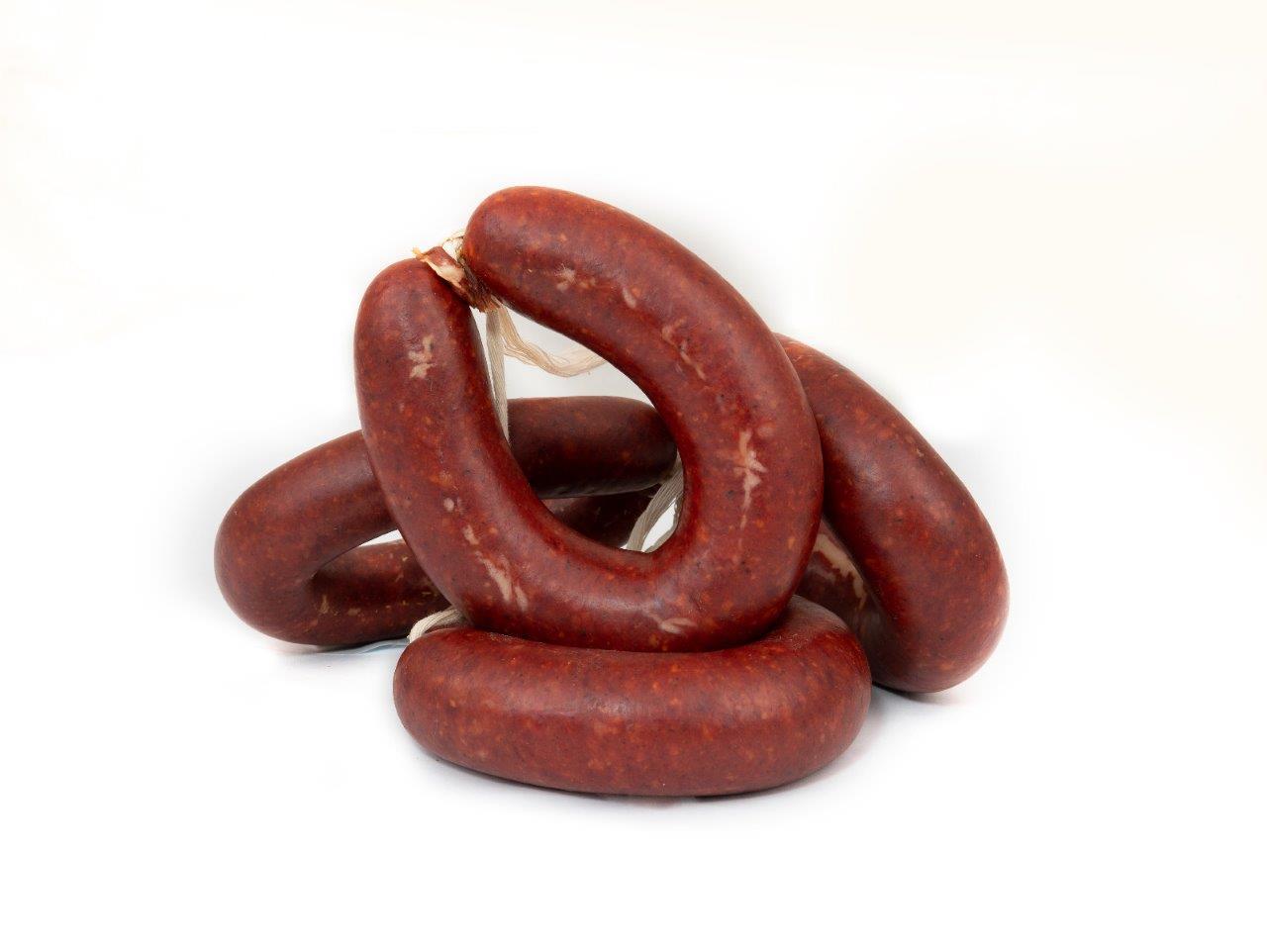
Erzurum sucuğu is a fermented and dried meat product produced by grinding large livestock meat, mixing the minced meat with salt, white sugar, and various spices, stuffing the resulting paste into casings, and allowing it to mature. As a result of an application submitted by the Erzurum Chamber of Commerce, it was registered on 25.04.2022 under registration number 1092 as a geographical indication following a request dated 23.03.2021.
In the production of Erzurum sucuğu, only fresh, well-chilled or frozen beef, veal, or bull meat with a pH value above 5.90, free from nerves and excess fat, is used. The sole source of fat in the product is sheep tail fat; neither internal fat nor rendered fat is permitted. The color of the matured product ranges from brick red to dark brown. It has a distinctive fermented meat flavor resulting from fermentation and spices, along with the characteristic aroma of matured sucuk.
The cross-section has no air pockets or cracks and exhibits a mosaic appearance. There is no air gap between the casing and the meat paste. The chemical properties of the product include a maximum moisture content of 40%, a minimum protein content of 18% (N x 6.25), and a maximum fat content of 30% (m/m). The pH value ranges between 4.7 and 5.4. The nitrite content in curing salt is limited to a maximum of 150 ppm, and the hydroxyproline content is capped at 400 mg/100 g. The product contains no artificial colorants. The salt content is at most 2 kg/kg, and the white sugar content is at most 0.5 kg/kg.
In the production of Erzurum sucuğu, the preferred ingredients are the leg and breast meats of large livestock raised on natural feed in the pastures of Erzurum, along with the tail fat of sheep raised in the same pastures.
The composition of 100 kg of product consists of 85 kg meat, 15 kg tail fat, 5 kg sucuk spice blend, 1.7 kg curing salt, and 100 g “baybal” (a preservative additive mixture).
The production process consists of the following stages:
Erzurum sucuğu has a geographical indication due to its established role in the culinary culture of Erzurum and its historical reputation. All stages of production must be carried out within the officially defined geographical boundaries of Erzurum province.
Monitoring activities are conducted under the coordination of the Erzurum Chamber of Commerce. The monitoring body consists of a three-member team representing the Chamber, the Department of Food Engineering at Atatürk University, and the Erzurum Provincial Directorate of Agriculture and Forestry. Inspections are carried out annually on a regular basis, as well as upon complaint or whenever necessary.
During inspections, compliance with the specified ingredients, production method, and chemical properties is verified, along with the correct use of the designation “Erzurum sucuğu,” its logo, and its geographical indication emblem.
Turk Patent and Trademark Office. "Erzurum Sucuğu Sicil Belgesi." *Geographical Indications Portal.* Accessed October 22, 2025. https://ci.turkpatent.gov.tr/Files/GeographicalSigns/1d9bbe3f-2f5a-4817-a7c5-1bb1684fd3f8.pdf.
Turk Patent and Trademark Office. "Erzurum Sucuğu." *Geographical Indications Portal.* Accessed October 22, 2025. https://ci.turkpatent.gov.tr/cografi-isaretler/detay/3704.

Type of Geographical İndication | Mahreç Sign | ||||||||
|---|---|---|---|---|---|---|---|---|---|
Province(s) | Erzurum | ||||||||
Registration Number | 1092 | ||||||||
Registration Date | 25.04.2022 | ||||||||
Product / Product Group(s) | Processed and unprocessed meat products | ||||||||
Applicant/Registrant(s) | Erzurum Chamber of Commerce | ||||||||
Product Characteristics
Production Method
Geographical Boundary
Monitoring