 Recently Added:
This article was automatically translated from the original Turkish version.
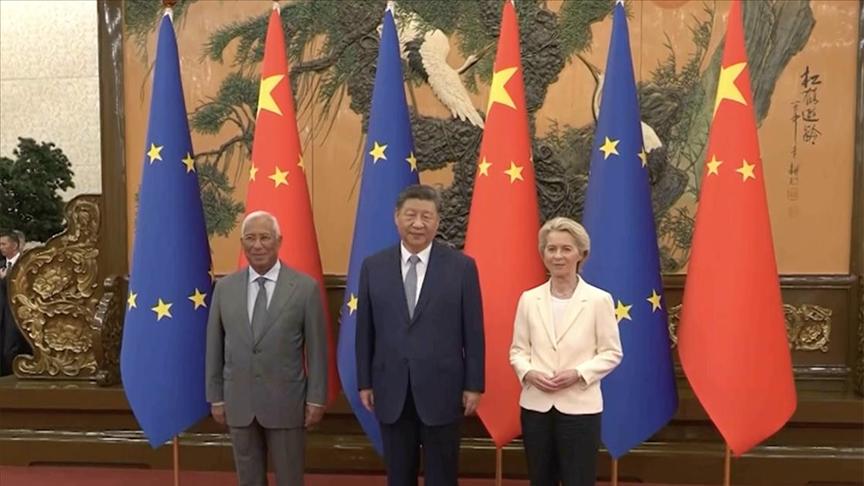
The 25th EU–China Summit was a diplomatic meeting held in Beijing on 24 July 2025 between the European Union and China. Key agenda items included the structure of economic relations, trade imbalances, climate cooperation, and geopolitical developments. The European Union was represented at the summit by European Commission President Ursula von der Leyen and European Council President Antonio Costa, while China was led by President Xi Jinping.

25th EU–China Summit, 24 July 2025 – (Anadolu Agency)
European Commission President Ursula von der Leyen, in a statement prior to the summit, recalled that 2025 marks the 50th anniversary of the establishment of diplomatic relations between the European Union and China. Von der Leyen noted that bilateral cooperation had developed significantly over the past five decades and highlighted that both Europe and China had undergone profound transformations during this period.
The central focus of the summit was the European Union’s demand for a fair and mutually beneficial competitive framework in its economic relations with China. EU officials stated that the approximately 357 billion dollar trade deficit with China as of 2024 had reached an unsustainable level.

25th EU–China Summit, 24 July 2025 – (Anadolu Agency)
The EU called for the removal of structural barriers faced by European companies seeking access to the Chinese market. It was noted that European firms operating in medical devices, automotive, livestock, pharmaceuticals, and cosmetics sectors encounter bureaucratic restrictions.
Commission President von der Leyen stated, “The depth of our commercial relations requires a structural balance between the parties. While China’s investments in Europe proceed freely, European companies do not enjoy the same conditions in China.”
The European Union emphasized that China must go beyond verbal assurances and implement concrete regulatory measures. Criticisms were also raised at the summit regarding China’s subsidy policies in the electric vehicle sector, which are seen as creating an unfair competitive environment in the European market.
The European Commission announced that additional tariffs could be imposed on Chinese-made electric vehicles under an ongoing anti-dumping investigation. Both sides agreed that constructive dialogue must be maintained to prevent escalation of commercial tensions.
On the occasion of the 10th anniversary of the Paris Agreement, climate change mitigation was addressed at the summit. Both parties expressed their commitment to jointly reduce methane emissions, promote clean energy technologies, and accelerate the transition to renewable energy. To this end, a joint “Green Innovation Platform” is targeted to be established by 2026 to conduct technical negotiations.
The impact of the war in Ukraine was also assessed at the summit. The European Union drew attention to China’s close ties with Russia and stressed that Beijing must contribute to peace within the framework of its international responsibilities.
European Council President Antonio Costa stated, “China’s global influence enables it to play a more active role in resolving conflicts. Every powerful actor bears responsibility in building peace.”
The joint statement issued at the conclusion of the summit affirmed that economic and political relations between the European Union and China are complex yet indispensable. Both sides emphasized the importance of continuing constructive dialogue despite existing challenges.
The European Union described the summit as a foundation for progress in bilateral relations, while China underscored the necessity of mutual understanding and strategic patience.
Chinese President Xi Jinping, speaking at the summit, highlighted the importance of anchoring relations with the European Union on a stable and sustainable basis. Xi stated, “Trust must be established in our relations and differences must be managed through dialogue. The European Union is one of China’s key economic partners.” China also expressed its openness to developing joint initiatives on global challenges such as health, food security, and climate change.
Anadolu Ajansı. “AB ve Çin, İkili İlişkilerin Geliştirilmesinde Mutabık.” Accessed July 24, 2025. https://www.aa.com.tr/tr/dunya/ab-ve-cin-ikili-iliskilerin-gelistirilmesinde-mutabik/3640637.
Anadolu Ajansı. “AB, Şirketlerinin Çin Pazarına Erişimi İçin Pekin’in Somut Adımlar Atmasını Bekliyor.” Accessed July 24, 2025. https://www.aa.com.tr/tr/ekonomi/ab-sirketlerinin-cin-pazarina-erisimi-icin-pekinin-somut-adimlar-atmasini-bekliyor/3640853.
Euronews Türkçe. “AB, Pekin’deki AB–Çin Zirvesi’nde Daha Dengeli Bir İlişki İçin Baskı Yapıyor.” Accessed July 24, 2025. https://tr.euronews.com/business/2025/07/24/ab-pekindeki-ab-cin-zirvesinde-daha-dengeli-bir-iliski-icin-baski-yapiyor.
The Wall Street Journal. “Beijing’s Trade Tactics, Ukraine Stance Cast Pall over Europe-China Ties.” Accessed July 24, 2025. https://www.wsj.com/world/beijings-trade-tactics-ukraine-stance-cast-pall-over-europe-china-ties-3cb35230.

The 25th EU–China Summit, held regularly between the European Union (EU) and China, took place in Beijing on 24 July 2025. The summit was convened to assess economic and political relations between the parties and to explore areas of cooperation on global issues. At this year’s summit, the EU side called on China to take concrete steps to facilitate access for European companies to the Chinese market, clearly expressing its expectations regarding trade imbalances, subsidies, and structural imbalances.
No Discussion Added Yet
Start discussion for "EU – China Summit (July 2025)" article
July 24, 2025
Issues Discussed at the Summit
July 24, 2025
Message of Cooperation and Dialogue