
This article was automatically translated from the original Turkish version.
+1 More
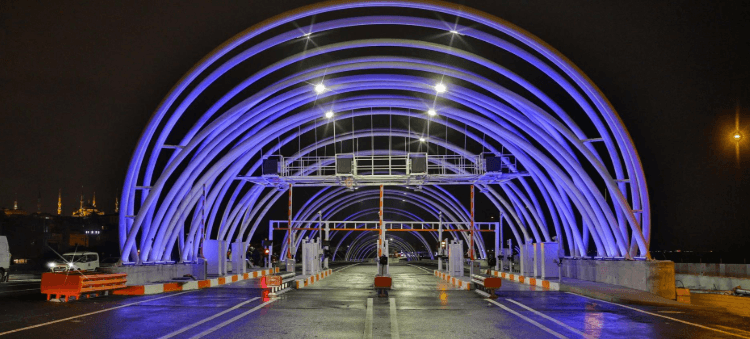
Eurasia Tunnel is designed as the world’s first two-level road tunnel connecting continents. The Eurasia Tunnel, passing beneath the Bosphorus Strait, is a important transportation project that links the two shores of Istanbul (Europe-Asia) via road. It serves the route between Kazlıçeşme and Göztepe, with a total length of 14.6 km.
The design phase of the Eurasia Tunnel was carried out by Parsons Brinckerhoff International Inc., an international firm with extensive experience, and certified by HNTB as the independent reviewer. The project was developed as an integrated system in collaboration with the Istanbul Metropolitan Municipality and other relevant public institutions, ensuring compatibility with existing traffic and infrastructure systems.
Construction of the tunnel began on 30 January 2013 and was completed in 47 months and 3 day like short, surpassing the planned schedule of 55 moon, thereby drawing attention for its project efficiency. The tunnel consists of two levels excavated using a Tunnel Boring Machine (TBM) and additional sections constructed using traditional methods (NATM) for land tunnels.
The TBM used in the project, named “Bayezid,” has a cutter head power of 33.3 kW/m², ranking it first in the world. Additionally, the tunnel was specifically engineered to withstand seismic activity due to its proximity to the North Anatolian Fault Line and is equipped with two seismic joints (hinges), the first such application globally. These joints enable tolerance of up to ±50 mm horizontal displacement and ±75 mm vertical elongation/shortening, thereby minimizing earthquake risks.
Due to challenging geological conditions, over 440 cutting discs and 475 brushes were replaced during excavation, and operations requiring maintenance under hyperbaric pressure were conducted. These operations, particularly at the deepest point where pressure reached 10.8 bar, set a benchmark in terms of world scale.
The operation of the Eurasia Tunnel is managed by ATAŞ. High safety standards have been achieved through collaboration with Egis Tunnel Operation Company. Traffic management and operational processes are controlled using advanced technological systems such as SCADA and the Intelligent Transportation System. Twenty-six different emergency possible scenarios have been planned to address all possible situation events.

Design and Construction Phases of the Project
Tunnel Technology and Advanced Techniques Used in Construction
Benefits Provided by the Project
Traffic and Travel Time
Environmental Contributions
Economic Contributions
Safety and Comfort
Operational Management of the Tunnel
Project Chronology
Project Firsts and Global Examples