

This article was automatically translated from the original Turkish version.
+1 More
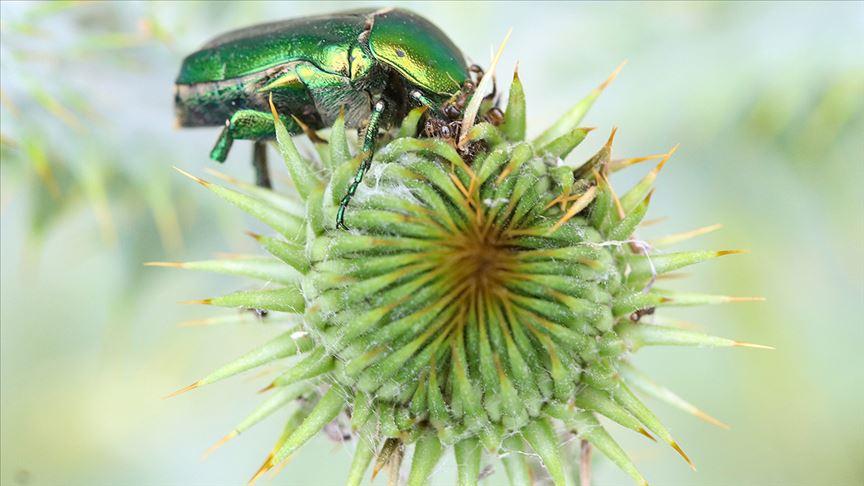
European Rose Beetle (Cetonia aurata) is a species of beetle belonging to the family Scarabaeidae within the order Coleoptera. It is known for feeding on the floral organs of various ornamental plants, particularly rose. Due to its high visibility during flowering periods and its potential to cause aesthetic damage to plants, the species has been the subject of ecological and agricultural research. In the literature, the rose beetle is classified among pests of ornamental plants, with its biology and control methods examined in detail.【1】In Türkiye, it is commonly referred to as the “golden beetle” due to the color of its wings.
The European rose beetle is classified within the subfamily Cetoniinae of the family Scarabaeidae. It is reported to be distributed across various regions of Türkiye as well as throughout Europe, with higher frequencies observed in areas where roses and ornamental shrubs are intensively cultivated. Its distribution is directly linked to the availability of host plants and environmental conditions.【2】
The life cycle of the European rose beetle consists of four main stages: egg, larva, pupa, and adult. Larvae typically live in soil and develop in environments rich in organic matter. Their development during this stage is influenced by environmental factors such as soil structure and moisture. After completion of the pupal stage, adults emerge and become active primarily during the flowering periods of plants. Adults are reported to be most active during daylight hours and possess well-developed flight capabilities.【3】
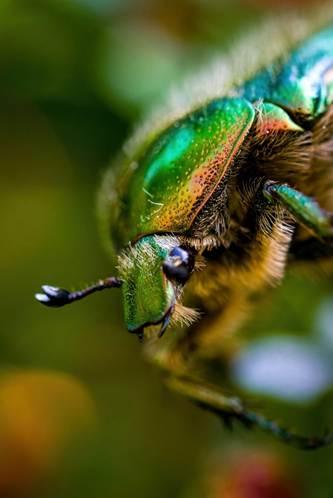
Close-up Image of the European Rose Beetle (Pixabay)
Adult rose beetles feed on the petals, pollen, and nectar of various ornamental plants, with roses being the primary host. The damage caused to floral tissues during feeding reduces the visual appeal of plants and can lead to economic losses in ornamental plant production. Observations in natural habitats indicate that rose beetles are often found feeding on the same plants alongside other insect species, highlighting their role in ecosystem interactions.【4】
The European rose beetle is regarded as a pest in areas dedicated to ornamental plant production. Damage to flowers can result in quality degradation of commercially valuable plants. This necessitates a thorough understanding of the beetle’s biology and population dynamics to develop effective and sustainable control methods.【5】
Research on biological control methods for the European rose beetle has highlighted the use of entomopathogenic nematodes. Studies examining the effect of Heterorhabditis bacteriophora on rose beetle larvae have reported high mortality rates when applied at specific dosages.【6】
Some studies have evaluated the effects of extracts derived from cyclamen (Cyclamen spp.) roots on rose beetle larvae. These studies report that such extracts reduce larval feeding and can exhibit lethal effects at certain concentrations. This potential of plant-derived substances contributes to scientific efforts aimed at developing alternative pest control methods.【7】
[1]
Anadolu Ajansı. "Iğdır'da altın böceklerinin beslenme anını AA kamerası görüntüledi." Yayınlanma tarihi: 22 Temmuz 2020. Erişim tarihi: 14 Ocak 2026. https://www.aa.com.tr/tr/yasam/igdirda-altin-boceklerinin-beslenme-anini-aa-kamerasi-goruntuledi/1938260
[2]
Ülgentürk, Selma. "Gül ve Süs Çalılarında Görülen Zararlılar Bölüm II." Ankara Üniversitesi Açık Ders Notları. Erişim tarihi: 14 Ocak 2026.
[3]
Ülgentürk, Selma. "Gül ve Süs Çalılarında Görülen Zararlılar Bölüm II." Ankara Üniversitesi Açık Ders Notları. Erişim tarihi: 14 Ocak 2026. https://acikders.ankara.edu.tr/pluginfile.php/13724/mod_resource/content/1/G%C3%BCl%20ve%20S%C3%BCs%20%C3%87al%C4%B1lar%C4%B1nda%20G%C3%B6r%C3%BClen%20Zararl%C4%B1lar%20B%C3%B6l%C3%BCm%20II.pdf
[4]
Anadolu Ajansı. "Iğdır'da altın böceklerinin beslenme anını AA kamerası görüntüledi." Yayınlanma tarihi: 22 Temmuz 2020. Erişim tarihi: 14 Ocak 2026. https://www.aa.com.tr/tr/yasam/igdirda-altin-boceklerinin-beslenme-anini-aa-kamerasi-goruntuledi/1938260
[5]
Ülgentürk, Selma. "Gül ve Süs Çalılarında Görülen Zararlılar Bölüm II." Ankara Üniversitesi Açık Ders Notları. Erişim tarihi: 14 Ocak 2026. https://acikders.ankara.edu.tr/pluginfile.php/13724/mod_resource/content/1/G%C3%BCl%20ve%20S%C3%BCs%20%C3%87al%C4%B1lar%C4%B1nda%20G%C3%B6r%C3%BClen%20Zararl%C4%B1lar%20B%C3%B6l%C3%BCm%20II.pdf
[6]
Yüksel, Ebubekir, Mustafa İmren, Merve Özdemir ve Ramazan Canhilal. "Avrupa Gül Böceği, Cetonia aurata (Linné, 1761) (Coleoptera: Scarabaeidae)'nin Mücadelesine Yönelik Sürdürülebilir Bir Yaklaşım: Entomopatojen Nematodlar." Erciyes Tarım ve Hayvan Bilimleri Dergisi 6, no. 1 (2023): 35-40. Erişim 14 Ocak 2026.https://dergipark.org.tr/tr/download/article-file/2921861
[7]
Ertürk, Ömer. "Cetonia aurata L. (Coleoptera, Scarabaeoidea, Cetoniidae) Gelişimi Üzerinde Cyclamen coum subsp. coum Miller Bitki Kök Özütlerinin Antifeedant ve Toksik Etkileri." Ordu Üniversitesi Bilim ve Teknoloji Dergisi 37, no. 2 (2022): 243-262. Erişim 14 Ocak 2026. https://dergipark.org.tr/tr/download/article-file/1799961

No Discussion Added Yet
Start discussion for "European Rose Chafer (Cetonia aurata)" article
Taxonomic Position and Distribution
Biology and Life Cycle
Feeding Behavior
Agricultural and Economic Importance
Control Methods
Biological Control
Plant-Derived Substances