


This article was automatically translated from the original Turkish version.
Extractive metallurgy is an applied branch of metallurgy that focuses on the separation and purification of metals from ores or secondary sources containing metals using various chemical, physical, and electrochemical methods. This field represents the first stage of the metal production chain and ensures the economic and efficient utilization of raw materials. Extractive metallurgy offers a broad range of technologies aimed at recovering metals directly from ores or from waste products of slag and industrial processes.
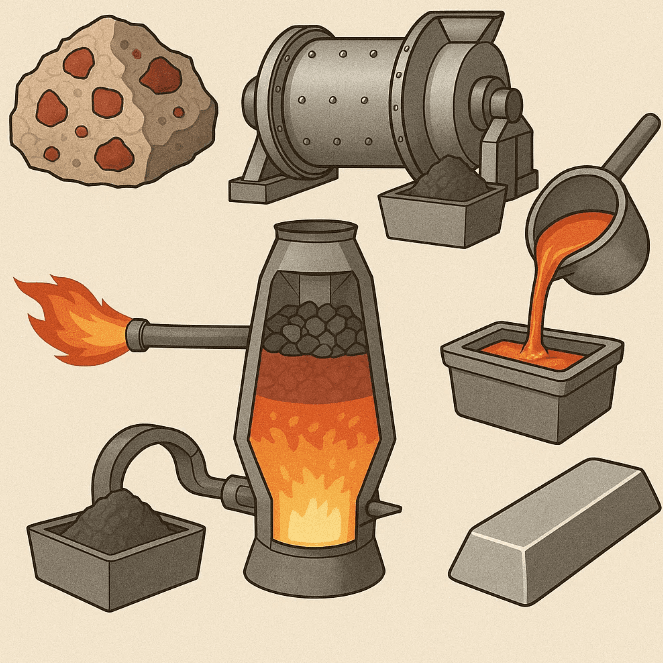
Extractive metallurgy (Generated by Artificial Intelligence.)
Extractive metallurgy is based on three fundamental methods: pyrometallurgy, hydrometallurgy, and solvometallurgy, which has been developed in recent years in response to environmental concerns. Each method is grounded in distinct physicochemical principles and is selected based on the characteristics of the material to be processed.
Pyrometallurgy encompasses all methods that recover metals through high-temperature processes. In these processes, ores or intermediate products are heated in a reductive atmosphere to reduce them to metallic form. The aluminothermic reduction method is a widely used technique among pyrometallurgical operations. In this method, metal oxides react with more active metals such as aluminum to liberate free metal. Studies on the production of CoB pre-alloys have demonstrated that this method is amenable to thermodynamic modeling and is viable at industrial scale.
Hydrometallurgy is based on the principle of dissolving metals in aqueous solutions. In this method, metal ions are leached into solution, then recovered through selective precipitation or solvent extraction. The leaching of copper anode slimes is one application of this technique. Research has shown that the use of low-eutectic-point solvents (easily melted solvent mixtures) increases metal solubility and improves process efficiency. These approaches also hold potential for reducing energy consumption and environmental impact.
Solvometallurgy is a modern approach to extractive metallurgy that differs from hydrometallurgy by using non-aqueous media such as organic solvents, ionic liquids, or deep eutectic solvents instead of water. This method draws attention due to its contribution to environmental sustainability. Studies have highlighted advantages of solvometallurgy including energy savings, low waste generation, and the recyclability of solvents. Positioned as an eco-friendly alternative in chemical metallurgy, solvometallurgy shows particular promise in the processing of low-grade ores.
In addition to traditional ore sources, secondary sources such as slag (metal smelting residue), tailings (ore beneficiation residue), and anode slimes (electrolysis residue) are also evaluated within the scope of extractive metallurgy. For example, studies on the recovery of base metals from copper slag tailings demonstrate that such wastes can be reprocessed to generate economic value. In such operations, sequential processes such as acid roasting, leaching, and magnetic separation are combined to recover both metals and magnetic by-products.
Extractive metallurgy is a discipline that forms the foundation of metal production and has wide applications in modern industry. Methods such as pyrometallurgy, hydrometallurgy, and solvometallurgy provide tailored solutions for different types of raw materials and production conditions. Advancing technologies in energy efficiency, environmental sustainability, and recycling potential have transformed extractive metallurgy into a dynamic and strategically important engineering field. In particular, the evaluation of secondary sources represents a key focus area that enhances the economic and environmental contributions of this field.
Topçu, Mehmet Ali, Volkan Kalem, and Aydın Rüsen. “Bakır Anot Çamurundan Bakırın Liçinde Düşük Ötektik Noktalı Çözücü Kullanımının Araştırılması.” *Çukurova Üniversitesi Mühendislik Fakültesi Dergisi* 36, no. 1 (2021): 105–119. Accessed July 26, 2025. https://dergipark.org.tr/en/download/article-file/1755214
Turan, Ahmet, and Mehmet Buğdaycı. “CoB Ön Alaşımlarının Alüminotermik Redüksiyon Yöntemiyle Üretilmesi ve Termokimyasal Modellenmesi.” *El-Cezerî Fen ve Mühendislik Dergisi* 7, no. 2 (2020): 436–447. Accessed July 26, 2025. https://dergipark.org.tr/en/download/article-file/1127751
Uzun Kart, Eda. “Bakır İzabe Curufu Flotasyon Atığından FeS₂ İlaveli Asit Kavurma, Liç ve Manyetik Ayırma ile Baz Metal ve Manyetik Ürün Eldesinin Araştırılması.” *International Journal of Advances in Engineering and Pure Sciences* 34, no. 2 (2022): 157–166. Accessed July 26, 2025. https://dergipark.org.tr/en/download/article-file/2221491
Çelik Kurtulan, Çisem, Ş. Samet Kaplan, Elif Güloğlu, Gökhan Orhan, Sebahattin Gürmen, and M. Şeref Sönmez. “Kimyasal Metalurjide Çevreci Bir Yaklaşım: Solvometalurji.” *Gazi Üniversitesi Mühendislik-Mimarlık Fakültesi Dergisi* 39, no. 4 (2024): 2643–2654. Accessed July 26, 2025. https://dergipark.org.tr/en/download/article-file/2950748

No Discussion Added Yet
Start discussion for "Extractive metallurgy" article
Basic Methods and Approaches
Pyrometallurgy
Hydrometallurgy
Solvometallurgy
Utilization of Secondary Sources