
+1 More

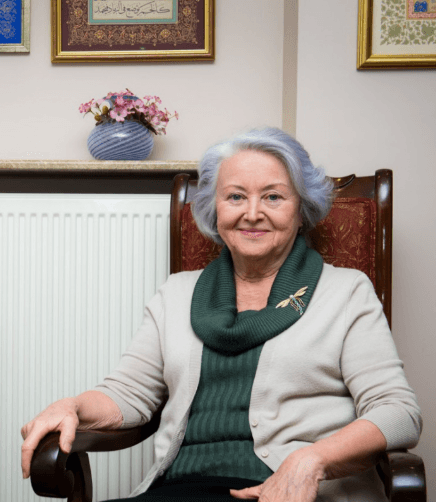
Fatma Çiçek Derman, born in 1945 in Kavaklıdere, Ankara, is an art historian and illuminator who played a significant role in the modern revival of the art of tezhip in Türkiye. She began her education at Istanbul Girls’ High School and later graduated from the Department of Art History at Istanbul University Faculty of Letters. Between 1963 and 1965, she worked as an assistant to Dr. Süheyl Ünver at the Department of History of Medicine and Deontology at Istanbul University, where she first encountered the art of tezhip. In addition to Ünver, she studied under Muhsin Demironat and Rikkat Kunt, learning the art through the master-apprentice tradition. In 1982, she received her master’s certification in illumination from Rikkat Kunt.
Derman served on the faculty of the Faculty of Fine Arts at Marmara University starting in 1985, becoming an associate professor in 1996 and a full professor in 2002 with her thesis titled “The Transformation of Illumination Art Through the Centuries.” She held the position of dean at the faculty and was the founding chair of the Department of Traditional Turkish Arts and the Main Art Discipline of Illumination and Miniature.
From 1976 to 2000, she taught illumination on a honorary basis at the Kubbealtı Nakışhânesi, training hundreds of students. Since 2015, she has continued teaching at the graduate level at the Faculty of Fine Arts of Marmara University and Haliç University. She has also served as a member of the Board of Trustees at 29 Mayıs University.
Çiçek Derman has approached illumination not merely as decoration but as a “spiritual discipline of contemplation.” In an interview published in the journal Ay Vakti, she stated, “Art is a gift bestowed by God upon humanity; this talent can be developed through education, but true mastery lies in work done with the heart.”【1】 She has argued that while preserving the deep historical roots of the art, new works must align with contemporary aesthetic sensibilities. According to Derman, the fundamental principles of illumination, refined over centuries, must be preserved.
She has conducted in-depth research on the types of gold, pigments, stamps, glue, and paper used in illumination. She has been a key guide in preserving classical techniques and integrating traditional materials into contemporary practices. She frequently emphasized the concepts of patience and humility as essential to the essence of the art. In her view, enduring works of art emerge when the practice is carried out with the devotion of worship.
Fatma Çiçek Derman has authored over a hundred articles and numerous encyclopedia entries. Her major books include:
She has also prepared numerous symposium papers and articles documenting the symbolic meanings and historical development of classical motifs.
In 1981, she held exhibitions in Switzerland, England, and Italy. In 1987, she organized an applied exhibition and delivered lectures on behalf of the Ministry of Culture and Tourism of the Republic of Türkiye at The Art Institute of Chicago as part of the Kanuni Sultan Süleyman exhibition.
This was followed by international exhibitions in Islamabad (1994), Frankfurt (1996), Tunis (1997), Tokyo (2003), and Sarajevo (2005). In her exhibitions, she demonstrated the technical aspects of illumination through practical applications and used lectures to explain the philosophical and aesthetic dimensions of the art.
Derman has maintained that art cultivates humility and patience in the individual and has described art as a “trust.” According to her, the artist must nurture this trust with modesty, not arrogance. She emphasized that the master-apprentice relationship extends beyond the period of instruction—it endures a lifetime. Through this philosophy, she led the training of many artists at the Kubbealtı Nakışhânesi.
She has consistently upheld the teachings of her mentors—Süheyl Ünver, Muhsin Demironat, and Rikkat Kunt—and aimed to transmit their artistic ethics to new generations. She adopted the phrase “Carry your art upon yourself” as her guiding principle and taught her students that art must first be integrated with moral character.
Çiçek Derman married Prof. Dr. Uğur Derman, a prominent figure in the arts of ebru and calligraphy. She has three sons and three grandchildren. Throughout her artistic career, Derman never relegated her familial responsibilities to the background, maintaining a balance between her art and her life philosophy.
Fatma Çiçek Derman has united the Ottoman illumination tradition with contemporary art education, playing a vital role in the transition of Turkish decorative art from the 20th to the 21st century through her dual identity as both academic and artist. She has regarded art not merely as formal aesthetics but as a cultural heritage of identity.
Many of her students now hold prominent positions among Türkiye’s leading illuminators and art historians. In this way, Derman has become one of the essential links ensuring the continuity of traditional art.
Ay Vakti. "Çiçek Derman ile Tezhip Üzerine Bir Söyleşi." *Ay Vakti Dergisi*, December 19, 2005. Accessed October 9, 2025. https://ayvakti.net/?p=9064
GZT. “Tezhip sanatının nadide ustalarından biri: Çiçek Derman.” *GZT Arkitekt*, January 5, 2021. Accessed October 9, 2025. https://www.gzt.com/arkitekt/tezhip-sanatinin-nadide-ustalarindan-biri-cicek-derman-3566329
Ketebe. "Sanatkâr Fatma Çiçek Derman kimdir? Fatma Çiçek Derman hayatı ve eserleri." Ketebe.org. Accessed October 9, 2025. https://www.ketebe.org/sanatkar/fatma-cicek-derman-2133
Klasik Türk Sanatları Vakfı. "Prof. Dr. Fatma Çiçek Derman." Klasik Türk Sanatları Vakfı. Accessed October 9, 2025. https://www.ktsv.com.tr/sanatkar/cicek-derman
Kubbealtı Akademisi Kültür ve Sanat Vakfı. "Prof. Dr. Çiçek Derman." Accessed October 9, 2025. https://kubbealti.org.tr/kisi/cicek-derman
Türkiye’s Masters. "Fatma Çiçek Derman." *Türkiye’nin Ustaları Projesi*. Accessed October 9, 2025. https://www.turkiyeninustalari.org/tr/ustalar/fn-altthhyb/fatma-cicek-derman
[1]
Ay Vakti. “Çiçek Derman ile Tezhip Üzerine Bir Söyleşi.” Ay Vakti Dergisi, 19 Aralık 2005. Erişim tarihi 9 Ekim 2025. https://ayvakti.net/?p=9064

Academic Career and Positions
Research and Contributions to Illumination Art
Works and Publications
Exhibitions and International Participation
Artistic Philosophy and Teaching
Awards
Family and Personal Life