This article was automatically translated from the original Turkish version.
+1 More
Elevation(s) | 1270 Metre | ||||||||
|---|---|---|---|---|---|---|---|---|---|
Establishment | Cilician Armenian Kingdom Period | ||||||||
Architectural Feature(s) | Defense Structure Towers Mazgal Windows | ||||||||
Location | Feke Adana | ||||||||
Current Status | Partially Standing | ||||||||
Strategic Location | Control of Mountainous Cilicia | ||||||||
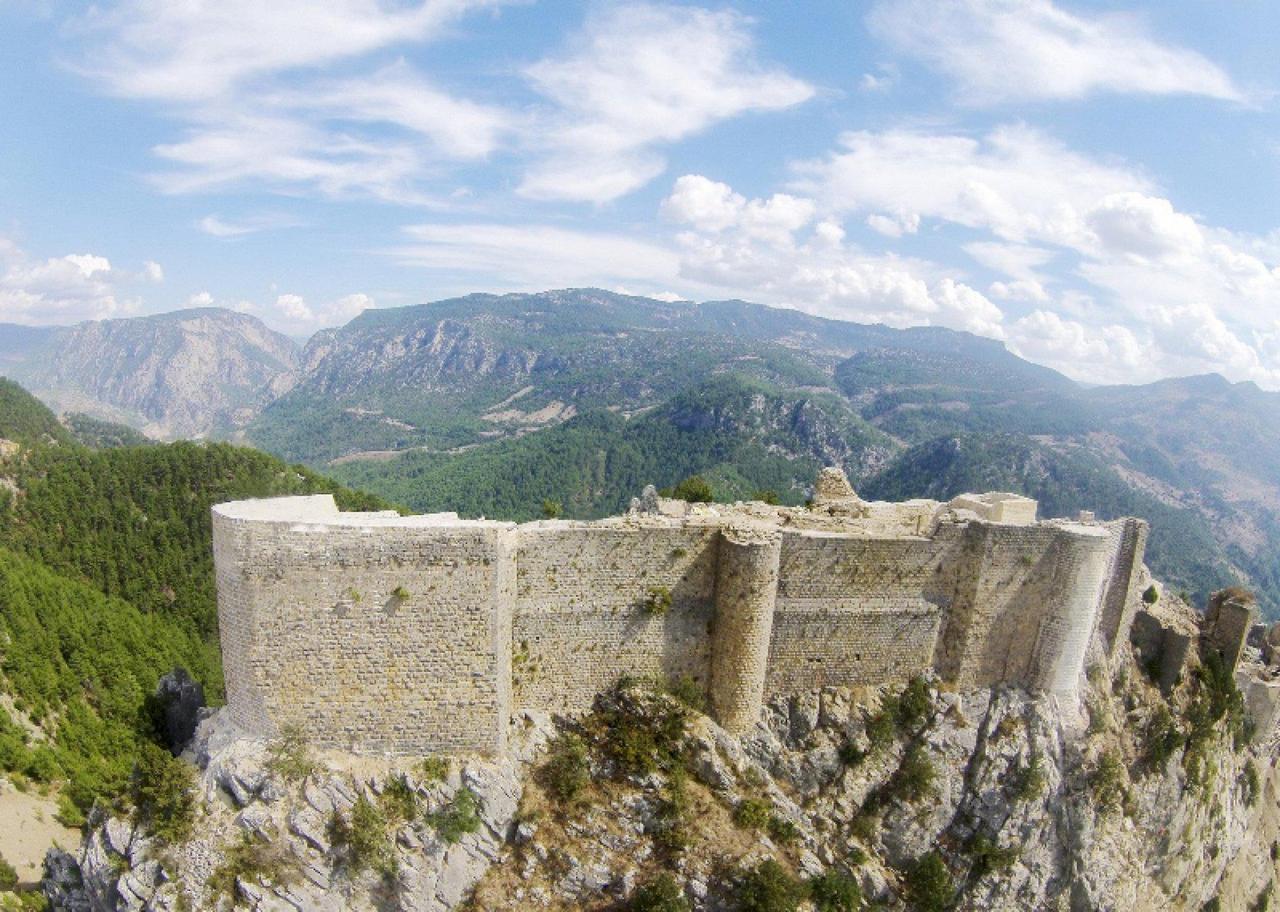
Feke Kalesi is a medieval military structure located on a steep hill at an elevation of 1270 metres near the district of Feke in Adana province. The castle, with a rectangular plan, is notable for its north-south oriented curtain walls, eight towers, and a watchtower. Built during the Armenian Kingdom period, it controlled the surrounding valleys and roads due to its strategic position. Today, only ruins remain accessible, and the structure reveals a complex entrance and interior layout designed for defense.
Feke Kalesi assumed a strategic role in the 12th century as one of the earliest castles of the Cilician Armenian Kingdom. Located six kilometres northeast of the Feke district centre along the Kozan-Kayseri road, it occupies an area measuring 190 by 25 metres in a north-south orientation.【1】 During the Armenian Kingdom period, it served as a significant base amid the region’s political and military activity. The castle, captured from the Byzantines in 1098 by Constantine, son of Ruben, changed hands several times at the end of the 11th and beginning of the 12th century due to his brief reign and shifting regional power balances. In 1111, spoils seized by Baron I. Toros were stored in Feke, and in 1138 the castle was besieged by the Byzantines; after a three-week siege, it surrendered.【2】

Feke Kalesi (Kültür Portalı)
In subsequent years, the castle changed hands between the Danishmendids and Armenian rulers, and during the reign of II. Toros it served as a central base in the conquest of southern Cilicia. In 1275, the Patriarch of Kozan sought refuge in Feke to escape Mamluk attacks, leaving or copying some manuscripts within the castle. The region later came under Mamluk and Ottoman rule, and the Armenian population persisted until the 1920s.【3】 This historical trajectory demonstrates the castle’s military and administrative functions in Cilicia and underscores its enduring strategic importance throughout the Middle Ages.
Feke Kalesi is situated on a steep hill at an elevation of 1270 metres near the district of Feke, approximately 120 kilometres north of the city of Adana. Its position along a north-south oriented valley and road network enabled surveillance of the region and control of key transit points. The steep slopes on the eastern and northern sides of the castle served as natural defenses, requiring substantial curtain walls to be constructed only on the western side. This topographical advantage strengthened the castle’s defense and made successful sieges by enemy forces difficult.
The castle’s strategic location enhanced its military and administrative significance during the Armenian Kingdom period. Control over the Kozan-Kayseri road and surrounding valleys made it suitable as both a regional power center and a logistical base. Additionally, the security of nearby settlements and agricultural areas was ensured by this strategic position, and the defensive layout of the entrance and interior spaces was designed to complement this geographical advantage.
Feke Kalesi is characterized by its north-south oriented curtain walls, eight towers, and a watchtower. The serpentine curtain walls winding along the hilltop merge with natural precipices that hinder access to the castle. The rectangular entrance section connects to the interior via a vaulted and stair-lined tunnel. The castle exhibits a complex defensive layout, with towers and wall buttresses positioned at strategically critical points. Interior spaces include cisterns, storage areas, and other functional zones. The overall plan was designed to meet both military and logistical needs, reflecting an architectural approach aimed at controlling the surrounding valleys and transit routes.
The interior spaces of Feke Kalesi were arranged to meet both defensive and daily operational needs. Within the castle, cisterns stored water, while storage areas served military and logistical functions, alongside kitchens and barracks. The vaulted and stair-lined tunnel, beginning at the entrance, provided secure access to the castle and was reinforced with defensive features. Cisterns collected water through channels carved into or onto the bedrock. Variations in elevation and machicolation windows between spaces enabled both observation and defense. This internal organization supports the castle’s strategic position and military functions.
The curtain walls and towers of Feke Kalesi were primarily constructed using ashlar stone. The use of stones of different colours in certain sections enhanced the visual prominence of the towers. Vaulted structures and cisterns were also built with ashlar masonry, with craftsmanship details particularly evident in the stair-lined tunnel and entrance areas. The thickness of the walls and the arrangement of buttresses increased the structure’s load-bearing capacity and strengthened its defensive function. Walls built upon the natural rocky terrain presented challenges during construction but simultaneously conferred additional durability to the castle.

Feke Kalesi (T.C. Milli Eğitim Bakanlığı)
The construction techniques of the castle, particularly the complex vaulted and stair-lined tunnels, stand out. These structural elements not only enhanced defense but were also designed to impede enemy access to the castle. The plans of the towers and bastions were arranged in rectangular and circular forms, and the curtain walls were equipped with machicolations. Cisterns and water channels were constructed in harmony with the bedrock to ensure safe water storage. All these technical applications reveal a detailed construction approach that supported both the military and logistical functions of the castle.
Feke Kalesi is currently a partially standing structure, with some sections having been destroyed. Particularly, portions of the eastern and western curtain walls on the cliff edges have survived in fragments, while the upper sections of several towers and bastions are largely ruined. Restoration and surveying efforts have documented the castle’s plan and structural characteristics. These works aim to preserve the historical integrity of the structure and ensure its transmission to future generations. The natural topography in areas difficult to access contributes to the castle’s preservation, while supportive measures have been taken to protect walls and cisterns in open areas. Restoration initiatives represent important steps toward safeguarding Feke Kalesi’s value as a cultural heritage.
Akpolat, Mustafa S. “Kilikya Bölgesinde Bir Ortaçağ Askeri Mimarlık Örneği: Feke Kalesi.” *Hacettepe Üniversitesi Edebiyat Fakültesi Dergisi* 25, no. 2 (2008): 1-14. Accessed February 4, 2026. https://dergipark.org.tr/tr/pub/huefd/article/509010
Culture Portal. "Feke Kalesi - Adana." Culture Portal, Ministry of Culture and Tourism of the Republic of Türkiye. Accessed February 4, 2026. https://www.kulturportali.gov.tr/turkiye/adana/gezilecekyer/feke-kalesi-1
Culture Portal. "Feke Kalesi." Culture Portal, Ministry of Culture and Tourism of the Republic of Türkiye. Accessed February 4, 2026. https://www.kulturportali.gov.tr/turkiye/adana/kulturenvanteri/feke-kalesi
Ministry of Interior of the Republic of Turkey, Feke District Governorate. "Feke Kalesi." Feke Kaymakamlığı Resmî Web Sitesi. Accessed February 4, 2026. https://www.feke.gov.tr/feke-kalesi-20-10-2015
T.C. Ministry of Interior, Feke District Governorship. "Feke Kalesi." Feke Kaymakamlığı Resmî Web Sitesi. Accessed February 4, 2026. https://www.feke.gov.tr/feke-kalesi
T.C. Ministry of National Education,Feke İlçe National Education Directorate. "Feke’s History." *Feke District National Education Directorate Official Website*. Accessed February 4, 2026. https://feke.meb.gov.tr/www/fekenin-tarihi/icerik/405
[1]
Mustafa S. Akpolat, “Kilikya Bölgesinde Bir Ortaçağ Askeri Mimarlık Örneği: Feke Kalesi,” Hacettepe Üniversitesi Edebiyat Fakültesi Dergisi 25, no. 2 (2008): 1, Son Erişim: 4 Şubat 2026, https://dergipark.org.tr/tr/pub/huefd/article/509010
[2]
Mustafa S. Akpolat, “Kilikya Bölgesinde Bir Ortaçağ Askeri Mimarlık Örneği: Feke Kalesi,” Hacettepe Üniversitesi Edebiyat Fakültesi Dergisi 25, no. 2 (2008): 4-5, Son Erişim: 4 Şubat 2026, https://dergipark.org.tr/tr/pub/huefd/article/509010
[3]
Mustafa S. Akpolat, “Kilikya Bölgesinde Bir Ortaçağ Askeri Mimarlık Örneği: Feke Kalesi,” Hacettepe Üniversitesi Edebiyat Fakültesi Dergisi 25, no. 2 (2008): 5, Son Erişim: 4 Şubat 2026, https://dergipark.org.tr/tr/pub/huefd/article/509010

Elevation(s) | 1270 Metre | ||||||||
|---|---|---|---|---|---|---|---|---|---|
Establishment | Cilician Armenian Kingdom Period | ||||||||
Architectural Feature(s) | Defense Structure Towers Mazgal Windows | ||||||||
Location | Feke Adana | ||||||||
Current Status | Partially Standing | ||||||||
Strategic Location | Control of Mountainous Cilicia | ||||||||
History
Location and Strategic Importance
Architectural Features
Interior Spaces
Materials and Construction Techniques
Conservation Status