This article was automatically translated from the original Turkish version.
+1 More
Name(s) | Fertek Kilise Cami | ||||||||
|---|---|---|---|---|---|---|---|---|---|
Other Name(s) | H. Taxiarchoi Church Fertek Greek Church | ||||||||
Location | Fertek (Aydınyurt) Neighborhood Niğde Niğde Central | ||||||||
Construction Date(s) | 1835 (some sources cite 1831 or 1837) | ||||||||
Patron | Karamanoğlu Hacı Nikola Karamanlis | ||||||||
Dedicated Saint | H. Taxiarchoi | ||||||||
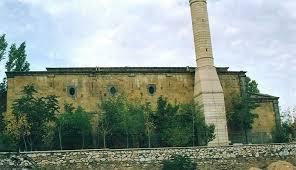
Fertek Kilise Cami is located in the former town of Fertek (historically known as Phertakaina, Ferteki, Ferteköy, Fertekena, today Aydınyurt), approximately two kilometers southwest of the center of Niğde. Originally constructed to serve the Orthodox Christian community, the church was dedicated to H. Taxiarchoi.
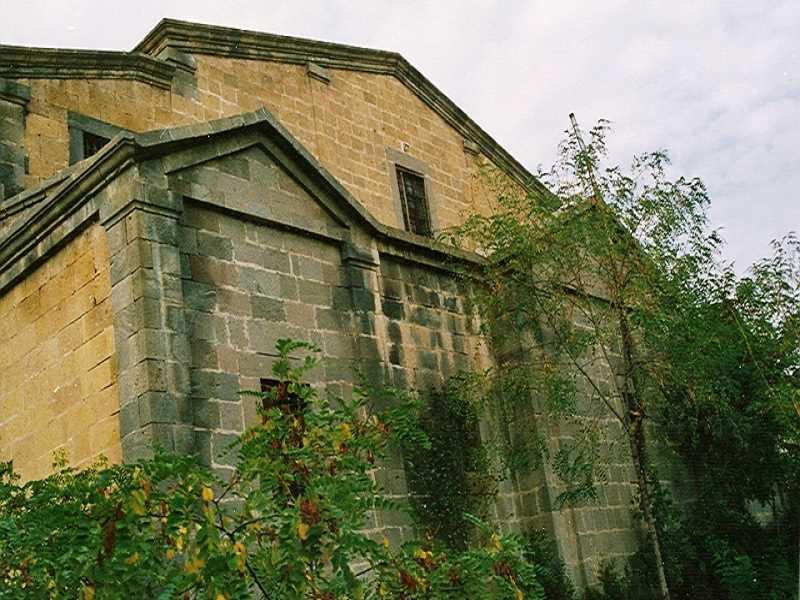
Fertek Kilise CamiTürkiye Culture Portal)
The building’s Karamanlı inscription, now housed in the Niğde Museum, bears the date 1835 and names its patron, Fertekli Karamanoğlu Hacı Nikola Karamanlis. Some sources cite alternative construction dates of 1831 or 1837.
On 7 December 1925, the building was officially converted into a mosque with permission, and a minbar and mihrap were added to the interior space. The original church architecture has been largely preserved.
Fertek Kilise Cami is a three-nave basilical structure oriented east-west. The central nave is wider and taller than the side naves and is covered by a barrel vault. Each nave is supported by five columns, which are connected to each other and to the side walls by semi-circular arches.
The narthex, located at the western end of the building, encircles the structure in a U-shape and projects outward with a semi-circular extension. The narthex has a flat wooden ceiling divided into five sections. Sixteen columns support the arches that form the narthex structure. Access to the gallery level is provided by a wooden staircase located in the prothesis section, and this gallery is also covered by a barrel vault.
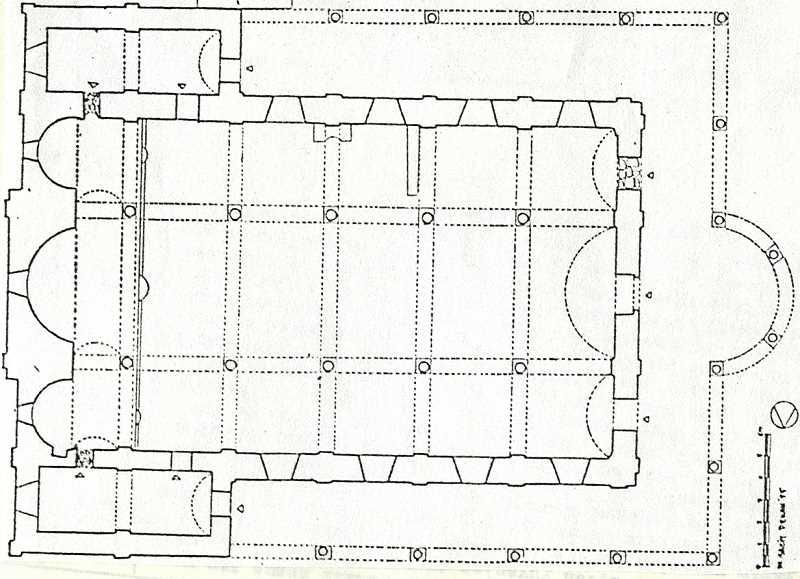
Fertek Kilise CamiTürkiye Culture Portal
The eastern end of the building features three apses. Internally, the apses are semi-circular, while externally they are articulated with flat facades enhanced by recesses. On either side of each apse are pastophoria chambers (diakonikon and prothesis) that connect to both the naos and the apses. These connections were sealed in later periods. A semi-circular niche in the style of an aedicula is notable in the north apse.
The building was constructed using yellowish cut stone and basalt. On the exterior façade, particularly on the narthex side, baroque relief decorations and a Karamanlı inscription are visible. On the north and south façades, three oval-shaped windows are arranged in the upper sections.
Calligraphic decorations draw attention on the arches and vaults of the naos. Additionally, figural wall paintings are present in the apses and pastophoria cells. The central apse and the north apse depict the Transfiguration, the south apse depicts the Panagia Mary, and the south face of the prothesis shows the Transfiguration scene. Five figures are depicted on the south and east side walls: two angels and three saints. The paintings on the north wall of the diakonikon have been damaged.
T.C. Ministry of Culture and Tourism. “Kilise ve Şapeller.” *Niğde İl Kültür veTurizm Müdürlüğü. Accessed June 24, 2025. https://nigde.ktb.gov.tr/TR-154659/kilise-ve-sapeller.html.
“Fertek Kilise Camii (Niğde).” *Kültür Envanteri*. Accessed June 24, 2025. https://kulturenvanteri.com/yer/fertek-kilise-camii-nigde/#17.1/37.97374/34.621441.
“Fertek Kilisesi.” *Kültür Portalı*. Accessed June 24, 2025. https://www.kulturportali.gov.tr/turkiye/nigde/kulturenvanteri/fertek-klses.
“Niğde Fertek Kilise Cami (H. Taxiarchoi Kilisesi).” *Türkiye Turizm Ansiklopedisi*. Accessed June 24, 2025. http://turkiyeturizmansiklopedisi.com/nigde-fertek-kilise-cami-h-taxiarchoi-kilisesi.
Name(s) | Fertek Kilise Cami | ||||||||
|---|---|---|---|---|---|---|---|---|---|
Other Name(s) | H. Taxiarchoi Church Fertek Greek Church | ||||||||
Location | Fertek (Aydınyurt) Neighborhood Niğde Niğde Central | ||||||||
Construction Date(s) | 1835 (some sources cite 1831 or 1837) | ||||||||
Patron | Karamanoğlu Hacı Nikola Karamanlis | ||||||||
Dedicated Saint | H. Taxiarchoi | ||||||||
No Discussion Added Yet
Start discussion for "Fertek Church Mosque" article
Construction Date and Patron
Conversion to a Mosque
Architectural Plan and General Features
Narthex and Gallery Level
Apses and Pastophoria Spaces
Materials and Facade Features
Interior Decorations