

This article was automatically translated from the original Turkish version.
+1 More
Giresun Museum
Address | Kale Mahallesi Giresun Atatürk Bulvarı No: 62 | ||||||||
|---|---|---|---|---|---|---|---|---|---|
Original Construction Date | 1850–1860 | ||||||||
Restoration | 1982–1988 | ||||||||
Opening Date as a Museum | 1988 | ||||||||
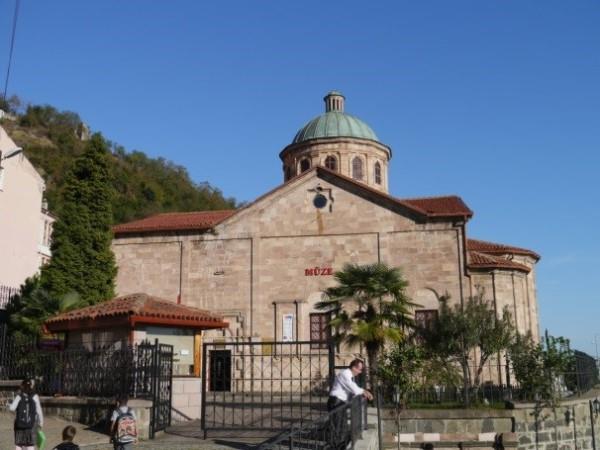
Giresun Museum operates in a historic building located in the Zeytinlik Neighborhood (formerly known as Gogora Neighborhood) of Giresun city center, in the Black Sea Region of Türkiye. The museum houses both archaeological and ethnographic artifacts, serving as a cultural institution that reflects the historical and cultural heritage of the region.
The museum building was constructed between the mid-18th century and 1850–1860 by the Greek Orthodox community as a church. Its original name was Gogora Church, and it was situated in the neighborhood bearing the same name. The structure served for worship until 1924, after which it was abandoned following the Turkey-Greece population exchange. From 1924 to 1948, the church remained vacant and suffered significant damage during this period. In 1948, the building was partially restored and used as a prison from 1948 to 1967. It was left vacant again between 1967 and 1982, during which time it fell into severe disrepair and faced imminent collapse. Between 1982 and 1988, the Ministry of Culture and Tourism undertook its restoration, and the building opened as a museum in 1988.
The Giresun Provincial Special Administration allocated the museum building to the Provincial Directorate of Culture and Tourism for a period of 25 years, thereby officially establishing its function as a public museum.
Giresun Museum is constructed as a rectangular building oriented east-west within a courtyard. The interior layout combines a basilical plan with a domed cross plan, resulting in a composite spatial arrangement. The exterior façade is built of cut stone, and the roof is hipped and covered with traditional Turkish clay tiles.
The main entrance is located on the western façade. On either side of this entrance are carved column profiles and twisted columns. The lintel above the entrance is decorated with twisted columns. The area surrounding the main door is framed by rectangular and plaited motifs. There are two secondary doors on both the northern and southern façades. The northern door features S-shaped false arch ends and toothed decorative elements, while the southern door is adorned with a battlement motif.
The interior consists of three naves. The central nave, covered by a barrel vault, is wider than the side naves. The naves are separated by two rows of columns whose capitals are in the Ionic style and whose bases exhibit local architectural characteristics. The building includes a triapsidal plan. The central apse and the projecting side apses create a dynamic appearance on the exterior façade. The central apse is both wider and taller than the side apses. At the center of the structure stands a high drum dome with twelve windows. Four columns extend toward the center of the dome, and at its exact center is a depiction of Jesus.
To the north of the main building stands a three-story structure known as the “Priest’s House,” built on a basement level and constructed at a later date than the church. Restored in 1993 according to its original design, the Priest’s House now serves as the museum’s administrative building. The ground floor and first floor are arranged as administrative offices, while the second floor functions as staff accommodation. Each floor is approximately 100 square meters. Adjacent to the western façade of the Priest’s House are two parallel vaulted storage rooms, also covered by barrel vaults, which are used as exhibition halls. Two stone fountains are located on the southern façade of the church and the western façade of the Priest’s House.
The Giresun Museum displays archaeological and ethnographic artifacts from the Early Bronze Age, Hittite, Hellenistic, Roman, Byzantine, Seljuk, and Ottoman periods. In addition to items collected locally, some pieces have been transferred from other museums. The archaeological collection includes terracotta figurines, vessels, amphorae, architectural fragments, and coins. The coins span various historical periods and shed light on the region’s economic history. The ethnography section features 19th-century clothing, kitchen and bath equipment, weapons, kilims, and jewelry. These artifacts reflect the traditional lifestyle and cultural structure of the local population.

Giresun Museum - AA
Giresun Museum is located within the boundaries of Kale Neighborhood in the city center of Giresun. The museum is easily accessible by foot and by vehicle.
Giresun Museum (YouTube/Giresun)
Anadolu Ajansı. *Giresun Müzesi*. Accessed May 16, 2025.
Culture and Museums General Directorate. "Giresun Müzesi." *Culture and Museums General Directorate Official Visual Archive*. https://kvmgm.ktb.gov.tr/Resim/353998,giresun-giresunmuze01jpg.png?0. Accessed May 16, 2025.
Giresun İl Directorate of Culture and Tourism. "Giresun Müzesi." *T.C. Kültür veTurizm Bakanlığı Resmî Web Sitesi*. https://giresun.ktb.gov.tr/TR-207018/giresun-muzesi.html. Accessed May 16, 2025.
Karadeniz Turizm Rehberi. "Giresun Müzesi." karadeniz.gov.tr. Accessed May 16, 2025.
Ministry of Culture and Tourism. "Giresun Müzesi." *Kültür Portalı*. https://kulturportali.gov.tr/turkiye/giresun/gezilecekyer/giresun-muzesi. Accessed May 16, 2025.
Türkiye Cumhuriyeti Kültür ve Turizm Bakanlığı. “Giresun Müzesi.” *Müze.gov.tr*. https://muze.gov.tr/muze-detay?SectionId=GRS01&DistId=MRK. Accessed May 16, 2025.
YouTube. "Giresun Müzesi." Published by: Kültür ve Turizm Bakanlığı, February 7, 2023. Video, 3:45. https://www.youtube.com/watch?v=Eo6FmSBEU8k. Accessed May 16, 2025.

Giresun Museum
Address | Kale Mahallesi Giresun Atatürk Bulvarı No: 62 | ||||||||
|---|---|---|---|---|---|---|---|---|---|
Original Construction Date | 1850–1860 | ||||||||
Restoration | 1982–1988 | ||||||||
Opening Date as a Museum | 1988 | ||||||||
History
Architectural Features
Museum Collection
Location and Access