

Geographical Indication Type(s) | Protected Geographical Indication | ||||||||
|---|---|---|---|---|---|---|---|---|---|
Registration Date | 11.10.2023 | ||||||||
Product / Product Group(s) | Dishes and Soups | ||||||||
Province(s) | Muğla | ||||||||
Applicant/Registrant(s) | Fethiye Chamber of Commerce and Industry | ||||||||
Fethiye Tarhana is a traditional type of tarhana produced in the Fethiye and Seydikemer districts of Muğla. It was registered with a Protected Geographical Indication on October 11, 2023 by the Fethiye Chamber of Commerce and Industry under Law No. 6769 on Industrial Property. This product has been shaped by the local climate, traditional production techniques, and cultural habits. Both in terms of ingredients and production method, it is distinct from tarhana produced in other regions of Türkiye.
Fethiye Tarhana possesses characteristics unique to its region regarding production method and ingredients. It is produced exclusively in the Fethiye and Seydikemer districts, following a long-standing tradition of collective preparation and cultural hospitality. Its reputation is directly linked to this geographical area.
Tarhana is made by mixing wheat, yogurt, dried beans, chickpeas, millet, corn, cowpeas, red pepper, dried onion, tomato, sourdough, garlic, mint, thyme, and salt in specific proportions. The dough is then left to ferment, dried, and ground. The product is also known locally as “Göceli Tarhana” due to the inclusion of a wheat and legume component called “göce flour.”
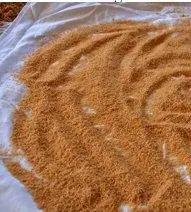
Fethiye Tarhana is fine-grained, non-clumping, and glossy, with red, yellow, and orange tones. It has a partially sour and spiced flavor, with visible pieces of spices, cereals, and legumes. No artificial flavors or additives are used in production.
The production involves multiple time-intensive steps:
Fethiye Tarhana is stored either in bulk or in food-grade packaging, preferably cloth bags, in cool, dry, and odor-free conditions. It is labeled according to relevant food regulations.
For soup preparation, tarhana is typically cooked with fat (butter, sunflower oil, or olive oil), red pepper, and water. The mixture is boiled until the desired consistency is reached and served hot.
Production and processing are inspected at least once a year by a supervisory committee of at least three people, coordinated by the Fethiye Chamber of Commerce and Industry, including representatives from the Fethiye District Directorate of Agriculture and Forestry and the Fethiye Chamber of Agriculture. Inspections check ingredient compliance, adherence to production methods, and proper use of the Protected Geographical Indication. Any non-compliance is reported, and corrective measures are taken.
Türk Patent ve Marka Kurumu. "Fethiye Tarhanası." Coğrafi İşaretler Portalı. Accessed October 25, 2025. https://ci.turkpatent.gov.tr/cografi-isaretler/detay/8374
Türk Patent ve Marka Kurumu. Fethiye Tarhanası Coğrafi İşaret Sicil Belgesi. Türk Patent ve Marka Kurumu. Accessed October 25, 2025. https://ci.turkpatent.gov.tr/Files/GeographicalSigns/37fa61e0-db3d-4168-8aab-a6655e085956.pdf

Geographical Indication Type(s) | Protected Geographical Indication | ||||||||
|---|---|---|---|---|---|---|---|---|---|
Registration Date | 11.10.2023 | ||||||||
Product / Product Group(s) | Dishes and Soups | ||||||||
Province(s) | Muğla | ||||||||
Applicant/Registrant(s) | Fethiye Chamber of Commerce and Industry | ||||||||
Geographical Context and Definition
Distinguishing Features
Production Process
Storage and Serving
Inspection and Protection
This article was created with the support of artificial intelligence.