

This article was automatically translated from the original Turkish version.
+2 More
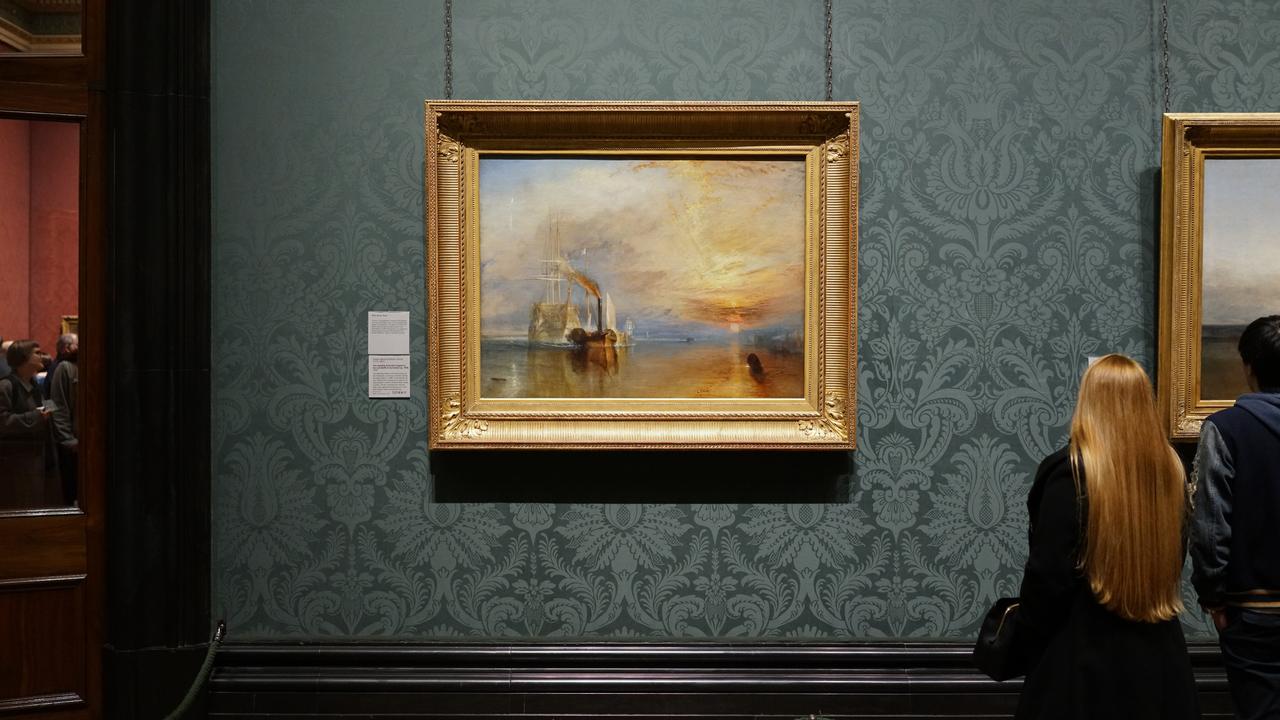
The Fighting Temeraire (The Fighting Temeraire) is an oil on canvas landscape painting completed in 1839 by the English painter Joseph Mallord William Turner. The work depicts the HMS Temeraire, one of the veteran ships of the 1805 Battle of Trafalgar, being towed up the River Thames on its final journey to be broken up. Measuring 90.7 × 121.6 cm, the painting was incorporated into the National Gallery collection in 1856 as part of the Turner Bequest.

The Fighting Temeraire (Flickr)
The HMS Temeraire, the subject of the painting, is a 98-gun, three-decked warship. Built using over 5,000 oak trees, it played a significant role during the Napoleonic Wars and defended Admiral Nelson’s flagship HMS Victory during the Battle of Trafalgar in 1805.【1】 Following the peace of 1815, like many large warships of the British Navy, it was rendered obsolete. From 1820 onward, it was moored off Sheerness and served as a supply vessel.
In June 1838, the Admiralty decided to sell the ship, which had surpassed 40 years of age and was beginning to decay, for its timber value. Prior to sale, the Navy removed its masts, rigging, and other reusable components, reducing it to a hollow hull. The ship was sold for £5,530 to John Beatson, a shipbreaker and timber merchant from Rotherhithe.【2】 Weighing 2,110 tons and unable to sail under its own power due to the absence of masts, Beatson hired two steam tugs to tow the Temeraire from Sheerness to its dismantling yard in Rotherhithe along the River Thames. This journey, which began on 5 September 1838, lasted approximately two days, with the ship arriving at the yard on 6 September.【3】

Detailed View (Flickr)
The painting depicts the HMS Temeraire warship being towed across the River Thames under a vast sunset. The composition is structured around geometric and optical balances derived from the river’s surface, the sky, and the positioning of the vessels.
Turner did not place the warship at the center of the canvas but positioned it to the left. In front of the ship is a black, steam-powered tugboat pulling it. On the right, at the intersection of the lower third and upper two-thirds of the composition, a golden sun disc is visible. In the distant right background, smaller vessels and the silhouette of another tugboat appear faintly. The lower third depicts the river’s surface, while the upper area is dominated by a cloud-filled sky.
A rich color palette is employed to create atmospheric effects. Temperature contrast is pronounced between the left and right sides of the composition. On the right, warm tones of deep orange and yellow dominate under the setting sun, while on the left, the cool blue of the sky, the silvery light of the moon, and the grayish hues of the ship create a colder impression.【4】 The sky is painted in shades of yellow, orange, red, and mauve, which are reflected on the water’s surface.【5】 A pale crescent moon rises in the upper left corner.

Color Usage Difference Between Left and Right Sides of the Painting (Flickr)
Organic and geometric forms coexist in the painting. The hull of the ship exhibits a more structural and geometric form, while the water and sky are rendered with fluid, organic lines. The vertical lines of the ship’s masts contrast with the horizontal lines of its furled sails. A cylindrical object (a buoy) floating on the water on the right and the circular form of the sun enhance the compositional variety.
In this work, Turner focused on the effects of light and atmosphere rather than the clarity of objects. Different brush techniques are applied across various areas of the painting.
The ship itself is rendered with considerable detail; elements such as windows, hanging ropes, and exterior design are executed with fine craftsmanship. In contrast, areas depicting the sun and clouds employ thick layers of paint (impasto).【6】 The thick application of paint imparts dramatic depth and volume to the sunset scenes. Elsewhere, in the water and sky, brushstrokes are looser, more scattered, and atmospheric.

Detailed View of the Ship (Flickr)
The artist creates a sense of depth through varying levels of detail. The Temeraire and the tugboat in the foreground are rendered with sharper outlines, while the other vessels and structures in the background appear blurred and silhouetted. A narrow band of blue sky directly beneath the sun establishes the horizon line, defining the spatial distance between sky and water.
Turner altered historical accuracy in composing the scene to preserve the ship’s visual dignity and emphasize the transition from sail to steam.
The painting was first exhibited at the Royal Academy in 1839 and received critical acclaim. Recognized as a key example of Romanticism, it was studied by contemporary writers such as William Makepeace Thackeray and John Ruskin. Ruskin associated Turner’s red hues in sunset scenes with death.【11】
Turner refused to sell the painting, which he affectionately called his “Darling,” and kept it in his studio throughout his life. Following his death in 1851, he bequeathed it to the British nation, and it was formally admitted into the National Gallery collection in 1856. The work remains one of Britain’s most popular paintings today.【12】
Art in Context. "The Fighting Temeraire by William Turner." Art in Context. Accessed February 2, 2026. https://artincontext.org/the-fighting-temeraire-by-william-turner/
Fox, Abram. “Turner, The Fighting Temeraire.” Smarthistory. Accessed February 2, 2026. https://smarthistory.org/turner-the-fighting-temeraire/
Google Arts & Culture. "The Fighting Temeraire, 1839." Google Arts & Culture. Accessed February 2, 2026. https://artsandculture.google.com/asset/the-fighting-temeraire-1839-joseph-mallord-william-turner/XgGDV23gWZqo0g?hl=en
National Gallery. “The Fighting Temeraire.” The National Gallery. Accessed February 2, 2026. https://www.nationalgallery.org.uk/paintings/joseph-mallord-william-turner-the-fighting-temeraire
Zucker, Steven. “J.M.W. Turner, The Fighting Temeraire, 1839.” *Flickr*. Accessed February 2, 2026. https://flic.kr/p/2jXv9iA
Zucker, Steven. “J.M.W. Turner, The Fighting Temeraire, 1839.” *Flickr*. Accessed February 2, 2026. https://flic.kr/p/2jXzDnU
Zucker, Steven. “J.M.W. Turner, The Fighting Temeraire, 1839.” Flickr. Accessed February 2, 2026. https://flic.kr/p/2jXyPfL
Zucker, Steven. “J.M.W. Turner, The Fighting Temeraire, 1839.” Flickr. Accessed February 2, 2026. https://flic.kr/p/2jXyPn4
Zucker, Steven. “J.M.W. Turner, The Fighting Temeraire, 1839.” Flickr. Accessed February 2, 2026. https://flic.kr/p/2jXzDjn
Zucker, Steven. “J.M.W. Turner, The Fighting Temeraire, 1839.” Flickr. Accessed February 2, 2026. https://www.flickr.com/photos/profzucker/50512085877/in/photolist-2jXyPfL-2jXyPn4-2jXv973-2jXv9iA-2jXzDnU-2jXyPdw-2jXzDct-2jXzDjn-2jXyPsz/
Zucker, Steven. “J.M.W. Turner, The Fighting Temeraire, 1839.” Flickr. Accessed February 2, 2026. https://www.flickr.com/photos/profzucker/50512086082/in/photolist-2jXyPfL-2jXyPn4-2jXv973-2jXv9iA-2jXzDnU-2jXyPdw-2jXzDct-2jXzDjn-2jXyPsz/
[1]
National Gallery, “The Fighting Temeraire,” The National Gallery, Access date: 2 February 2026, https://www.nationalgallery.org.uk/paintings/joseph-mallord-william-turner-the-fighting-temeraire
[2]
National Gallery, “The Fighting Temeraire,” The National Gallery, Access date: 2 February 2026, https://www.nationalgallery.org.uk/paintings/joseph-mallord-william-turner-the-fighting-temeraire
[3]
Google Arts & Culture, “The Fighting Temeraire, 1839,” Google Arts & Culture, Access date: 2 February 2026, https://artsandculture.google.com/asset/the-fighting-temeraire-1839-joseph-mallord-william-turner/XgGDV23gWZqo0g?hl=en
[4]
Art in Context, “The Fighting Temeraire by William Turner,” Art in Context, Access date: 2 February 2026, https://artincontext.org/the-fighting-temeraire-by-william-turner/
[5]
Google Arts & Culture, “The Fighting Temeraire, 1839,” Google Arts & Culture, Access date: 2 February 2026, https://artsandculture.google.com/asset/the-fighting-temeraire-1839-joseph-mallord-william-turner/XgGDV23gWZqo0g?hl=en
[6]
Art in Context, “The Fighting Temeraire by William Turner,” Art in Context, Access date: 2 February 2026, https://artincontext.org/the-fighting-temeraire-by-william-turner/
[7]
Art in Context, “The Fighting Temeraire by William Turner,” Art in Context, Access date: 2 February 2026, https://artincontext.org/the-fighting-temeraire-by-william-turner/
[8]
National Gallery, “The Fighting Temeraire,” The National Gallery, Access date: 2 February 2026, https://www.nationalgallery.org.uk/paintings/joseph-mallord-william-turner-the-fighting-temeraire
[9]
National Gallery, “The Fighting Temeraire,” The National Gallery, Access date: 2 February 2026, https://www.nationalgallery.org.uk/paintings/joseph-mallord-william-turner-the-fighting-temeraire
[10]
Smarthistory, “Turner, The Fighting Temeraire,” Smarthistory, Access date: 2 February 2026, https://smarthistory.org/turner-the-fighting-temeraire/
[11]
National Gallery, “The Fighting Temeraire,” The National Gallery, Access date: 2 February 2026, https://www.nationalgallery.org.uk/paintings/joseph-mallord-william-turner-the-fighting-temeraire
[12]
National Gallery, “The Fighting Temeraire,” The National Gallery, Access date: 2 February 2026, https://www.nationalgallery.org.uk/paintings/joseph-mallord-william-turner-the-fighting-temeraire

No Discussion Added Yet
Start discussion for "Fighting Temeraire (Painting)" article
Historical Background and HMS Temeraire
Description and Composition
Artistic Technique and Style
Texture and Brushwork
Perspective
Deviations from Historical Reality and Symbolic Elements
Exhibition and Provenance