


This article was automatically translated from the original Turkish version.
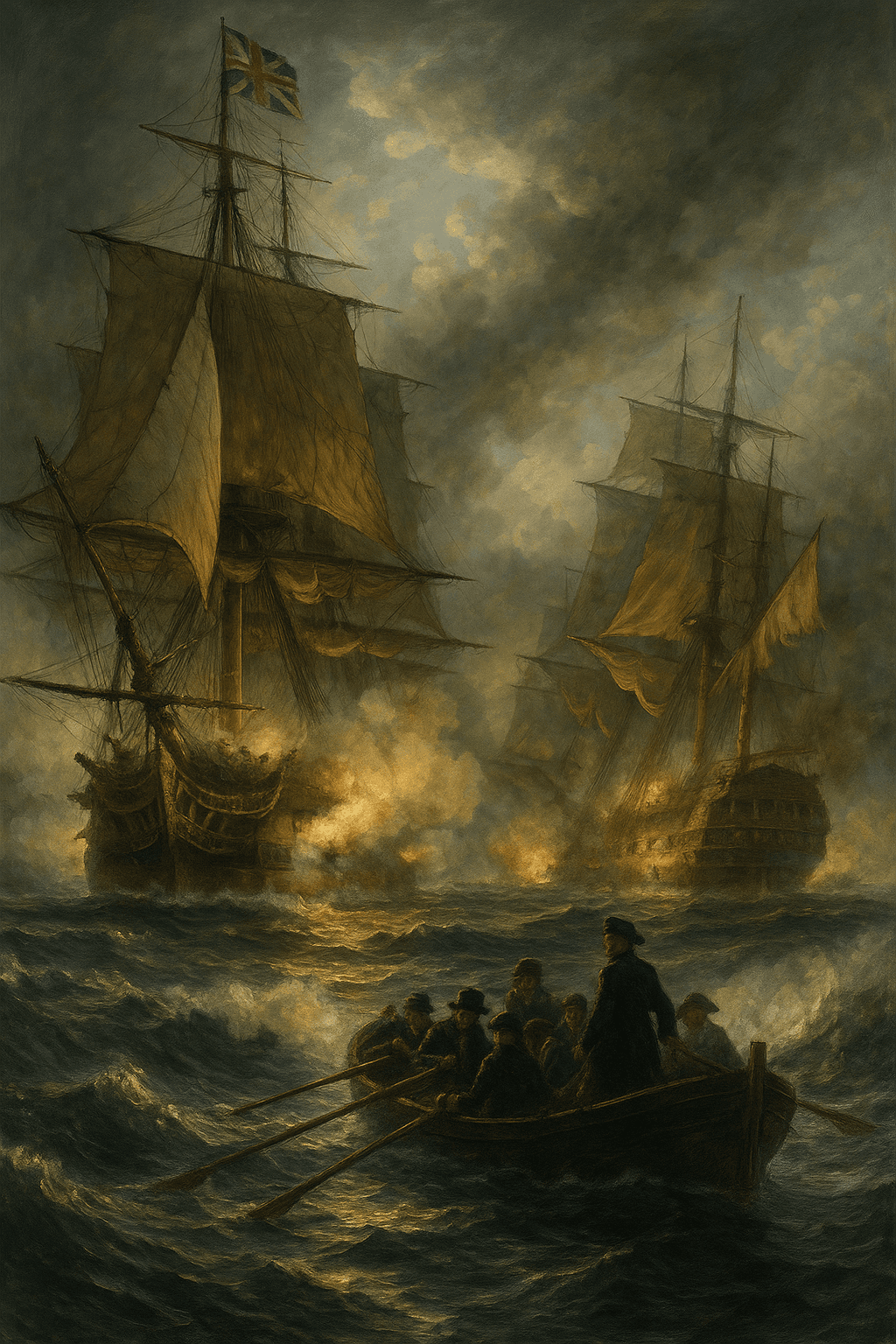
Battle of Trafalgar
History | 21 October 1805 | ||||||||
|---|---|---|---|---|---|---|---|---|---|
Place(s) | Off the coast of Cadiz southwest Spain (Atlantic Ocean) | ||||||||
Parties | Combined Fleet of France and Spain Royal Navy of England | ||||||||
Result(s) | England won a decisive victory | ||||||||
The Battle of Trafalgar, fought on 21 October 1805 off the coast of Cadiz in southwestern Spain, is regarded as one of the most significant naval engagements in history. This battle took place between the British Royal Navy and the combined French-Spanish fleet and fundamentally altered the balance of naval power in Europe during the Napoleonic Wars. The battle yielded important tactical, strategic, and technological consequences.
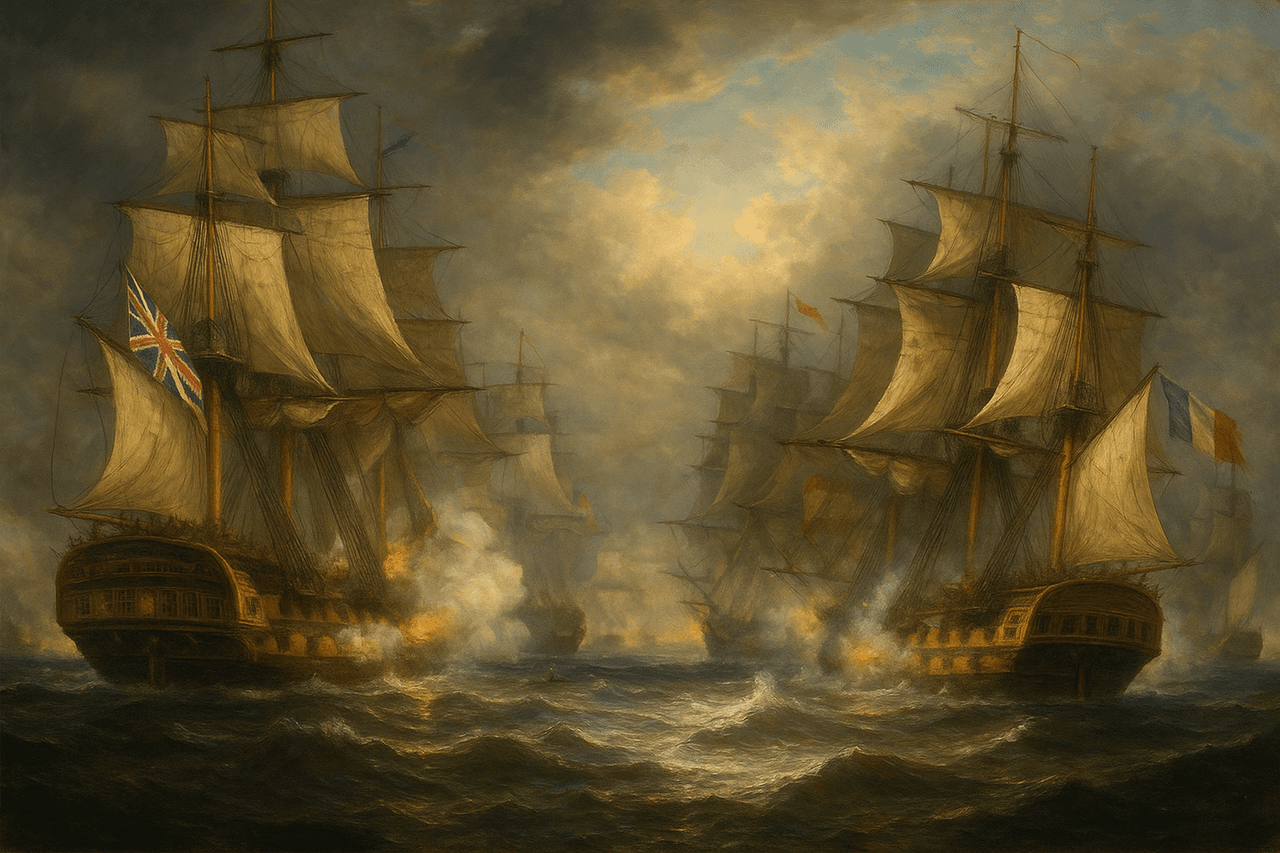
A Scene from the Battle of Trafalgar (Image Generated by Artificial Intelligence)
The late 18th and early 19th centuries witnessed Europe embroiled in a struggle for power shaped by revolutions and wars. Following the French Revolution, Napoleon Bonaparte seized power with the aim of establishing French hegemony across Europe. Britain countered this expansionist policy by leveraging its naval supremacy to resist France.
France and its ally Spain devised a plan to invade Britain and concluded that achieving naval superiority was essential to its success. In this context, the combined French-Spanish fleet under Admiral Villeneuve sailed from the port of Cadiz with the objective of breaking the British blockade. However, this movement was closely monitored by British Admiral Horatio Nelson, who prepared for a decisive confrontation off the coast of Trafalgar.
The British fleet under Admiral Horatio Nelson employed an innovative tactic against the numerically superior enemy force, abandoning the traditional line-of-battle formation. Nelson positioned his fleet in two columns that attacked the French-Spanish line perpendicularly, thereby splitting the enemy line and disrupting its communication and coordination.
Nelson’s flagship, HMS Victory, positioned at the center of the battle, directly engaged the French flagship Bucentaure. Thanks to the disciplined gunnery and superior maneuverability of the British ships, the combined fleet suffered heavy losses. During the battle, Admiral Nelson was fatally wounded by a sharpshooter; however, the British secured a decisive victory. By the end of the engagement, 22 French and Spanish ships were either sunk or captured, while the British lost not a single vessel.
The warships used in the Battle of Trafalgar represented the most advanced sailing warships of their era. Artillery fire, close-quarters combat, and boarding actions were central to naval tactics. The British excelled particularly in aiming accuracy and rate of fire.
Nelson’s perpendicular attack tactic broke with the conventional parallel line-of-battle formation and pioneered a revolutionary development in naval warfare. This maneuver fragmented the enemy’s central line, isolated its units, and paralyzed its command structure.
The Battle of Trafalgar irrevocably cemented Britain’s naval supremacy. This victory eliminated the threat of French invasion and allowed Britain to maintain a strategic counterbalance to Napoleon’s continental military dominance.
After the battle, France was unable to rebuild a large-scale navy and lost control of the seas in both the Mediterranean and the Atlantic. This granted Britain a strategic advantage in global maritime trade and colonial expansion. Trafalgar is also regarded as one of the foundational events of the Pax Britannica, the era of British maritime dominance.
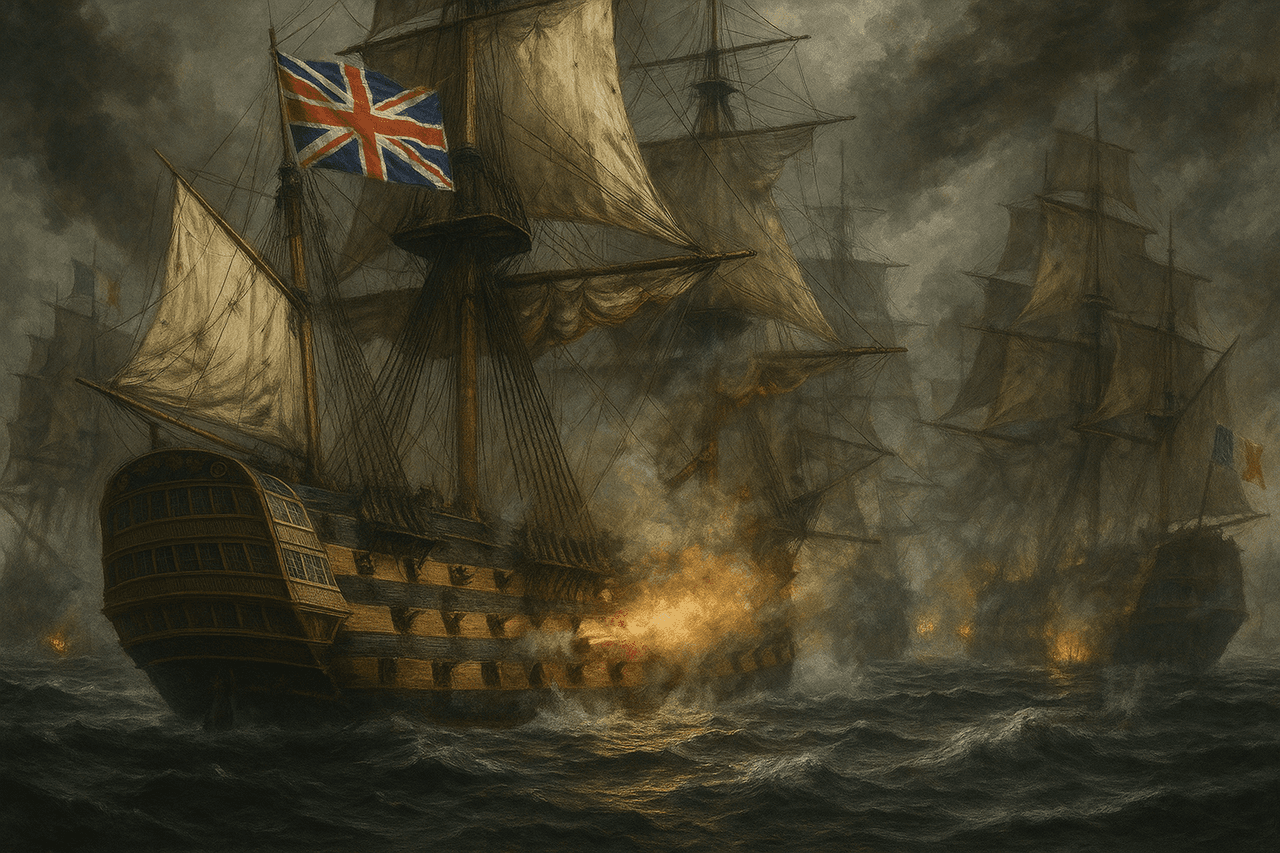
A Drawing Depicting the British Fleet (Image Generated by Artificial Intelligence)
From the British perspective, the victory at Trafalgar became a symbol of national pride and naval tradition. Nelson’s death transformed him into a folk hero, and his famous message, “England expects that every man will do his duty,” became embedded in the British collective memory.
For the French, this defeat was a devastating blow to Napoleon’s ambitions of building a powerful navy. The British naval blockades severely damaged France’s economic structure, forcing Napoleon to focus entirely on land warfare as the cornerstone of his strategy.
National Museum of the Royal Navy. “Trafalgar Day 2024: Battle of Trafalgar.” Accessed May 15, 2025. https://www.nmrn.org.uk/news/trafalgar-day-2024-battle-trafalgar.
Çiçek, Ali. *Trafalgar Deniz Muharebesi’nin Napolyon Savaşları’ndaki Yeri ve Avrupa Siyasetinde Bıraktığı İzler*. Academia.edu. Accessed May 15, 2025. https://www.academia.edu/36674720/Trafalgar_Deniz_Muharebesinin_Napolyon_Sava%C5%9Flar%C4%B1ndaki_Yeri_ve_Avrupa_Siyasetinde_B%C4%B1rakt%C4%B1%C4%9F%C4%B1_%C4%B0zler.

Battle of Trafalgar
History | 21 October 1805 | ||||||||
|---|---|---|---|---|---|---|---|---|---|
Place(s) | Off the coast of Cadiz southwest Spain (Atlantic Ocean) | ||||||||
Parties | Combined Fleet of France and Spain Royal Navy of England | ||||||||
Result(s) | England won a decisive victory | ||||||||
No Discussion Added Yet
Start discussion for "Battle of Trafalgar" article
Historical Background
Course of the Battle
Technological and Tactical Elements
Strategic Consequences
The Significance of the Battle from British and French Perspectives