


This article was automatically translated from the original Turkish version.
+1 More
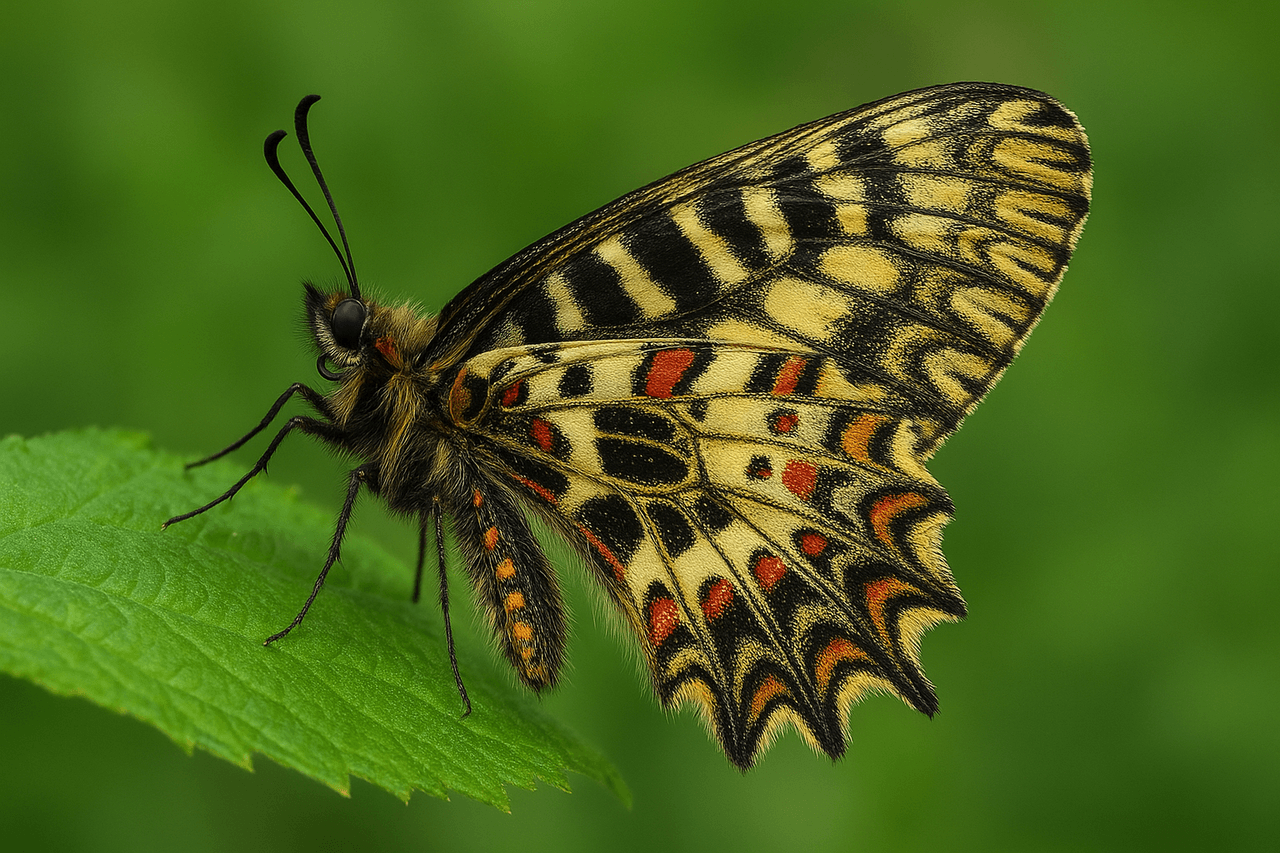
Forest Pistachio Butterfly (Generated by Artificial Intelligence.)
Scientific Name(s) | Zerynthia cerisy | ||||||||
|---|---|---|---|---|---|---|---|---|---|
Division | Arthropoda | ||||||||
Class | Insecta | ||||||||
Order | Lepidoptera | ||||||||
Family | Papilionidae | ||||||||
Distribution(s) | Türkiye Lebanon and Iran Syria Cyprus Bulgaria Greece | ||||||||
Similar Species | Zerynthia polyxena | ||||||||
Conservation Status | Least Concern (LC) | ||||||||
The Forest Pistachio Butterfly (Zerynthia cerisy) is a day-flying butterfly belonging to the family Papilionidae. It is distributed across the Eastern Mediterranean region, with Türkiye being its primary range. It is distinguished by its wing patterns: a pale cream to yellowish ground color marked with black bands, red and orange spots, and wavy wing margins, which are the most prominent features of the species.
The wingspan of the Forest Pistachio Butterfly ranges from 45 to 55 mm. Males are generally smaller and more brightly colored, while females are larger and exhibit darker patterns. The cream-yellow base of the wings contrasts sharply with black bands; the hindwings feature red and orange spots.

Forest Pistachio Butterfly (pixabay)
Z. cerisy is a species native to the Eastern Mediterranean. Its range extends across Türkiye, Greece, Bulgaria, Cyprus, Syria, Lebanon, and Iran. Its primary habitats include forest clearings, scrublands, shrublands, and areas where species of Aristolochia grow. It can be observed at elevations up to 1500 meters above sea level.
This butterfly species flies between April and June and produces only one generation per year. Its larvae feed primarily on species of Aristolochia, especially Aristolochia clematitis and Aristolochia rotunda. It overwinters in the pupal stage. Due to its close ecological relationship with these host plants, it serves as an important indicator species for habitat health.
Z. cerisy closely resembles Zerynthia polyxena in appearance. However, it can be distinguished by the higher contrast of its wing patterns and its greater prevalence in southern regions of Türkiye.
According to IUCN data, this species is categorized as “Least Concern (LC)” at the global level. Nevertheless, local populations are threatened by excessive use of agricultural chemicals, habitat loss, decline of Aristolochia species, and climate change. Conservation of its natural habitats and host plants through sustainable management is essential for the species’ survival.
Z. cerisy is one of the species distributed across the Eastern Mediterranean biogeographic region. Its ecological relationship with Aristolochia plants is used in scientific studies to understand its life cycle and adaptation mechanisms. It is also one of the species considered in systematic, ecological, and biogeographic research on butterflies.
Pixabay. "Kelebek, Güney festonu, Poliksen görseli JPG." Pixabay. Accessed September 16, 2025. https://pixabay.com/tr/photos/kelebek-g%C3%BCney-festonu-poliksen-944417/
Popović, M., Ilić, M., Nowicki, P. "Ecology of Eastern and Southern Festoons: Living in a City or Thriving in Semi-Natural Areas?" J Environ Manage, no. 390 (2025): 0301-4797. Accessed September 16, 2025. https://doi.org/10.1016/j.jenvman.2025.126361
Slancarova, J., Vrba, P., Platek, M., Zapletal, M., Spitzer, L., and Konvicka, M. "Co-occurrence of three Aristolochia-feeding Papilionids (Archon apollinus, Zerynthia polyxena and Zerynthia cerisy) in Greek Thrace." J Nat Hist 49, no. 29-30 (2015): 1825-1848. Accessed September 16, 2025. https://doi.org/10.1080/00222933.2015.1006281

Forest Pistachio Butterfly (Generated by Artificial Intelligence.)
Scientific Name(s) | Zerynthia cerisy | ||||||||
|---|---|---|---|---|---|---|---|---|---|
Division | Arthropoda | ||||||||
Class | Insecta | ||||||||
Order | Lepidoptera | ||||||||
Family | Papilionidae | ||||||||
Distribution(s) | Türkiye Lebanon and Iran Syria Cyprus Bulgaria Greece | ||||||||
Similar Species | Zerynthia polyxena | ||||||||
Conservation Status | Least Concern (LC) | ||||||||
No Discussion Added Yet
Start discussion for "Forest Palm Butterfly (Zerynthia cerisy)" article
Morphology
Distribution and Habitat
Biology and Ecology
Similar Species
Conservation Status
Scientific and Cultural Significance