

This article was automatically translated from the original Turkish version.
+1 More
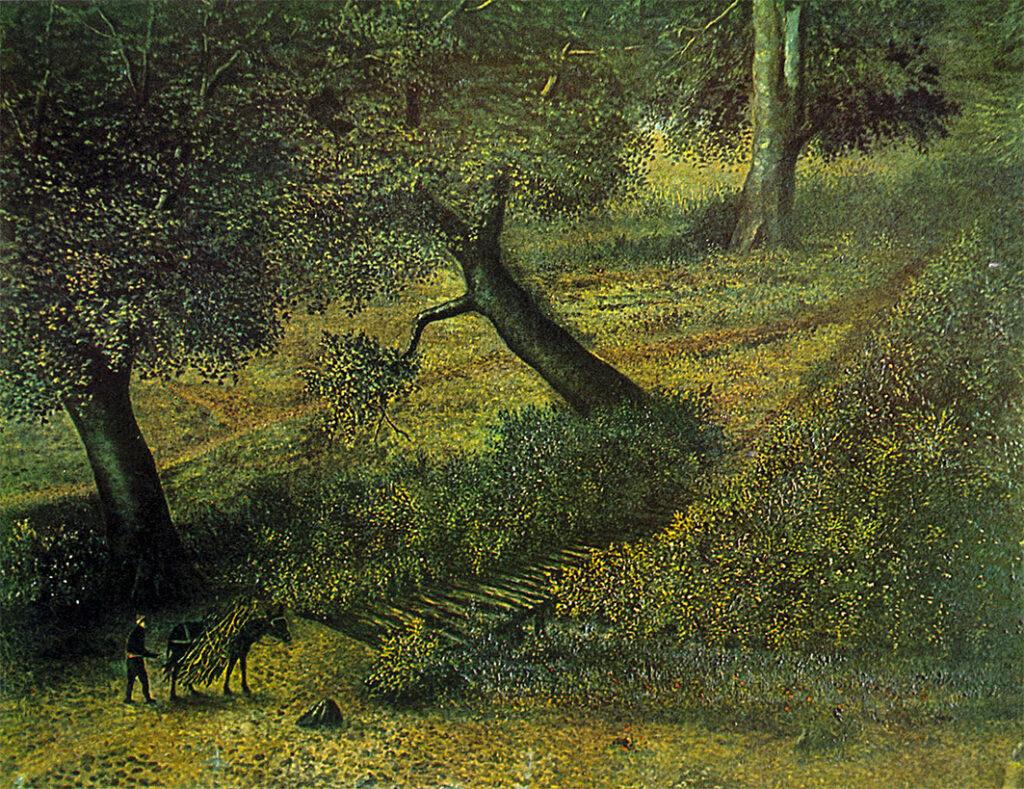
Woodcutter in the Forest, Ottoman painting, this figurative landscape is attributed to Şeker Ahmed Paşa (1841–1907) and is assessed within the context of the development of Western-inspired landscape painting. The work is significant for demonstrating how the artist combined his academic training in Paris with the aesthetics of the Barbizon School and the visual traditions of the Ottoman Empire. Its composition presents an original approach that diverges from the academic norms of its time in terms of the relationship between nature and humanity, spatial perception, and the use of perspective.
Woodcutter in the Forest is one of the works examined within the framework of visual arts developments during the second half of the 19th century in the Ottoman Empire, a period marked by intensified Westernization. This era corresponds to the moment when painting began to emerge as an institutionalized discipline, supported by military and technical schools that introduced instruction in perspective, anatomy, and drawing. State-sponsored artists sent to Europe brought back the academic understanding of painting, and landscape painting gained importance as an autonomous genre alongside historical and allegorical subjects.
Şeker Ahmed Paşa’s output represents one of the early and defining examples of this transformation. His synthesis of academic training in Paris with the Barbizon School’s focus on nature contributed significantly to the evolution of landscape painting in Ottoman art, enabling it to move beyond serving merely as a background and become a subject in its own right.
Şeker Ahmed Paşa (Türkiye Kültür Portalı)
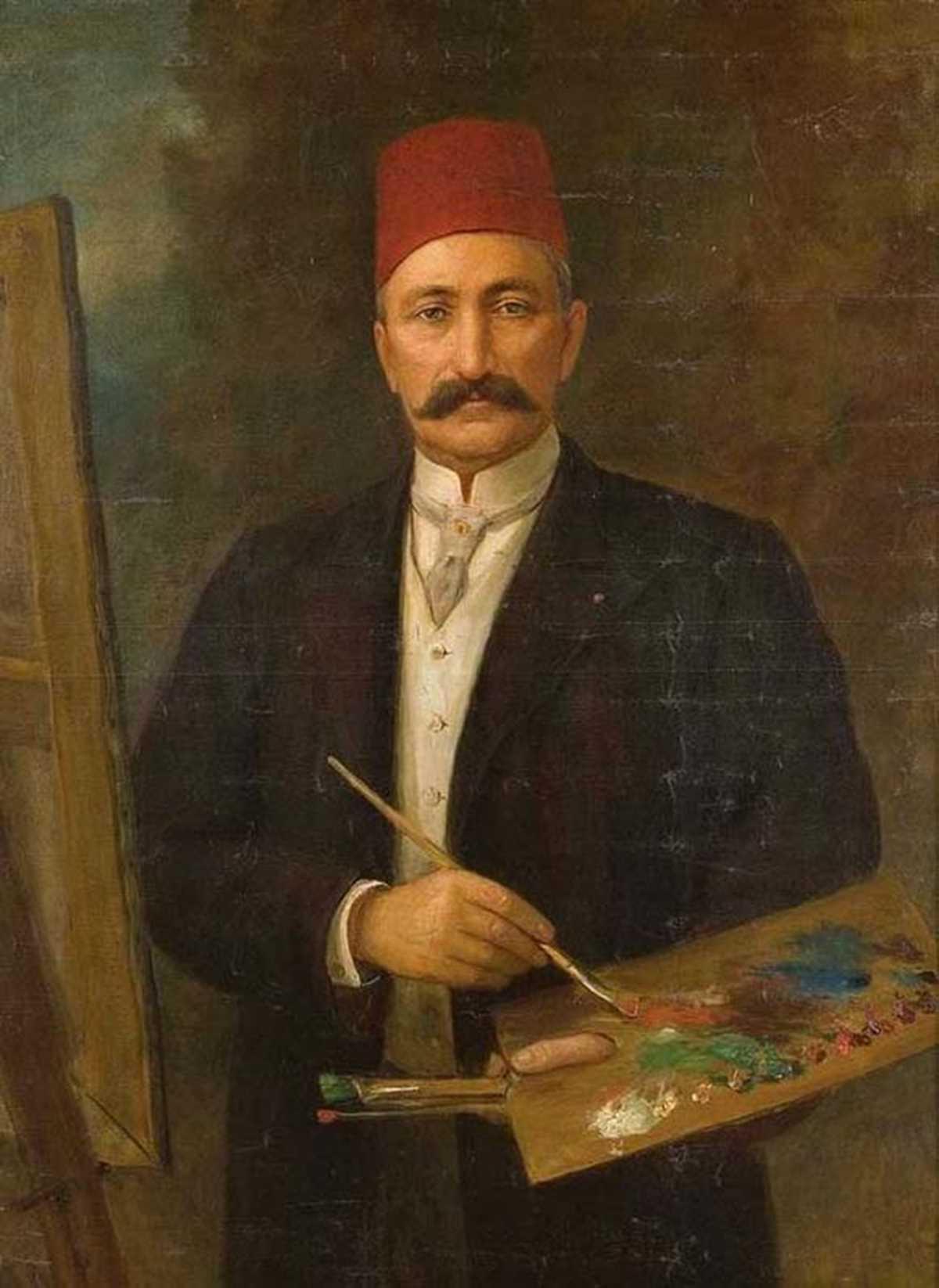
Şeker Ahmed Paşa received foundational training in anatomy and perspective at military schools and was sent to Paris in 1861 with state support. There he continued his studies at the Mekteb-i Osmanî and later received academic training in the ateliers of Gustave Boulanger and Jean-Léon Gérôme at the École des Beaux-Arts. At the same time, he showed affinity with the Barbizon School’s approach to nature and produced landscape studies en plein air under the influence of artists such as Courbet, Corot, Daubigny, and Diaz. This fusion of academic discipline with direct observation of nature defined his unique position within Ottoman painting. In this context, Şeker Ahmed Paşa is regarded as one of the pivotal artists who, alongside Hüseyin Zekâi Paşa and Miralay Seyit Bey, established the first direct and meaningful engagement between Turkish art and European art, laying the foundation for a new era.
Despite this sophisticated artistic formation, Şeker Ahmed Paşa’s reception in Turkish art history has remained limited. Over a period of approximately one and a half centuries, scholarly work on the artist has largely been confined to brief introductory texts and scattered assessments. Following early attempts at contextualization by Sami Yetik and Pertev Boyar, later contributions by smaller-scale publications from Ayhan Dürrüoğlu and Cemal Tollu, as well as limited insights from Eşref Üren, Nurullah Berk, and Mustafa Cezar, have come to the fore.
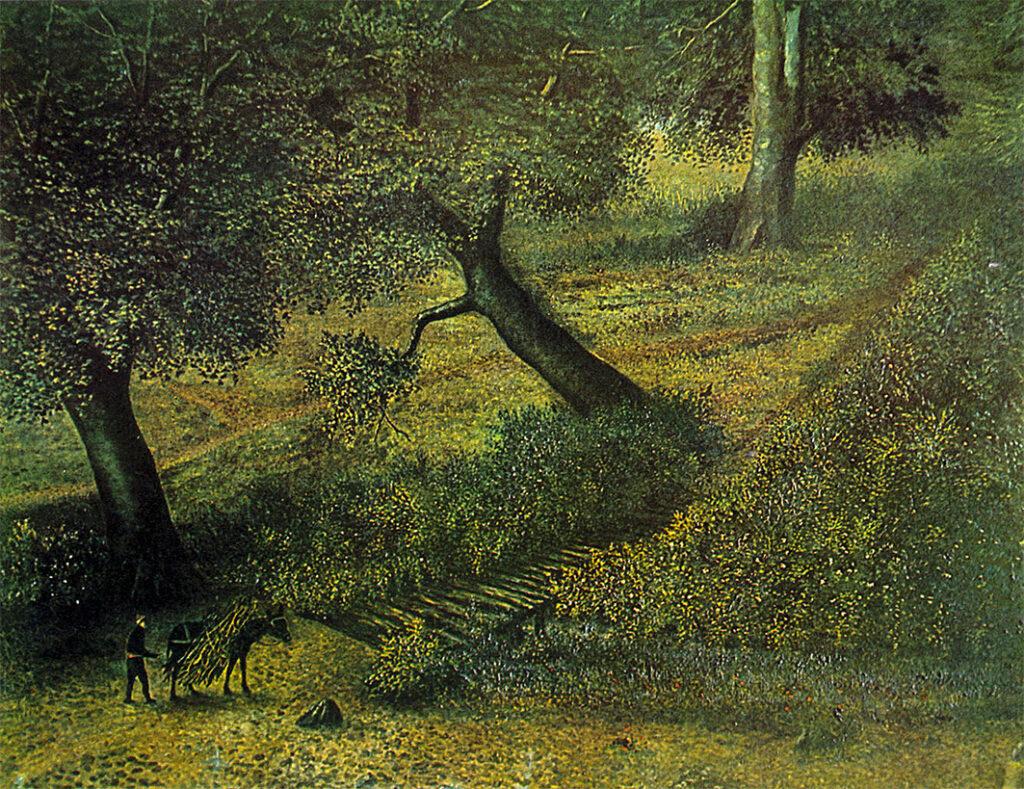
Woodcutter in the Forest is a figurative landscape executed in oil on canvas. The painting features free and occasionally thick brushwork that emphasizes the textural richness of nature. The color palette, dominated by shades of green and brown, reflects natural light through soft transitions. The use of light and shadow avoids the sharp contrasts typical of academic painting and instead creates an atmospheric unity.
The application of paint prioritizes an impressionistic response to direct observation over meticulous detail. In the relationship between the figure and its surroundings, tonal values and patches of color are more decisive than linear precision. This contributes to a sense of spatial ambiguity that is central to the work’s effect.
Woodcutter in the Forest, though its exact date of creation is unknown, is among the artist’s most powerful expressions of his perception of nature, evident in its large-scale canvas and figurative landscape approach. The small-scale human figures commonly found in the artist’s landscapes are here positioned as secondary yet meaning-generating elements in the face of nature’s grandeur. The woodcutter and his donkey do not occupy the center of the narrative but instead serve to highlight the overwhelming presence of the forest.
Woodcutter in the Forest (saglamart)
The painting distinguishes itself from the artist’s other landscapes primarily through its perspective construction. The composition integrates two distinct viewpoints on the same surface, a key structural feature. The first viewpoint is from the opposite end of the forest, causing the farthest beech tree to appear closer than other elements in the painting; this leads the woodcutter and donkey to be perceived as the most distant figures in the composition. The second viewpoint looks inward from the woodcutter’s eye level, emphasizing the smallness of the human figure against the vastness of the forest.
The forest boundary at the upper right corner of the painting creates spatial ambiguity by being perceived simultaneously as the farthest point and the nearest element to the viewer. The fact that the distant tree appears larger than the human figure, combined with the similarity in scale between its leaves and those in the foreground and the way light highlights it, challenges academic perspective rules. The diagonal line extending from the bridge into the forest further reinforces this ambiguity: it simultaneously evokes a sense of depth and creates a flat, surface-oriented effect. Thus, space is perceived by the viewer as both three-dimensional and two-dimensional at the same time.
Although the tree trunks, dense foliage, vegetation, and light reflections evoke the influence of the Barbizon School, the overall composition clearly departs from the academic landscape tradition. The forest is no longer a backdrop or setting but becomes a dominant subject in its own right. These features, which might be considered “incorrect” from an academic perspective, do not weaken the painting’s credibility but rather enhance it, offering a unique spatial experience that immerses the viewer in the feeling of being lost within nature.【1】
According to John Berger, the painting’s persuasiveness stems from a “existential certainty.”【2】 This certainty aligns with the lived experience and perception of the forest. The forest is presented as an enclosing, intimidating, and all-encompassing space. The viewer simultaneously experiences the sensation of moving through the forest and of observing it from the outside.
According to Berger, this dual perspective constitutes the unique persuasiveness of Woodcutter in the Forest.【3】 The painting faithfully reflects the woodcutter’s life and his relationship with the forest. According to Berger, the language developed in European landscape painting lacks the experiential depth needed to convey a forest or field from within. Courbet, for instance, typically treated forests as settings for hunting, death, or human narratives, whereas Şeker Ahmed Paşa perceived the forest as a place existing in its own right.【4】 In his painting, the forest’s presence is so overwhelming that he consciously eliminates the distance expected between academic training and direct experience of nature.
The compositional schema and spatial construction in the painting show similarities not only with Western academic painting traditions but also with the visual organization found in Ottoman miniature art. The schematic arrangement, surface emphasis, and internalized light perception characteristic of miniatures are subtly felt in Woodcutter in the Forest. According to İpek Düben, the impression that light emanates from within rather than from an external source, along with the overall calm yet enclosing atmosphere of the painting, reflect traces of this tradition.
Bedri Rahmi Eyüboğlu also emphasizes that despite Şeker Ahmed Paşa’s Western education, he maintained a connection to Eastern tradition, and that this synthesis endowed his paintings with unity.【5】 Thus, Woodcutter in the Forest is regarded as an original work that unites the technical legacy of Western landscape painting with the perceptual continuity of Ottoman visual culture.
[1]
John Berger, "Şeker Ahmet ve Orman," Şeker Ahmet Paşa - 1841-1907. TBMM Milli Saraylar Yayınları, İstanbul, (2008): s. 221-223, https://acikerisim.tbmm.gov.tr/items/874cafbc-5053-4007-86a1-3e199e0d055d
[2]
A.e., syf 223
[3]
İlona Baytar, “Sonsuza Doğru ‘Uçsuz Bucaksız’ Bir Yol ve Şeker Ahmed Paşa’nın Manzara Resimleri,” Art Sanat, 10, (2018): syf 6-7, https://dergipark.org.tr/tr/download/article-file/515704
[4]
A.e., syf 7
[5]
A.e., syf 9


No Discussion Added Yet
Start discussion for "Forester in the Forest (Painting)" article
Historical Context
The Artist’s Education, Artistic Context, and Place in Art History
Technical Characteristics of the Painting
Composition and Perspective
The Relationship Between Nature and Perception
Style and Tradition