
This article was automatically translated from the original Turkish version.
The expression “Ti’ye Almak” is commonly used in everyday language to mean belittling, mocking, or not taking someone seriously. While standard linguistic explanations exist for the origin of this phrase, some interpretations in popular culture and military history circles link its origin to a critical naval warfare tactic known as “Crossing the T.” This claim is intriguing because it goes beyond mere phonetic similarity, connecting the phrase’s connotations of absolute dominance and overwhelming superiority to one of the most dramatic events in naval history—and I believe this may well be correct.
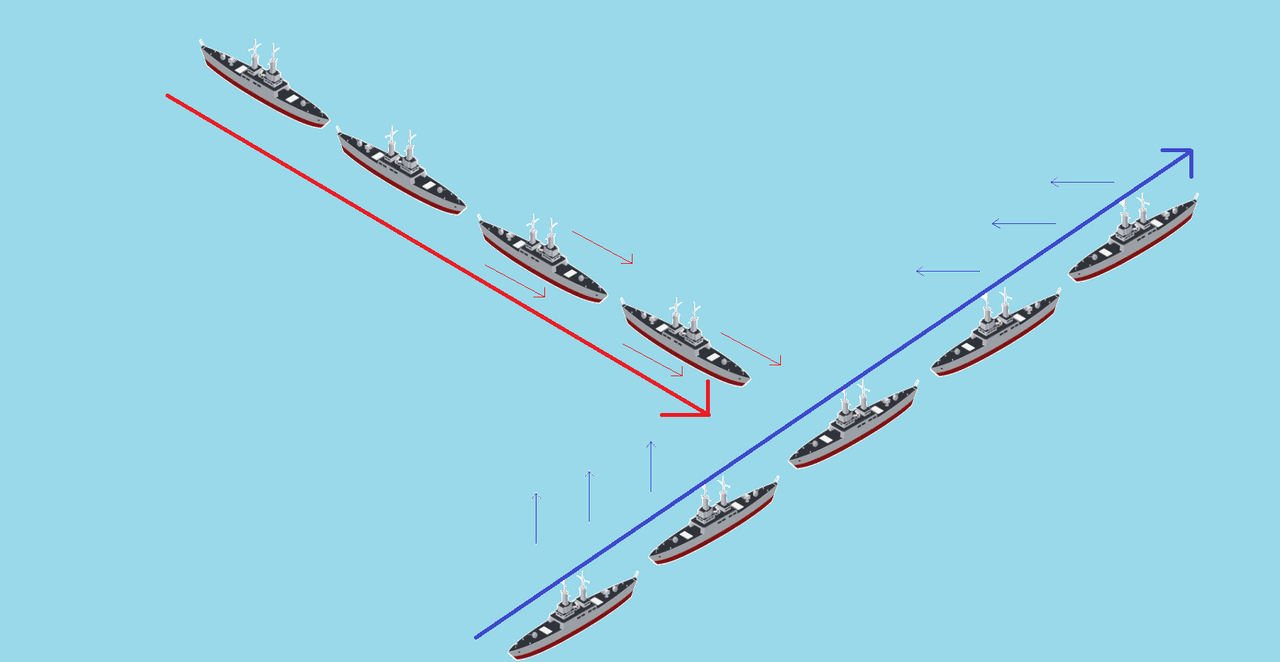
T Maneuver Plan (Source: Mehmet Salih Çoban)
T Maneuver is a crucial naval strategy employed in battles involving armored warships, particularly before and during the Dreadnought era. The fundamental principle of this tactic is as follows:
This strategic asymmetry maximizes the firing power of the fleet executing the T while minimizing the enemy’s ability to resist. The result is typically the overwhelming destruction of the enemy force. The most famous and symbolic application of this tactic was the decisive victory achieved by the Japanese Navy over the Russian Baltic Fleet in the 1905 Battle of Tsushima.
When examining the meaning of the expression, it becomes clear that it does not merely imply simple mockery but emphasizes rendering an opponent helpless, ineffective, and diminished. The T Maneuver thesis directly ties this metaphorical meaning to the tactical situation created by the maneuver itself.
The T Maneuver represents the most concrete and visual method of disarming and neutralizing an enemy in naval warfare. Crossing the T condemns the enemy to inevitable destruction by depriving it of its greatest strength—its broadside batteries. This act can be perceived as an absolute act of dominance, equivalent to mocking or disregarding the enemy in a military context. The fleet subjected to the maneuver becomes a powerless, diminished target by virtue of its position. It is argued that this situation directly corresponds to the meanings of crushing domination and helplessness embedded in the phrase.
The outcomes of the T Maneuver at the Battle of Tsushima were closely studied by navies and military academies around the world in the early 20th century, including Ottoman Navy officers. Such critical tactics likely became part of military jargon within war colleges and barracks.
It is plausible that during military training and operations, a short, vivid, and metaphorical expression such as “Ti’ye Almak” emerged to refer to the strategic rendering of an enemy helpless. Usage among officers or soldiers such as “We crossed the T on them” (meaning, we placed them in an overwhelming position) may have gradually migrated from military circles into civilian speech, evolving into the form “Ti’ye Almak” and broadening in meaning to encompass general mockery or belittlement. It is not uncommon for technical or military terms to be adapted into everyday language.
Of course, these are speculative hypotheses, and this must be remembered.
