


This article was automatically translated from the original Turkish version.
+1 More
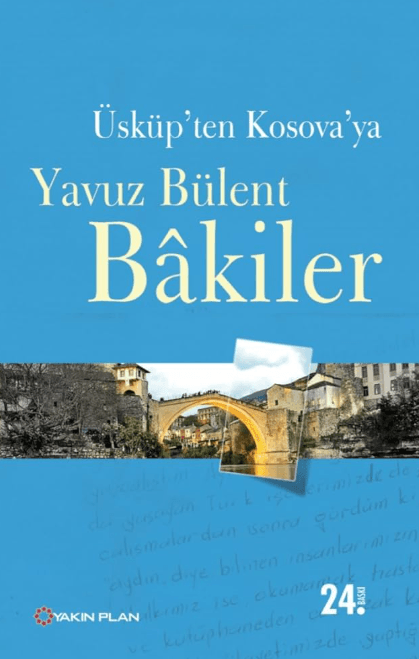
From Skopje to Kosovo (Book)
Author(s) | Yavuz Bülent Bakiler | ||||||||
|---|---|---|---|---|---|---|---|---|---|
Publisher(s) | Yakın Plan Yayınları | ||||||||
Publication Date | 2018 | ||||||||
Number of Pages | 208 | ||||||||
From Skopje to Kosovo is a travelogue and memoir by Yavuz Bülent Bâkiler, written after his 1976 journey through the regions of Macedonia and Kosovo, then within the borders of the Socialist Federal Republic of Yugoslavia, during his participation in the Struga Poetry Evenings as a representative of Türkiye. The book documents visits to cities such as Skopje, Pristina, Prizren, Struga, and Kalkandelen, recording the cultural and social elements encountered in these places.
Through conversations with people he met during the journey, observations of architectural structures, tombstones, and local media activities, the author provides information on the historical background, linguistic situation, and identity structure of the Turkish communities living in the region.
Cultural Continuity and Ottoman Heritage: The work records the surviving traces of Ottoman-era architecture, tombstones, and urban fabric in the Balkans.
Turkish Identity and Language: Bâkiler shares his observations on the linguistic and identity presence of the Turkish population in Macedonia and Kosovo. Issues such as the state of Turkish language education, the existence of Turkish-language radio stations, books, and newspapers are examined.
Migration and Demographic Change: The book presents data on how migration to Türkiye affected the Turkish population in the region and contributed to demographic shifts in the cities.
Relationship Between National and Cultural Identity: The text explores how Turkish identity is positioned within a multilingual and multi-identity framework, and how ties with Türkiye are maintained.
The work is written in the first person. The language is simple and the narrative follows a chronological structure typical of travel notes. Cityscapes, historical structures, and individuals encountered are described in detail. Although no visual material is used, the text is supported by historical references. Occasional quotations and local expressions are included.
Skopje: Described as a city rich in Ottoman-era heritage; mosques, caravanserais, and cemeteries are examined.
Struga: The city where the poetry event took place; encounters with poets and literary themes are featured.
Prizren: One of the cities with a high concentration of historical structures and a significant Turkish population.
Kalkandelen, Pristina: Experiences and observations involving interaction with Turkish-speaking communities are recorded.
Bâkiler, Yavuz Bülent. Üsküp’ten Kosova’ya. Yakın Plan Yayınları, 2018.

From Skopje to Kosovo (Book)
Author(s) | Yavuz Bülent Bakiler | ||||||||
|---|---|---|---|---|---|---|---|---|---|
Publisher(s) | Yakın Plan Yayınları | ||||||||
Publication Date | 2018 | ||||||||
Number of Pages | 208 | ||||||||
No Discussion Added Yet
Start discussion for "From Skopje to Kosovo (Book)" article
Themes
Style
Cities and Sites Covered in the Work