This article was automatically translated from the original Turkish version.
+2 More
Location | Mavikent Neighborhood Türkiye Antalya Kumluca | ||||||||
|---|---|---|---|---|---|---|---|---|---|
Region(s) | Lycia | ||||||||
Foundation | Early Bronze Age II | ||||||||
Abandonment | Late Byzantine Period | ||||||||
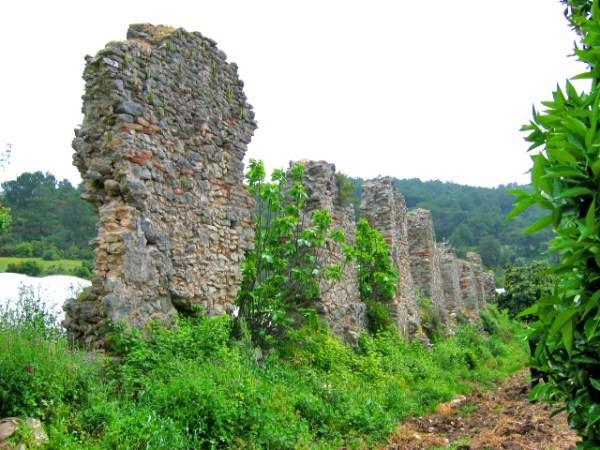
Gagai (in ancient sources Gaxe) is an ancient settlement located in the southeastern corner of Lycia, within the boundaries of modern Mavikent, Kumluca district, Antalya Province. The city, known today as “Asartepe” or “Aktaş Ruins”, was built on a hill commanding the sea. It was first mentioned by Pseudo-Scylax as “Palaion Teikos” (Old Fortress).
The name Gagai has been explained in various forms since antiquity. According to one tradition, the Rhodians named the settlement Gagai after requesting land in the area by saying “Ga-ga” (earth). However, this explanation appears mythological. Philologist O. Carruba traces the origin of the name to Anatolian languages, noting that it derives from the ancient Anatolian word “hahha” (father) and was rendered in Greek as “Gaxe”.
Eusebius describes Gagai as an “insignificant Lycian city”, while ancient sources mention a nearby lignite mine called “gagates”. This lignite deposit is believed to have contributed to the city’s economic importance.
Surface surveys conducted in 2007 under the leadership of Professor Dr. Nevzat Çevik revealed that Gagai’s history extends far earlier than the Rhodian colony. Two-handled ceramic vessels found at the site date to the Early Bronze Age II period (2700–2400 BCE), representing the earliest known settlement evidence in the region. This discovery confirms the presence of settlement layers predating Rhodian colonization by centuries.
A tower constructed on the hill during the Hellenistic period formed the core of the city’s defensive system. Gagai fell under the control of Limyra during the Hellenistic era and continued to exist as a small but organized settlement during the Roman period. Spratt and Forbes report that Gagai formed a sympoliteia with Rhodiapolis and Corydalla.
The remains of the city are divided into four main areas: the upper acropolis, the lower acropolis, the flat area (Roman public center), and the necropolis.
The earliest coins found at Gagai date to between 430 and 420 BCE. These coins bear the inscription “Gaxe”, documenting the early form of the city’s name. During the period of the Lycian League (2nd–1st centuries BCE), Gagai minted silver and bronze coins depicting Apollo. In the Roman period, bronze coins bearing imperial portraits of Caracalla and Gordian III were produced.
T.C. Ministry of Culture and Tourism, Lycian Way. "Pafta 20: Mavikent - Gagai." *likyayolu.ktb.gov*. Accessed October 11, 2025. https://likyayolu.ktb.gov.tr/TR-236441/pafta-20-mavikent---gagai.html
Çevik, N. and S. Bulut. "The Rediscovery of GAGAE / ‘GAXE’ in the South-East Corner of Lycia. New Finds from the Total Surface Surveys." *ADALYA* 11 (2008): 63-98. Accessed October 11, 2025. https://www.researchgate.net/publication/298951968_The_rediscovery_of_GAGAE'GAXE'_in_the_south-east_corner_of_Lycia_New_finds_from_the_total_surface_surveys


Location | Mavikent Neighborhood Türkiye Antalya Kumluca | ||||||||
|---|---|---|---|---|---|---|---|---|---|
Region(s) | Lycia | ||||||||
Foundation | Early Bronze Age II | ||||||||
Abandonment | Late Byzantine Period | ||||||||
Etimology
Historical Development and Archaeological Findings
Urban Structure and Architectural Elements
Coinage and Artifacts