


This article was automatically translated from the original Turkish version.
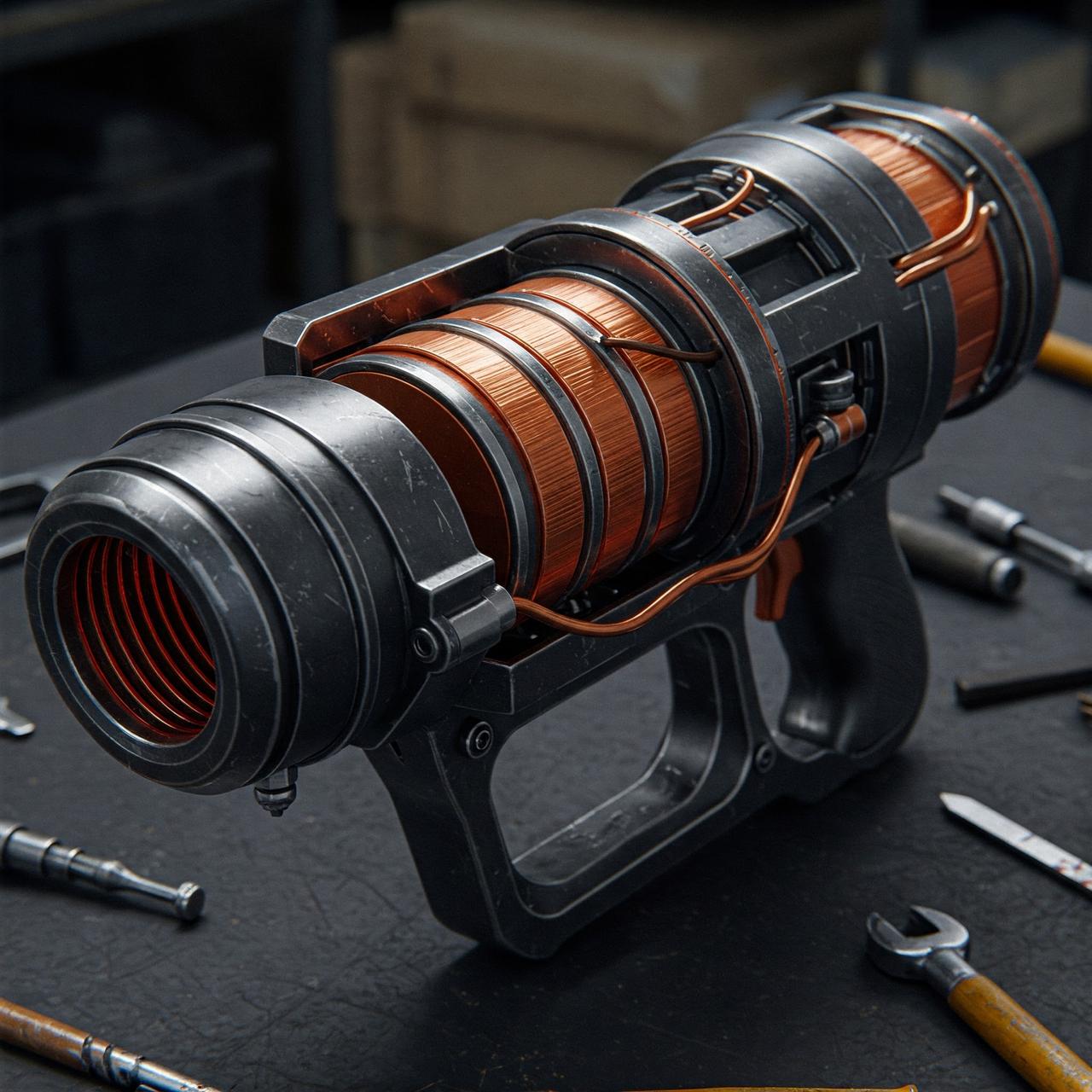
A coilgun, also known as a Gauss gun, is an electromagnetic launcher system designed to propel ferromagnetic projectiles at high velocities using electromagnetic force. Its operating principle is based on converting electrical energy into magnetic energy to accelerate a ferromagnetic material. Unlike conventional propulsion systems such as gunpowder or compressed air, a coilgun operates entirely through the influence of electromagnetic fields. This allows previously used objects (electromagnetic projectiles or their derivatives) to be reused.

Basic schematic of a Gauss gun (Elektrikport)
Initial research on electromagnetic launchers began in the 1980s in the United States, with the first feasibility studies conducted by DARPA and the U.S. Army. Over time, these technologies developed in both military and scientific domains. After 1985, electromagnetic launchers reemerged as a focus for developing systems capable of countering armored vehicles. Plasma armatures used in early stages were gradually replaced by solid armatures.
A coilgun consists of a series of coils (electromagnets) arranged in sequence and a ferromagnetic projectile that accelerates through them. Electrical energy is stored in a capacitor and transferred to the coils via switching elements. Each coil is triggered at the appropriate moment to pull the projectile toward the next coil, thereby accelerating it progressively.
During the pulling phase, the magnetic field within the coil aligns the dipoles of the projectile, generating a net attractive force. If the trigger is deactivated before the projectile reaches the center of the coil, it is directed toward the next coil, preventing it from being pulled back.
The fundamental electromagnetic theories underlying coilgun operation:

Visual representation of a Gauss gun (generated by artificial intelligence.)
"GaussGun Coil Gun Electronics and Engineering Project," Instructables. Accessed April 22, 2025.
Doe, John. "Design and Construction of a Coilgun." *IEEE Transactions on Magnetics*, Volume 45, Issue 3 (2009): 1234–1240. Accessed May 3, 2025. Accessed Adresi.

No Discussion Added Yet
Start discussion for "Gauss Gun (Coilgun)" article
History
Operating Principle
Theoretical Foundation
Design Components
Critical Parameters
Applications