

This article was automatically translated from the original Turkish version.
Type of Geographical İndication | Mahreç Sign | ||||||||
|---|---|---|---|---|---|---|---|---|---|
Registration Number | 1057 | ||||||||
Registration Date | 31.03.2022 | ||||||||
Product / Product Group(s) | Processed and unprocessed fruits vegetables and mushrooms | ||||||||
Province(s) | Gaziantep | ||||||||
Applicant/Registrant(s) | Gaziantep Metropolitan Municipality | ||||||||
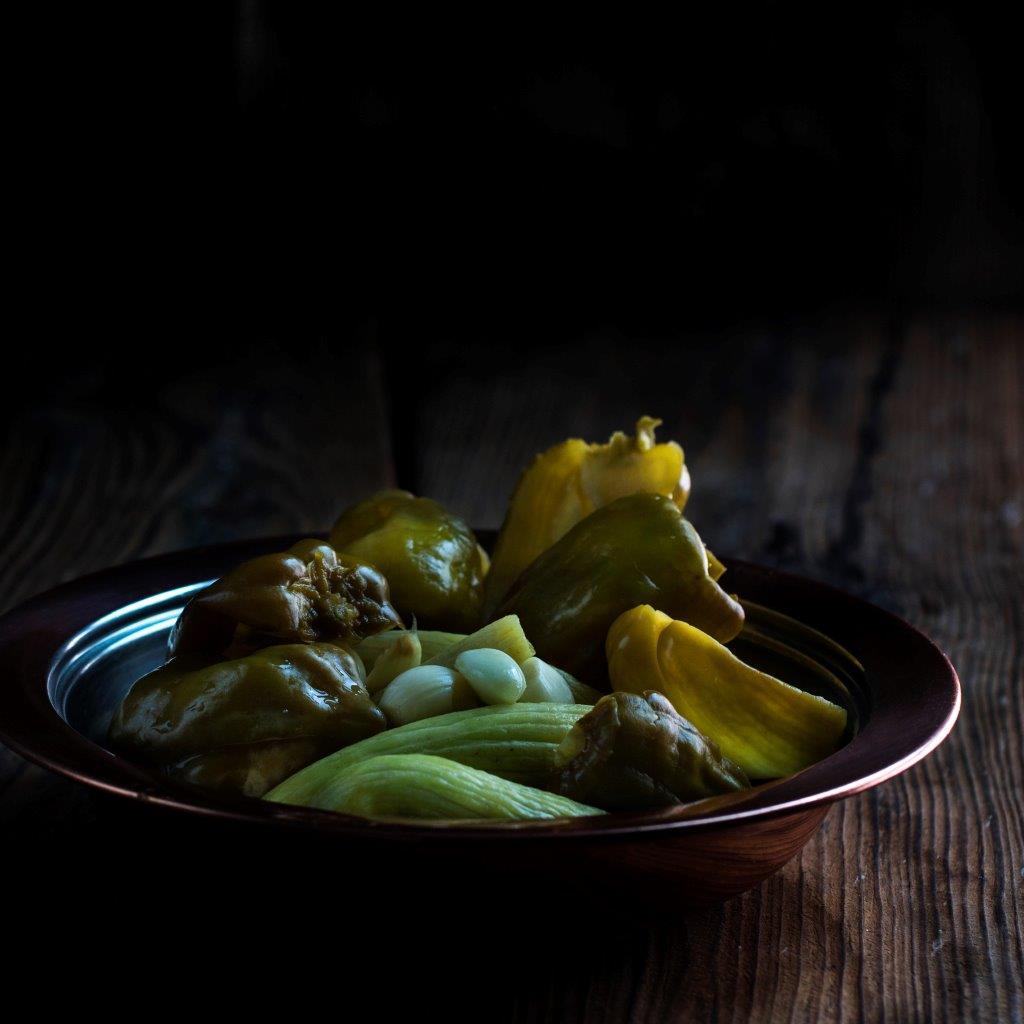
Gaziantep acur-biber turşusu is a traditional pickled vegetable specialty unique to the city of Gaziantep in Türkiye’s Southeastern Anatolia Region, produced using conventional methods. This product is protected under the Industrial Property Law No. 6769 as a geographical indication and was officially registered on 31 March 2022, with a geographical indication application submitted by the Gaziantep Metropolitan Municipality.
Gaziantep acur-biber turşusu is obtained by fermenting acur, pepper and garlic in a mixture of vinegar and lemon salt. No preservatives or additives are used during production. The distinguishing feature of this pickle lies in the selection and cutting method of the vegetables, as well as the fact that the fermentation process is carried out exclusively within the geographical boundaries of Gaziantep. This product is prepared and consumed locally using traditional methods.
The main ingredients used in preparing Gaziantep acur-biber turşusu are slender and firm acur, preferably red peppers grown within Gaziantep’s geographical boundaries, garlic, vinegar, lemon salt, iodine-free rock salt and water. Chickpeas may also be added optionally. For a standard 5-liter jar, it is recommended to use approximately 2 kg of acur, 1 kg of pepper, 1–2 cloves of garlic, 400–700 ml of vinegar, 2–2.5 liters of water, 220–300 g of iodine-free rock salt, 100–140 g of lemon salt and 20–30 g of chickpeas.
The preparation process begins by peeling the garlic and cutting off the root ends. The acur and peppers are then washed and dried. The ends of the acur are trimmed and each is cut into two or three pieces, approximately 10–15 cm in length. The peppers are cut in a crescent shape from the bottom rounded area while holding them by the stem. Alternatively, the peppers can be sliced lengthwise on a cutting board to separate the seeds into two equal halves.
The prepared garlic, acur and peppers are layered together in a glass or food-safe plastic jar. If chickpeas are used, they are placed at the bottom of the jar. In a separate container, water, vinegar, lemon salt and rock salt are mixed and poured into the jar until the vegetables are fully covered. The jar is sealed and left to rest in a cool, dark environment for 1–2 weeks.
Once fermentation is complete, the color of Gaziantep acur-biber turşusu turns entirely yellow. This color change indicates that the pickle is ready for consumption. The product is stored in a cool place or in a refrigerator. No preservatives or additives are used during production, a key feature that preserves the product’s traditional nature and natural composition.
The reputation of this pickle is exclusively tied to the city of Gaziantep. All stages of production must be carried out within this geographical boundary. This ensures the preservation of the product’s traditional character and its place in the local culinary culture.
To ensure compliance with geographical indication standards, inspections are coordinated by the Gaziantep Metropolitan Municipality. The inspection body consists of experts from the Gaziantep Provincial Directorate of Agriculture and Forestry, the Gaziantep Chamber of Tradesmen and Craftsmen, and the Gaziantep Metropolitan Municipality. Inspections are conducted at least once annually and may be carried out at any time if deemed necessary or upon complaint. During inspections, the suitability of ingredients and quantities, adherence to production methods, and correct use of the geographical indication label are verified.
Turk Patent and Trademark Office. "Gaziantep Acur-Biber Turşusu Mahreç İşareti Tescil Belgesi." Accessed October 21, 2025. https://ci.turkpatent.gov.tr/Files/GeographicalSigns/e8301136-41b3-49ee-b93a-6235202f70c7.pdf.
Turkish Patent and Trademark Office. "Gaziantep Acur-Biber Turşusu." *Turkish Patent and Trademark Office Geographical Indications Portal*. Accessed October 21, 2025. https://ci.turkpatent.gov.tr/cografi-isaretler/detay/3403.

Type of Geographical İndication | Mahreç Sign | ||||||||
|---|---|---|---|---|---|---|---|---|---|
Registration Number | 1057 | ||||||||
Registration Date | 31.03.2022 | ||||||||
Product / Product Group(s) | Processed and unprocessed fruits vegetables and mushrooms | ||||||||
Province(s) | Gaziantep | ||||||||
Applicant/Registrant(s) | Gaziantep Metropolitan Municipality | ||||||||
No Discussion Added Yet
Start discussion for "Gaziantep Acur-Biber Pickle" article
Product Characteristics
Preparation
Geographical Boundary and Production Conditions
Monitoring Mechanism