This article was automatically translated from the original Turkish version.
Type of Geographical İndication | Mahreç Sign | ||||||||
|---|---|---|---|---|---|---|---|---|---|
Registration Number | 356 | ||||||||
Registration Date | 04.06.2018 | ||||||||
Product / Product Group(s) | Cheeses | ||||||||
Province(s) | Gaziantep | ||||||||
Applicant/Registrant(s) | Gaziantep Chamber of Commerce | ||||||||
Gaziantep cheese is a traditional cheese variety native to the province of Gaziantep and officially protected under its geographical origin name. It has been protected since 20 April 2017 under Law No. 6769 on Industrial Property and was registered on 6 June 2018 by the Gaziantep Chamber of Commerce. The product is produced exclusively within the boundaries of Gaziantep province and marketed with its geographical indication logo.
Gaziantep cheese is made from the milk of small ruminants grazed on the pastures of Gaziantep and is also known locally as “pişken” or “kelle.” This cheese is produced in a semi-hard texture by boiling the curd and is consumed either fresh without brining or aged in brine. Only sheep or goat milk may be used in production, or a 50 percent mixture of both may be preferred.
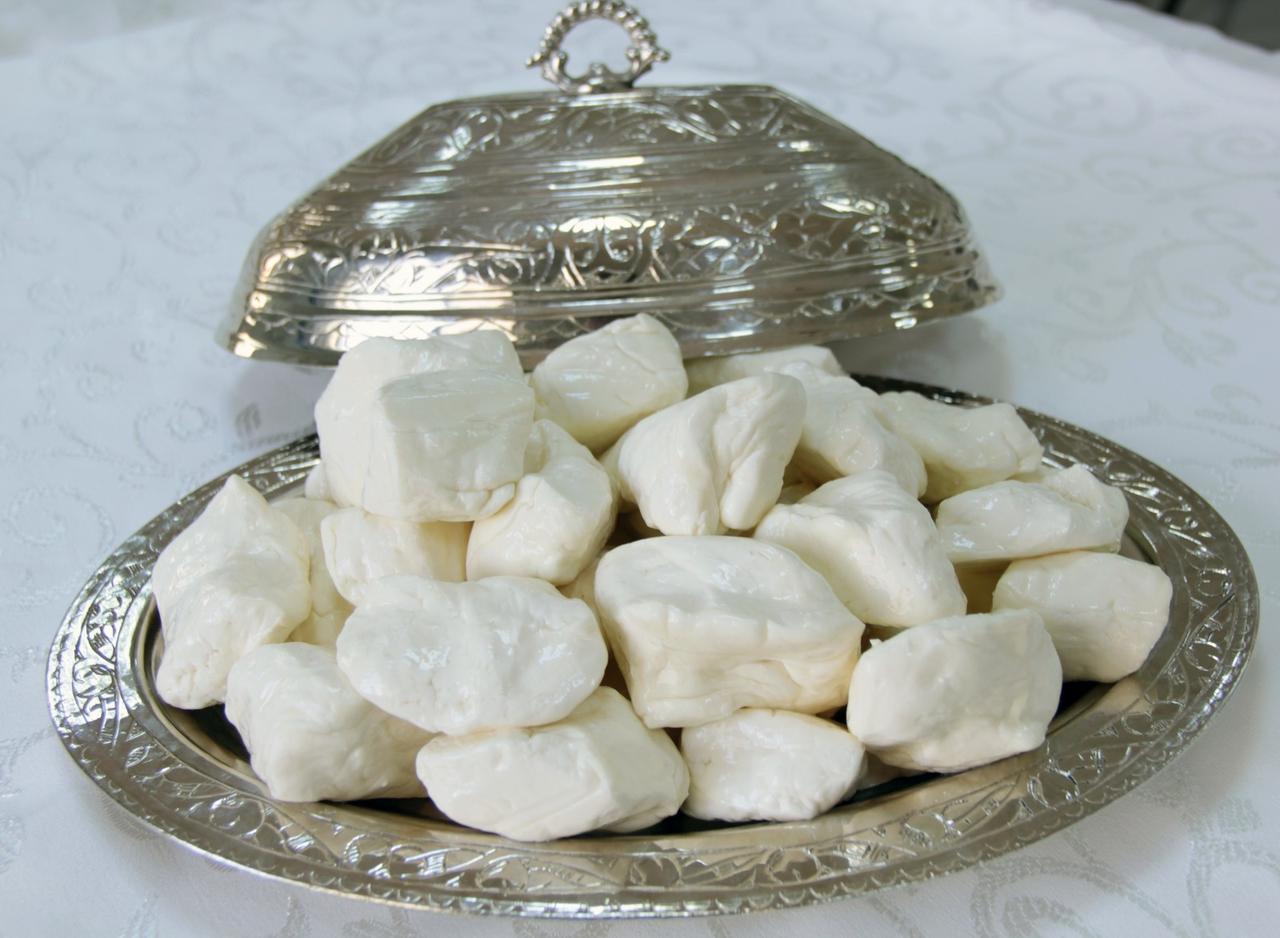
Its oval shape, resembling the palm of a hand, results from the traditional method of shaping it by hand. The long axis of the oval ranges from 6 to 10 cm. The structure is homogeneous, non-porous, smooth and dense; when cut, it does not crumble, is elastic and melts easily in the mouth. It provides a slight crunching sensation during chewing. Its color ranges from gray to white tones.
Brined Gaziantep cheese:
Fresh Gaziantep cheese:
Reducing the fat content may negatively affect the physical structure and aromatic profile of the cheese; therefore, this ratio must be maintained during production.
A total of 49 aroma-active compounds and 64 substances influencing aroma have been identified in Gaziantep cheese. In the neutral/basic fraction, 48 volatile compounds are present, belonging to the classes of ketones, esters, alcohols, lactones, terpenes, aldehydes and aromatic hydrocarbons.
Key compounds:
These compounds provide chemical indicators of the cheese’s geographical origin, the animals’ feeding practices and traditional production methods.
Gaziantep cheese is produced using raw milk and traditional methods. The milk is coagulated immediately after milking at body temperature (approximately 35 °C) using rennet, microbial starter or fig milk. Fig milk coagulation is practiced by shepherds during mountain grazing. The milk obtained from unripe figs known as “kerik” is added at a rate of 4–5 drops per half liter of milk.
The coagulated milk is placed in cloth bags, drained and pressed. Once the curd has hardened, it is transferred into small mesh bags, oiled on the surface and then boiled for one minute at 80–90 °C in whey. The cooled cheese is shaped by hand into a firm oval form.
Salting is carried out in two ways:
The brine salt concentration is traditionally adjusted using a raw egg or olive. If the egg rises to the surface, the salt concentration is appropriate. Olives are used in brined cheese intended for consumption.
Brined cheeses are stored for 2–3 months in cold storage at 3–5 °C in sealed tin containers. Under suitable conditions, they can be preserved for 2–3 years. Before consumption, they are soaked in cold water for 8–10 hours to reduce salt content.
Monitoring is coordinated by the Gaziantep Chamber of Commerce. The monitoring board includes experts from the Department of Food Engineering at Gaziantep University, the Şehitkamil Chamber of Agriculture, the Gaziantep Provincial Directorate of Food, Agriculture and Livestock, and the Gaziantep Metropolitan Municipality.
Monitoring includes physical, chemical and aromatic analyses of samples taken at production and sales points. Legal proceedings are initiated against productions that deviate from the registered specifications. Routine inspections are conducted at least once per year and may be repeated in response to complaints. A report is prepared after each inspection and an annual report is compiled.
Turk Patent and Trademark Office. "Antep Peyniri/Gaziantep Peyniri/Antep Sıkma Peyniri Coğrafi İşaret Tescil Belgesi" (Registration No: 356). Accessed October 21, 2025. https://ci.turkpatent.gov.tr/Files/GeographicalSigns/695365ed-fdf1-4b79-adce-2c718b2b0dfd.pdf.
Turkish Patent and Trademark Office. "Antep Cheese / Gaziantep Cheese / Antep Squeezed Cheese." Geographical Indications Portal. Accessed October 21, 2025. https://ci.turkpatent.gov.tr/cografi-isaretler/detay/38271.

Type of Geographical İndication | Mahreç Sign | ||||||||
|---|---|---|---|---|---|---|---|---|---|
Registration Number | 356 | ||||||||
Registration Date | 04.06.2018 | ||||||||
Product / Product Group(s) | Cheeses | ||||||||
Province(s) | Gaziantep | ||||||||
Applicant/Registrant(s) | Gaziantep Chamber of Commerce | ||||||||
No Discussion Added Yet
Start discussion for "Gaziantep Cheese / Antep Cheese / Antep Pressed Cheese" article
Definition and Distinctive Characteristics
Physical and Chemical Properties
Aroma Profile
Production Method
Monitoring