This article was automatically translated from the original Turkish version.
Type of Geographical İndication | Mahreç Sign | ||||||||
|---|---|---|---|---|---|---|---|---|---|
Registration Number | 665 | ||||||||
Registration Date | 09.02.2021 | ||||||||
Product / Product Group(s) | Meals and Soups | ||||||||
Province(s) | Gaziantep | ||||||||
Applicant/Registrant(s) | Gaziantep Metropolitan Municipality | ||||||||
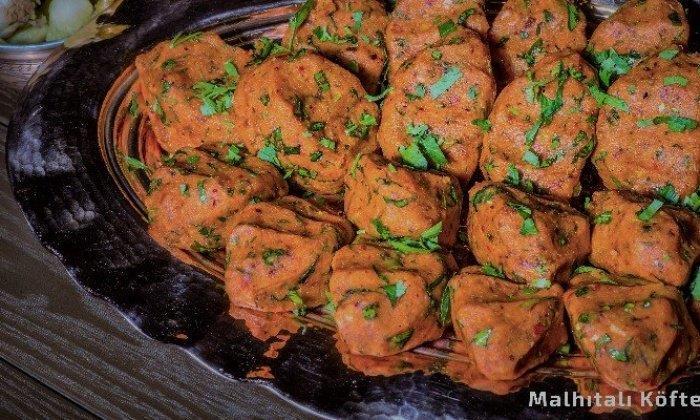
Gaziantep malhıtalı köftesi is a traditional dish unique to Gaziantep cuisine, featuring red lentils known locally as “malhıta” as the main ingredient. Also referred to as Gaziantep lentil köfte, this product is protected under Industrial Property Law No. 6769 as a geographical indication and was registered on 9 February 2021. The registering authority is the Gaziantep Metropolitan Municipality, and the geographical boundary of the product is limited to Gaziantep Province.
Gaziantep malhıtalı köftesi is prepared using fine bulgur (simit) and red lentils as its base. Its distinctive feature is the use of fresh or dried tarhun, depending on the season, which imparts a unique aroma and local character to the dish. The köfte is shaped by hand according to regional methods. During shaping, a hollow is formed in one palm, into which two or three walnut-sized portions of filling are placed, and then the top is sealed with the other hand to form the shape. It is typically served with turnip, tere, pickles, and ayran.
For a yield of five to six portions, the basic ingredients are: 300–400 g red lentils, 300–400 g fine bulgur, 30–50 g dried garlic, 140–180 g dried onion, 80–150 g fresh onion, 50–150 g fresh garlic (optional), 50–80 g parsley, 15–30 g fresh or 5–10 g dried tarhun, 30–50 g pepper paste, 18–30 g tomato paste, 18–30 g red chili powder, 130–180 g olive oil, 5–10 g salt, and optionally 3–5 g cumin.
The preparation process proceeds as follows: The lentils are washed and boiled in water until they reach a thick soup consistency, after which bulgur, pastes, and salt are added and left to rest. In a separate container, dried onion is sautéed in olive oil and then mixed with chili powder. The cooled lentil-bulgur mixture is transferred to a mixing bowl and kneaded with chopped dried onion and garlic. Fresh herbs and tarhun are then added and thoroughly blended with the sautéed onion-oil mixture. If dried tarhun is used, it is rubbed between the palms before being incorporated into the mixture. In the final stage, the köftes are shaped by hand according to the regional method.
The production of Gaziantep malhıtalı köftesi is a skill-intensive process, and the product is intrinsically linked to Gaziantep Province. Therefore, all stages of production must be carried out exclusively within the boundaries of Gaziantep Province.
Supervision of the product is conducted by a three-member authority composed of experts from the Gaziantep Provincial Directorate of Agriculture and Forestry, the Gaziantep Metropolitan Municipality, and the Gaziantep Chamber of Tradesmen and Craftsmen, under the coordination of the Gaziantep Metropolitan Municipality. Inspections are carried out at least once annually and may be conducted at any time if deemed necessary or upon complaint. During inspections, the product’s compliance with ingredients, production method, and correct use of the geographical indication mark are verified.
Turkish Patent and Trademark Office. "Gaziantep Malhıtalı Köftesi / Gaziantep Mercimekli Köftesi Mahreç İşareti Tescil Belgesi." Accessed October 20, 2025. https://ci.turkpatent.gov.tr/Files/GeographicalSigns/915698f0-56ac-4f29-b8a7-9b71252179f9.pdf.
Turkish Patent and Trademark Office. "Gaziantep Malhıtalı Köftesi/Gaziantep Mercimekli Köftesi." Geographical Indications Portal. Accessed October 20, 2025. https://ci.turkpatent.gov.tr/cografi-isaretler/detay/2066.

Type of Geographical İndication | Mahreç Sign | ||||||||
|---|---|---|---|---|---|---|---|---|---|
Registration Number | 665 | ||||||||
Registration Date | 09.02.2021 | ||||||||
Product / Product Group(s) | Meals and Soups | ||||||||
Province(s) | Gaziantep | ||||||||
Applicant/Registrant(s) | Gaziantep Metropolitan Municipality | ||||||||
No Discussion Added Yet
Start discussion for "Gaziantep Malhıtalı Köftesi / Gaziantep Lentil Köftesi" article
Definition and Distinctive Characteristics
Production Method
Geographical Boundary and Control Process