This article was automatically translated from the original Turkish version.
Type of Geographical İndication | Mahreç Sign | ||||||||
|---|---|---|---|---|---|---|---|---|---|
Registration Number | 223 | ||||||||
Registration Date | 31.10.2017 | ||||||||
Product / Product Group(s) | Bakery and confectionery products sweets dough products | ||||||||
Province(s) | Gaziantep | ||||||||
Applicant/Registrant(s) | Gaziantep Chamber of Commerce | ||||||||
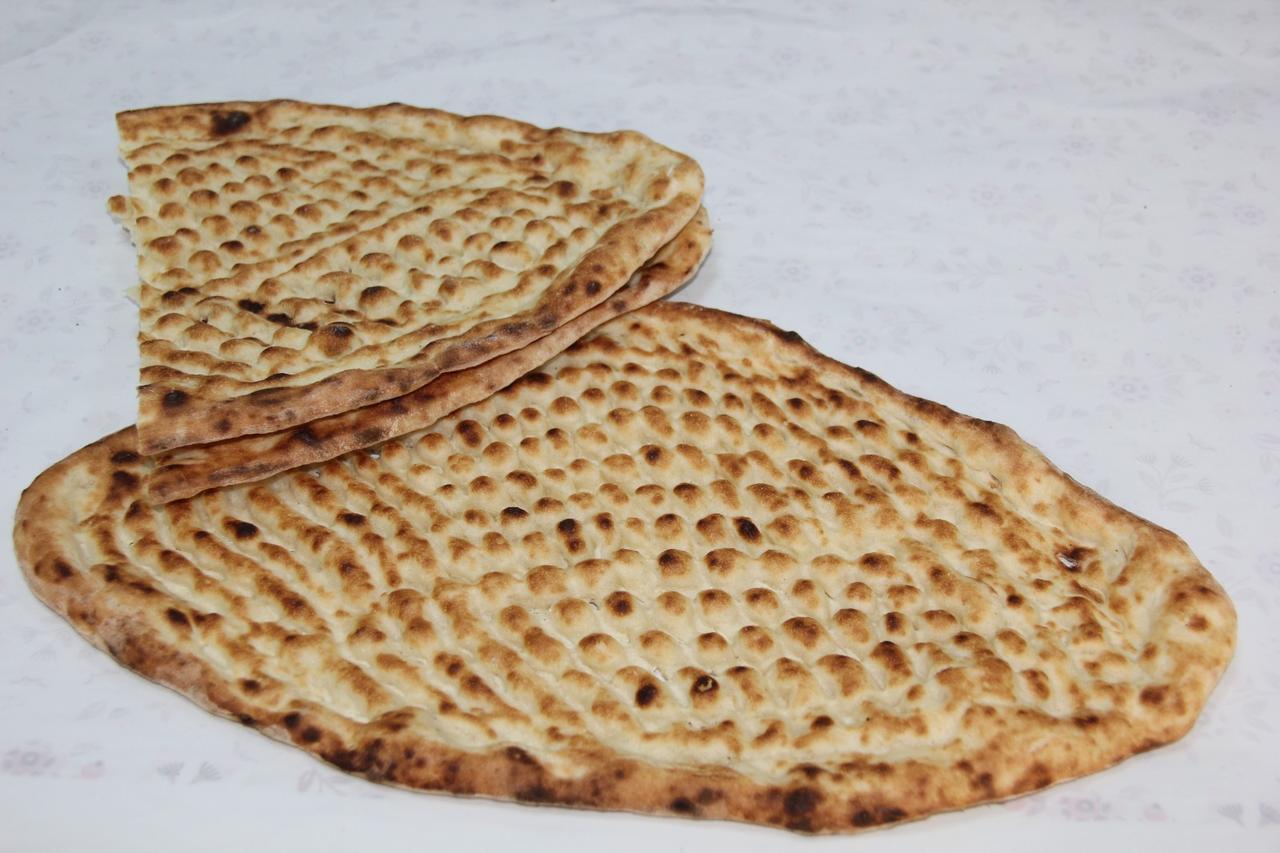
Gaziantep’s nail-marked pide is one of the foundational elements of Gaziantep’s culinary culture. This product, registered with a geographical indication mark, is a type of pide produced using traditional methods within the boundaries of Gaziantep province. It has an oval shape with a surface marked by impressions made by fingernails. It was officially registered on 31 October 2017 under Law No. 6769 on Industrial Property and granted geographical indication protection.
The Gaziantep nail-marked pide measures approximately 20 cm in width, 39 cm in length, and 1 cm in thickness. Its surface features evenly distributed nail impressions, each measuring about 1.35 x 1.40 cm. The weight of the pide ranges between 175 and 200 grams. The upper surface has a light brown hue, while the bottom surface is lighter in tone. Color values were measured using a Hunter Lab Colorimeter. The moisture content is 34.17%, the protein content on a dry matter basis is 12.68%, and the salt content does not exceed 1.50%.
Production uses bread-grade wheat flour and/or whole wheat flour in accordance with the Turkish Food Code’s Notice on Wheat Flour. The dough is prepared using flour, water, yeast, and salt. The quantity of yeast and fermentation time vary according to season—summer and winter. After kneading, the dough is rested, divided into balls, rolled out, and coated with a paste of flour and water. The nail-marking process then follows. Baking time is approximately 3 to 4 minutes.
Nail-marking is the defining characteristic of this pide. It is applied rapidly and consecutively using eight fingers, excluding the thumb. The dough is first marked along its length, then rotated 180 degrees and marked again along the crosswise axis. This technique ensures even baking and produces the characteristic woven pattern. The number of nail marks may vary depending on the artisan’s hand size and experience.
Gaziantep nail-marked pide is produced exclusively in neighborhood ovens in Gaziantep, using stone ovens and by artisans specialized in this craft. The ovens are semi-spherical in shape and constructed with special materials such as red clay, karataş stone, salt, and ground glass. The fire does not come into direct contact with the pide; baking is achieved through the heat retained by the stone. While wood fire is common, natural gas may also be used. The type of fuel does not affect the flavor.
The production process is divided into four primary artisan roles:
This hierarchy reflects the traditional transmission of skills and division of labor.
Pides are produced on demand in neighborhood ovens and consumed while hot. They are typically served rolled with kebab and grilled vegetables. The shelf life is 3 to 4 hours; beyond this period, sensory qualities may deteriorate. Pides produced during peak hours are kept at room temperature under cotton cloths.
The product’s reputation is exclusively tied to Gaziantep province; all stages of production must occur within this geographical boundary. Oversight is conducted at least once annually under the coordination of the Gaziantep Chamber of Commerce. Inspection criteria include production ingredients, oven construction, nail-marking technique, baking process, and the physical-chemical properties of the final product.
Turkish Patent and Trademark Office. "Antep Tırnaklı Pidesi / Gaziantep Tırnaklı Pidesi / Antep Pidesi Mahreç İşareti Sicil Belgesi." Accessed October 21, 2025. https://ci.turkpatent.gov.tr/Files/GeographicalSigns/dc200ac2-cd5e-4f7b-8947-e6e4b80d45fa.pdf.
Turkish Patent and Trademark Office. "Antep Tırnaklı Pidesi / Gaziantep Tırnaklı Pidesi / Antep Pidesi." Geographical Indications Portal. Accessed October 21, 2025. https://ci.turkpatent.gov.tr/cografi-isaretler/detay/38245.

Type of Geographical İndication | Mahreç Sign | ||||||||
|---|---|---|---|---|---|---|---|---|---|
Registration Number | 223 | ||||||||
Registration Date | 31.10.2017 | ||||||||
Product / Product Group(s) | Bakery and confectionery products sweets dough products | ||||||||
Province(s) | Gaziantep | ||||||||
Applicant/Registrant(s) | Gaziantep Chamber of Commerce | ||||||||
No Discussion Added Yet
Start discussion for "Gaziantep Tırnaklı Pidesi / Antep Tırnaklı Pidesi / Antep Pidesi" article
Physical Characteristics
Production Process
Nail-Marking Technique
Oven Characteristics
Artisan Hierarchy
Consumption and Storage
Geographical Boundary and Oversight